
Updated November 2026 · Reviewed by Billy Forte
The best Texas driving test practice uses two free DPS sources: the Texas Driver Handbook with its review questions for the written test, and the four graded skills for the road test. The knowledge test needs 70 percent or better, and the road test grades control, observation, positioning and signaling on every drive. Practice both with a plan, and test yourself the way DPS will.
Key Facts
- Study source: the free Texas Driver Handbook (DL-7, revised January 2026). See start with the handbook.
- Review questions: Appendix C has open-ended questions with no answer key. See how to use Appendix C.
- Passing score: 70 percent or better on the Class C knowledge exam. See the 70 percent mark.
- Road test skills: control, observation, positioning and signaling. See a mock road test.
- Who rides with a learner: a licensed driver 21 or older with one year of experience, in the front seat. See who you can practice with.
- Retest window: DPS holds your application for 90 days and three tries. See if a test goes wrong.
Two Tests, Two Kinds of Practice
A first Texas license usually means a vision test, a knowledge test and a driving test. The knowledge test checks what you know. The driving test checks what you do.
Each one needs a different kind of practice. You study for the written test with the handbook. You practice for the road test behind the wheel, with someone watching and scoring you.
Order matters too. The handbook says DPS gives the driving exam only after you pass the other exams and show proof of financial responsibility.
So plan your study first and your road practice right after. For the whole test-day picture, see our Texas driving test guide.
Texas Driving Test Practice Starts With the Handbook
The Texas Driver Handbook is free from Texas DPS. The current version says “Revised January 2026” on the cover. DPS writes the test, so its handbook is the safest study source.
The chapters follow the topics on the test. They cover:
- Your license and vehicle inspection and registration
- Safety responsibility and right-of-way
- Signals, signs and markers
- Signaling, passing, turning, parking and stopping
- Speed limits and special driving situations
- Alcohol and drugs, crashes, people walking and bicycles
Read one chapter at a time. Short sessions work better than one long cram. Mark the pages that feel new, and come back to them later in the week.
Practice sites run by other companies are not DPS sources. If you use one, treat it only as a check on what you learned from the handbook.
How to Use Appendix C
Appendix C is called “Study and Review Questions for Class C Operators.” It is the handbook’s built-in quiz, and most people use it the wrong way.
The questions are open-ended. There are no answer choices and no answer key. Each question ends with a chapter number in parentheses, such as “(Chpt. 5).” That number tells you where to look.
This makes Appendix C a recall drill, not a guessing game. You have to say or write the answer from memory. That is harder than picking A, B or C, and it builds stronger recall.
Build Your Own Answer Key
Because the handbook gives no answers, make your own key:
- Answer each question out loud or on paper without looking.
- Open the chapter in the parentheses and find the real answer.
- Write the correct answer next to the question in a notebook.
- Mark every question you missed.
- Next session, answer only the marked questions again.
Keep going until you can answer every question from memory. Your notebook becomes a study guide written in your own words, with every answer checked against DPS.
Topics Worth Extra Study Time
Some handbook rules have exact numbers or a fixed order. These are easy to mix up, so give them extra time. Signs get their own guide, so for sign shapes and colors see our written knowledge test guide.
| Rule | What the handbook says |
|---|---|
| Following distance | At least 2 seconds at 30 mph or less; 4 seconds above 30 mph |
| Multi-way stop | Go in the order you arrived; if two arrive together, yield to the car on the right |
| Right turn on red | Stop first; you may turn right unless a law prohibits it |
| Center lane | For left turns only, never for passing or through traffic |
| No passing | Within 100 feet of an intersection, railroad crossing, bridge, viaduct or tunnel |
| Emergency vehicles | Do not follow a fire truck on an alarm or an ambulance with flashing red lights within 500 feet |
Two more rules come up often. Stop for a school bus showing alternating flashing red lights until it moves, signals you on or turns the lights off. And it is against the law to read, write or send messages on a phone while you drive.
The handbook calls the 4-second gap the best practice for new drivers. Add more time in rain or other poor conditions.
The 70 Percent Mark and the ADE Option
The handbook says you need 70 percent or better to pass the Class C knowledge exam. Aim well above that in your practice, so a few hard questions on test day do not sink you.
There is a second path for some adults. Under Transportation Code 521.1655, a TDLR-licensed Adult Driver Education provider can give the highway sign and traffic law parts of the DPS knowledge test. A test you pass in the course counts for DPS.
That does not cover every case. It applies to those parts of the test, given by a licensed course. TDLR says first-time applicants ages 18 to 24 must take an adult driver education course. A defensive driving or driving safety course is a different course and does not count.
A Practice Driving Test Texas Drivers Can Run at Home
The best road practice copies the real test. DPS form DL-60, “How to Prepare for a Drive Test”, says to practice every maneuver before you schedule and to have someone instruct you and point out mistakes. A mock test puts that advice into one drive.
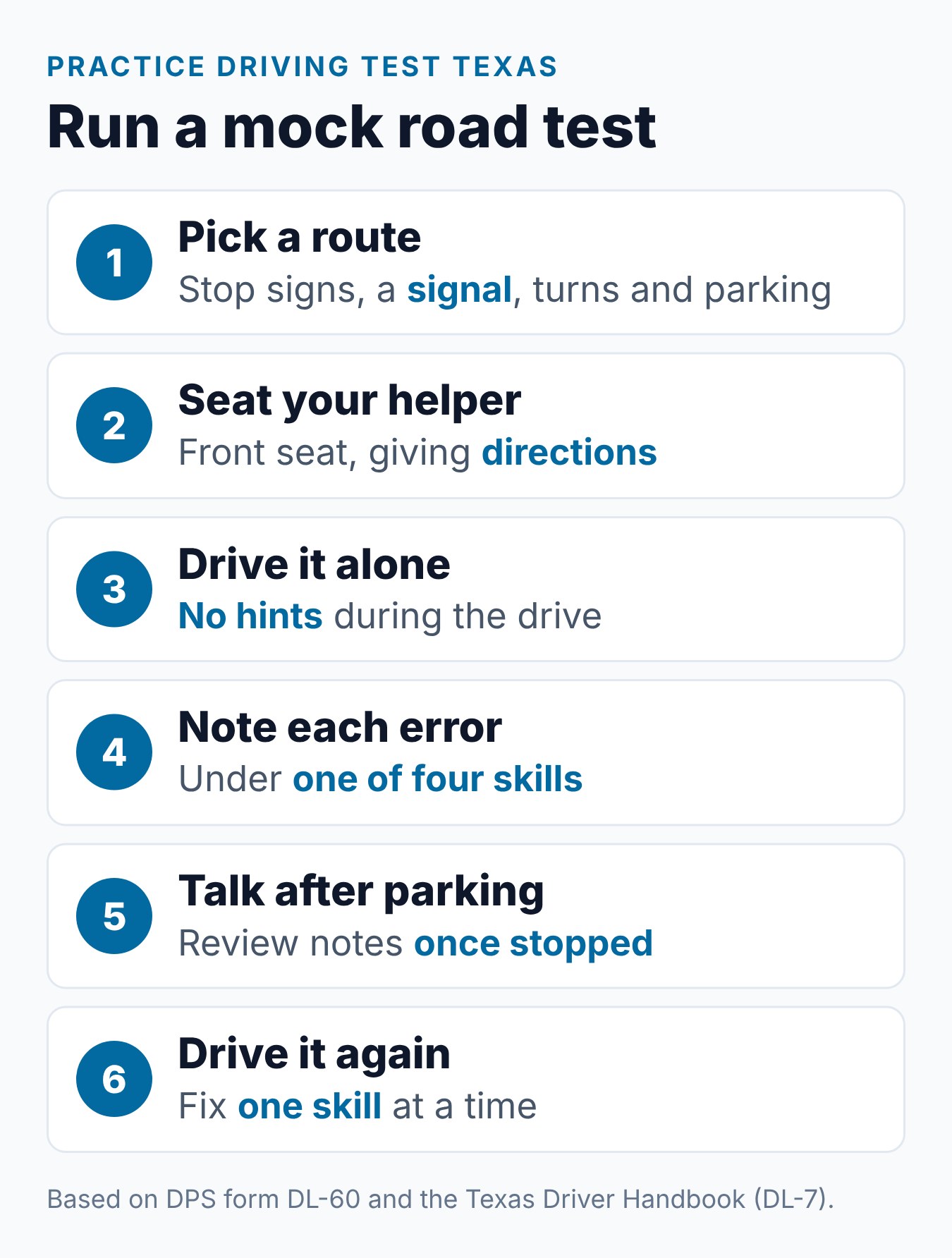
Use these steps for a practice driving test in Texas:
- Pick a quiet route with stop signs, a traffic signal, turns and a place to park.
- Ask your helper to sit in the front seat and give directions like an examiner.
- Drive the route without help or hints.
- Have your helper note each error under one of the four skills.
- Talk through the notes after you park, not while you drive.
- Drive the same route again and fix one skill at a time.
Run the mock test in the car you plan to use on test day. Each car brakes, steers and parks a little differently.
Scoring Your Mock Drive
Give your helper a sheet with four columns: control, observation, positioning and signaling. Those are the four skills DPS grades on every drive.
- Control: smooth braking, steady speed and clean steering.
- Observation: mirrors, signs, signals and people walking.
- Positioning: staying in your lane and stopping in the right place.
- Signaling: a signal before every turn and lane change.
A column that fills up fast shows you what to work on next. On the real test, more than 30 points deducted means your application is not approved. So the goal of your mock drive is an empty sheet, not a passing one.
Practicing the Maneuvers
The handbook lists maneuvers you may be graded on. They include parallel parking, a quick stop, backing, stop signs, traffic signals, intersections, turns, right-of-way, following and passing, and posture. Our skills and maneuvers guide explains each one.
One rule matters for practice. You may use a back-up camera for parallel parking and, along with your mirrors, for backing. Automated parking features are not allowed for either maneuver, so practice with them turned off.
Practice the maneuvers in an empty lot first. Then move to quiet streets. Repeat each one until it feels routine.
Who You Can Practice With
Texas learner licenses are for drivers ages 15 to 17 (Transportation Code 521.222). A learner license holder may practice only with a licensed driver who:
- Is at least 21 years old
- Has at least one year of driving experience
- Sits in the front seat beside the learner
- Is not intoxicated, asleep or unable to watch and respond
Adults 18 and older apply for a license without a learner license. If you are not licensed yet, the handbook says a licensed driver must drive the car to the office and test area. Plan for that person on test day.
Practice in the Car You Will Test In
Your test car must match the license class you apply for. You also need proof of financial responsibility for it. The handbook says dealer temporary cardboard tags may not be used for driving exams.
Check the car a few days before you test. Lights, signals, horn, brakes and mirrors should all work.
The handbook says required equipment must be in proper working order for a car to be safe. For the full car list, see our Texas driving test guide.
Timing Your Practice Around ITAD
If you are 18 or older, you need an Impact Texas Adult Drivers (ITAD) certificate before the driving test. ITAD is a free 1-hour DPS video about distracted driving at impacttexasdrivers.dps.texas.gov. It is not the same as Adult Driver Education.
The ITAD certificate must be dated within 90 days of your driving test. So watch it near the end of your practice plan, once your test date is set. Our DPS wait time guide shows how to plan around the 90 days.
If you are 18 to 24, keep your ADE-1317 course certificate with your papers. DPS needs it with your application.
If a Test Goes Wrong
DPS holds your application for 90 days. You get three tries at the exams on one application and fee. After 90 days or three failed exams, you need a new application and fee.
Use a failed test as a practice guide. The examiner’s notes show which skill cost you points. Our guide to what to do if you fail covers the retest rules in detail.
What We Found in the Handbook
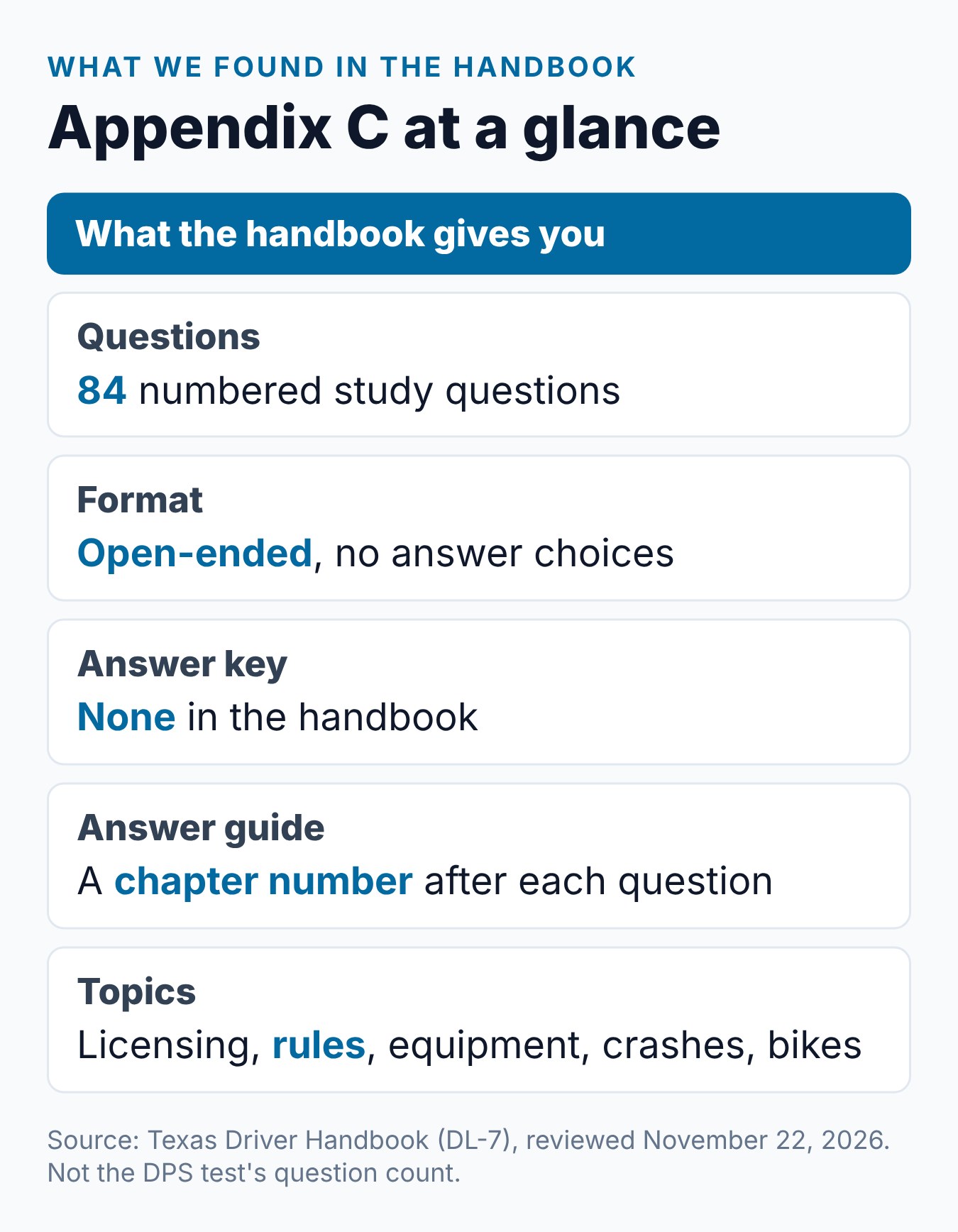
On November 22, 2026, we read the January 2026 Texas Driver Handbook to see what it gives you for practice. Here is what we found.
- Appendix C has 84 numbered questions. That is the size of the study list, not the number of questions on the DPS test.
- Every question is open-ended. There are no answer choices and no answer key anywhere in the handbook.
- Every question points to a chapter. The chapter number in parentheses is the only answer guide.
- The questions go beyond signs. They cover licensing, equipment, stopping distances, crashes and insurance, bicycles, alcohol and drugs, and safety belts.
The takeaway is simple. The handbook already gives you a full practice quiz, but you have to check your own answers. The answer-key method above turns that into a study tool.
Common Mistakes to Avoid
Each of these comes from the DPS handbook, DL-60, ITAD or TDLR rules:
- Skipping Appendix C. It is the handbook’s own review list, written by the agency that gives the test.
- Treating a practice site as the source. Only the handbook comes from DPS.
- Practicing with self-parking on. Automated parking is not allowed on the test.
- Following too closely. Above 30 mph, the handbook says to leave 4 seconds.
- Taking ITAD too early. The certificate must be dated within 90 days of the driving test.
- Taking the wrong course. A defensive driving course is not Adult Driver Education.
- Bringing a car with cardboard dealer tags. The handbook says they cannot be used for the driving exam.
- Practicing with the wrong supervisor. A learner’s helper must be 21 or older with one year of experience.
How Requirements Can Vary
Texas driver license rules come from state law, Texas DPS rules and TDLR rules, and they apply statewide. What you need still depends on your age, whether you hold a license from another state, and which tests you have already passed.
Laws, fees and office procedures can change. Check the Texas DPS and TDLR websites for current rules before you book an appointment or enroll in a course.
Frequently Asked Questions
How can I practice for the Texas driving test?
Study the free Texas Driver Handbook and answer its Appendix C review questions for the written test. For the road test, practice the handbook maneuvers and run mock drives scored on control, observation, positioning and signaling.
Does the Texas Driver Handbook have practice questions?
Yes. Appendix C, “Study and Review Questions for Class C Operators,” is a list of open-ended questions. It has no answer key, so check each answer in the chapter the question names.
What score do I need on the Texas knowledge test?
The handbook says you need 70 percent or better on the Class C knowledge exam. Practice until you score well above that.
Can an adult driver education course help with the written test?
It can. Under Transportation Code 521.1655, a TDLR-licensed Adult Driver Education provider can give the highway sign and traffic law parts of the DPS knowledge test, and a passed course test counts for DPS. This covers those parts only.
Can I use a back-up camera during practice and the test?
Yes. The handbook allows a back-up camera for parallel parking and, with your mirrors, for backing. Automated parking features are not allowed.
Who can ride with me while I practice?
A learner license holder must practice with a licensed driver who is at least 21, has at least one year of experience and sits in the front seat. That driver must be alert and able to respond.
Conclusion
Good Texas driving test practice follows what DPS publishes. Use the handbook and Appendix C for the written test, then run mock drives scored on the four graded skills. Time your ITAD certificate so it is inside the 90 days before your driving test. If you are 18 to 24 and need the required course, you can take Driving Logic’s online Texas adult driver education course.
Related Articles
- Texas Driving Test: What to Expect and How to Prepare
- Texas Driving Test Skills and Maneuvers
- Texas DPS Written Knowledge Test: What It Covers and How ADE May Help
- What to Do If You Fail the Texas Driving Test
Sources
- Texas DPS — Texas Driver Handbook (DL-7, revised January 2026)
- Texas DPS — How to Prepare for a Drive Test (DL-60)
- Texas DPS — Apply for a Texas Driver License
- Texas DPS — Driver License
- Texas DPS — Impact Texas Drivers
- TDLR — Do I Need Driver Education?
- Texas Transportation Code Chapter 521 (PDF)
Billy Forte is the owner of Driving Logic, a state-approved driver improvement course provider serving Texas and other U.S. states.
This article is general information, not legal advice. Texas driver license and driver education rules are set by Texas law, Texas DPS and TDLR, and they can change. Check the official DPS and TDLR websites for current requirements before you apply.