
Updated November 2026 · Reviewed by Billy Forte
No, there is no self taught drivers ed Texas teens can do without a parent or a school. The closest option is parent-taught drivers ed (PTDE), where an eligible family member authorized by TDLR is the instructor and the curriculum comes from a TDLR-licensed provider. If no one in the family can teach, a driving school or a public school course is the route for a teen under 18.
Key Facts
- Short answer: a Texas teen cannot teach themselves drivers ed. See the short answer.
- Closest option: parent-taught drivers ed, with a family member as the instructor. See the closest option.
- Who can teach: a parent, stepparent, grandparent, step-grandparent, foster parent or legal guardian. See who can be the instructor.
- Paperwork: a $20 online application to TDLR for each student. See what the adult handles.
- Record checks: DPS checks the instructor’s record at both license applications. See the two checks.
- Adults: ages 18 to 24 take a 6-hour adult course instead. See age 18 and older.
Self Taught Drivers Ed Texas: The Short Answer
No. A Texas teen cannot teach themselves drivers ed. No teach-yourself route leads to a license for a driver under 18.
Every teen route has a teacher, and the teacher is never the teen. On the parent-taught route, a family member teaches. On the school routes, the school does the teaching.
That can be a letdown for a driven teen. A student who reads well and works hard may feel ready to go alone. Texas still wants an adult in the instructor seat.
One route does come close. Parent-taught drivers ed puts the teaching in the family’s hands. A parent or another eligible relative is the instructor, and the lessons come from a licensed course provider.
So the honest answer has two parts. Your teen cannot do it alone. Your family may be able to do it together.
Why Families Ask About Self-Taught
Families look for a do-it-yourself route for good reasons. Most of them fall into four groups:
- Time. Parents work, and a set class schedule can be hard to keep.
- Pace. Some teens study well alone and want to move at their own speed.
- Distance. A driving school may be a long way from home.
- Money. Families hope a home route costs less than a school.
These are real needs. Texas answers them with a parent-taught route, not a teach-yourself route. The rest of this page shows how close that route comes to what you had in mind.
What “Self-Taught” Really Means in Texas
“Self-taught” is a search phrase. It is not a Texas program. No teen course type goes by that name.
People who type it tend to mean one of three things. This table shows each meaning and the Texas answer.
| What a family means by “self-taught” | Can a teen under 18 do it? | What Texas has in its place |
|---|---|---|
| The teen teaches themselves with no adult | No | An eligible family member is the instructor |
| A parent teaches, and no school instructor does | Yes, as parent-taught drivers ed | TDLR authorizes that parent as the instructor |
| The family uses its own books or free videos | No | A curriculum bought from a licensed provider with the parent-taught endorsement |
The first meaning is the one Texas rules out. A student cannot be named as their own instructor.
The second meaning is real. It has an official name, and it has rules. The sections below walk through them.
The third meaning trips up many families. TDLR’s Parent Taught FAQ says the curriculum must be bought from a licensed provider with the parent-taught endorsement. A stack of library books is not the course, and a video playlist is not the course either.
Self-Taught and Parent-Taught Side by Side
The two phrases sound alike, but they point to different people. Self-taught would make the teen the teacher. Parent-taught makes an eligible adult in the family the teacher.
Of those two, Texas allows only the second. That one swap, from teen to adult, is the whole difference. Every rule below follows from it.
Parent Led Drivers Ed Texas: The Closest Option
Some families call it parent led drivers ed. The state’s name is parent-taught driver education, or PTDE. Both names mean the same program.
PTDE stands on three legs:
- An instructor in the family. An eligible family member teaches, with authorization from TDLR.
- A licensed curriculum. The lessons come from a TDLR-licensed provider.
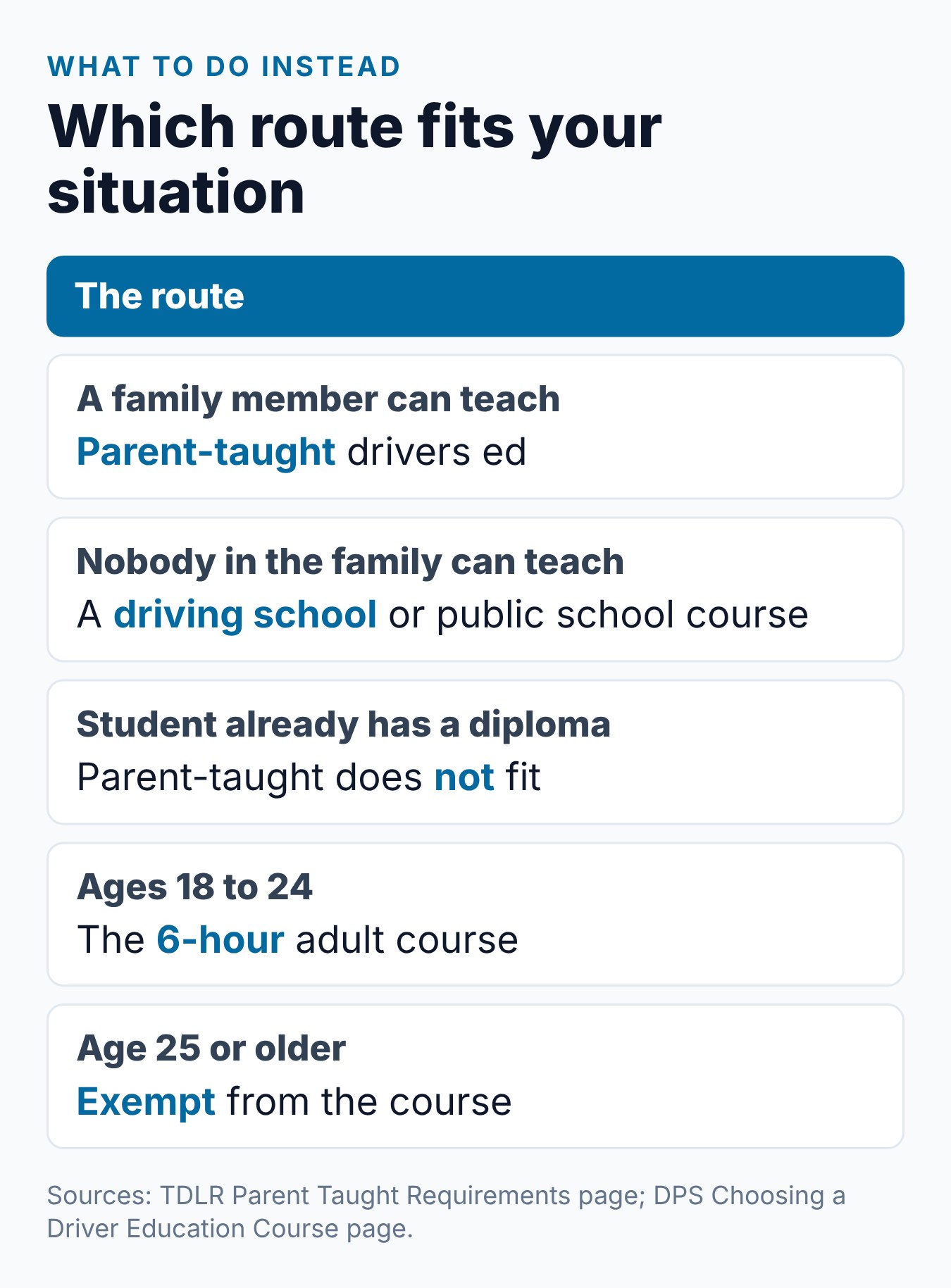
- A teen student. The student must be under 18 and must not have a diploma.
TDLR’s Parent Taught Requirements page sets that student rule. A teen who already holds a diploma does not fit PTDE, even with a willing parent.
Two agencies share the work. TDLR, the Texas Department of Licensing and Regulation, handles courses and instructors. Texas DPS handles the licenses.
So PTDE is not a way around having a teacher. It moves the teaching from a school to the family. For the whole program in one place, see our parent taught drivers ed guide.
What a Self-Starter Still Brings
A teen who wanted to self-teach is often a strong student. That drive is not wasted on the parent-taught route. The teen still has to learn the lessons and do the driving.
What changes is who leads. The adult is the instructor, and the teen is the student. A motivated student makes the instructor’s job much easier.
Who Can Be the Instructor
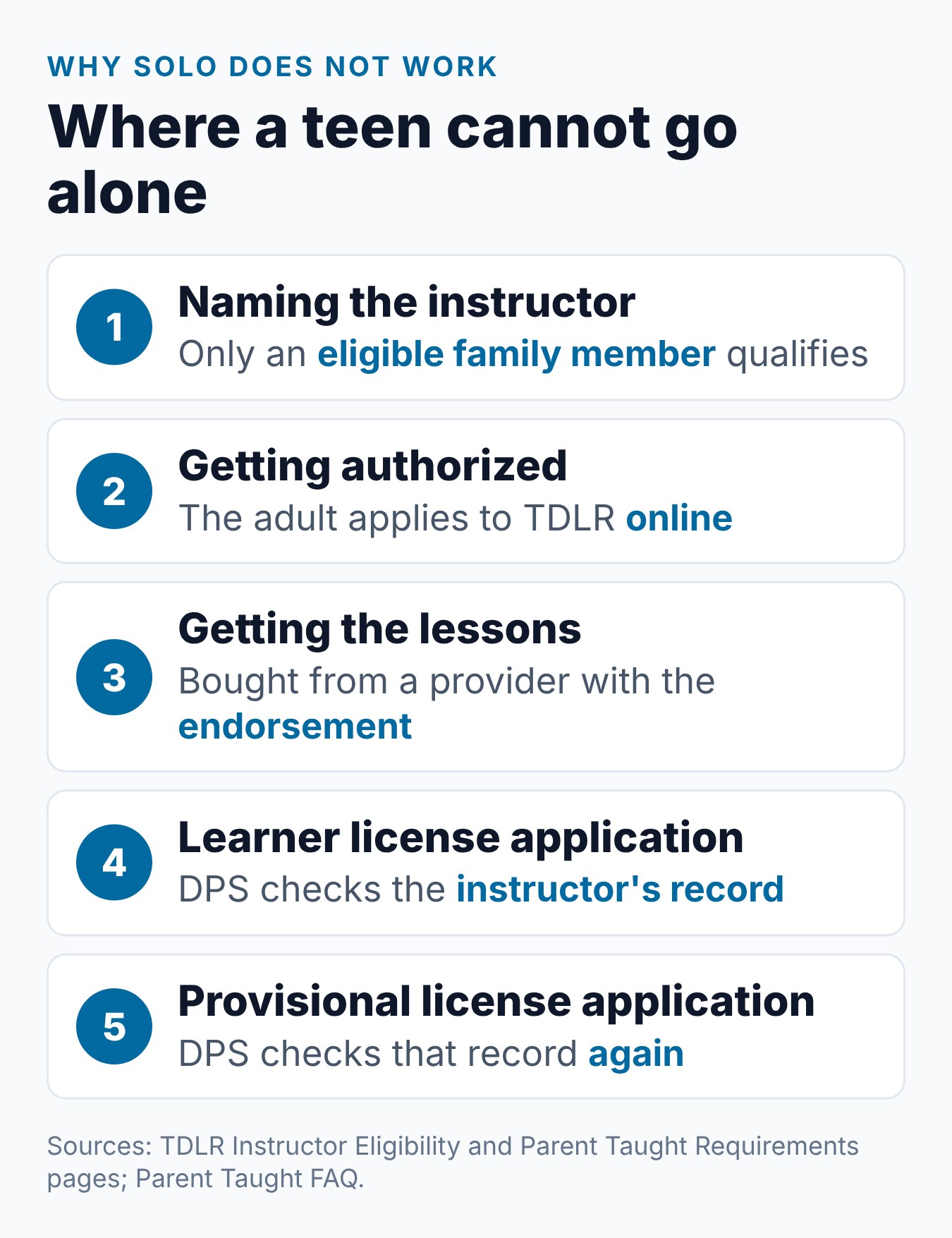
TDLR’s Instructor Eligibility page names the family members who can teach. They are a parent, stepparent, grandparent, step-grandparent, foster parent or legal guardian.
The instructor may also name an alternate. The alternate has to meet the same requirements. The alternate may not charge a fee.
Relationship is only the first test. The instructor also needs an excellent driving history and no disqualifying criminal convictions. A driver license with a B restriction disqualifies a person.
Look at who is missing from that list. The teen is not on it. That is the plain reason a self-taught plan does not work.
This page gives only the outline. Our instructor requirements guide goes through the checks one by one, so read it before anyone applies.
What the Adult Handles
A self-taught plan would start with a teen and a book. A parent-taught plan starts with an adult and an application. The instructor needs authorization from TDLR.
The Parent Taught Requirements page gives the basics of that authorization:
- Where: online.
- Fee: $20, and it is non-refundable.
- How many: one application per student.
- What follows: the Program Guide, which comes through the Parent Instructor Portal and by email.
That fee pays for the instructor authorization. It does not pay for the course, and it is not a price for the guide. A family with two teens files two applications.
The curriculum is a separate purchase. It has to come from a licensed provider that holds the parent-taught endorsement. Check for the endorsement before you pay.
Three of our guides go deeper on these jobs:
- The guide itself. Our Program Guide article explains what TDLR sends.
- The provider check. Our article on who approves online drivers ed shows how to look up a provider.
- The order of steps. Our guide to how parent taught drivers ed works online lists each step from first to last.
DPS Checks the Instructor Twice
TDLR’s authorization is not the last look at the instructor. Texas DPS checks that person’s record too. It does so when the teen applies for the learner license, and again at the provisional license application.
The result lands on the teen. If the instructor is disqualified, the student’s application is denied. Hours logged after that point are invalid.
You may hear the license office called the Texas DMV. The agency that issues teen licenses is the Texas Department of Public Safety, or DPS.
The instructor also has to show up. TDLR says PTDE takes two DPS visits with the instructor. A name on a form is not enough.
This is why the choice of instructor matters so much. Pick an adult whose record is sound and who can be there for the whole course. If there is doubt about a record, settle it before the teen logs hours.
How Much Time the Adult Needs
Self-taught sounds fast. Parent-taught is not a quick fix. TDLR says PTDE takes at least 7 weeks.
The hours explain why. The teen course has 24 classroom hours and 44 in-car hours. The instructor needs time for the teaching and for both DPS visits.
Birthdays set the pace as well. The learner license comes at 15 and must be held for 6 months. The provisional license comes at 16.
So be frank about the adult’s calendar before you start. A parent with a packed season may want to wait for a calmer one. Our guide on how long parent-taught drivers ed takes lays out the full timeline.
What Parent-Taught Does Not Change
Having a parent as the teacher does not shrink the state’s list. These parts stay the same for a parent-taught teen:
- The certificate. The course certificate is the DE-964. It has a learner license portion, which follows Module One, and a driver license portion. Our DE-964 guide explains both.
- ITTD. Impact Texas Teen Drivers is a free, 2-hour program from Texas DPS. Teens take ITTD, not ITAD.
- The phone rule. A driver under 18 may not use a phone, and that includes hands-free use.
- Night and passenger limits. Midnight and passenger rules apply until the teen turns 18.
None of these bend for a home course. The teacher is different, but the teen answers to the same state rules.
If No Parent Can Teach
Some families cannot name an instructor. A parent may lack the time, or a record may rule a parent out. That does not send the teen back to a self-taught plan.
Work through these choices in order:
- Look past mom and dad. The eligible list is wider than two parents. A grandparent or a legal guardian may be able to teach.
- Share the load. If time is the issue, the instructor may name an alternate who meets the same requirements.
- Use a school. A driving school course is the other main route for a teen. Some families use public school driver education, which has its own certificate, the DE-964E.
A school route does not need a family instructor at all. Our guide to teen driver education and parent-taught explains how a school course runs. To weigh the two for your family, see parent taught vs commercial drivers ed.
One thing is not on the list. Going without a teacher is not a choice Texas gives a teen.
If Your Teen Is 18 or Older
PTDE is for teens, not adults. The DPS Choosing a Driver Education Course page says adults 18 to 24 take a 6-hour adult driver education course instead, and our guide to the 6-hour adult course online covers it. Drivers 25 and older are exempt, as our article on Texas adult driver education over 25 explains.
Questions to Settle Before You Start
A short family talk can save weeks. Sit down with your teen and go through these questions:
- Who will be the instructor? Name one eligible adult, and be sure that person wants the job.
- Is that adult’s record in good shape? The rules call for an excellent driving history.
- Does the license carry a B restriction? Look at the card before you apply.
- Can the instructor make both DPS visits? The teen cannot go without the instructor.
- Which provider will you buy from? It must hold the parent-taught endorsement.
- Does the adult have at least 7 weeks to give? That is the minimum, not a target.
If every answer is yes, the parent-taught route is worth a closer look. If one answer is no, fix that item or look at a school course. Either way, your teen ends up with a real teacher.
What We Found on the Official Pages
The four official pages behind this article were reviewed on November 23, 2026. Read with the self-taught question in mind, they show five things:
- The teacher is a named adult. The eligibility list has six family roles, and the student is not one of them.
- The adult is looked at more than once. TDLR authorizes the instructor, and DPS checks the record at two license applications.
- The paperwork is per student. Each teen needs a separate application.
- The lessons cannot be homemade. The curriculum is bought from a licensed provider with the endorsement.
- Age changes the route. Adults 18 to 24 are sent to a different course, and drivers 25 and older are exempt.
Count the parties in those rules. There is the student, the instructor, TDLR, a licensed provider and DPS. A teen working alone fills only one of those five seats.
Common Mistakes With Self-Taught Plans
Each of these mistakes runs into an official rule:
- Starting with books and videos. They are not the course. The curriculum has to be bought from a licensed provider with the endorsement.
- Treating the TDLR fee as the course price. The fee covers the instructor authorization only.
- Filing one application for two teens. Each student needs a separate one.
- Missing a B restriction. A license with that restriction disqualifies the instructor.
- Paying the alternate. An alternate may not charge a fee.
- Counting on an instructor with a record problem. A disqualified instructor means a denied application and invalid hours.
- Sending the teen to DPS alone. Both visits are made with the instructor.
- Using PTDE for a graduate or an adult. The student must be under 18 without a diploma.
How Requirements Can Vary
Texas driver education rules come from TDLR, and driver license rules come from Texas DPS. They apply statewide, but what you need depends on the student’s age, the course method, and whether the classroom part comes from a parent-taught course, a driving school, or a public school.
Fees, forms, and office procedures can change. Check the TDLR parent-taught pages and the DPS driver license pages before each step, and follow the instructions from your course provider.
Frequently Asked Questions
Can a teen do self-taught drivers ed in Texas?
No. A Texas teen cannot teach themselves drivers ed. The closest option is parent-taught drivers ed, with an eligible family member as the instructor.
Is parent led drivers ed the same as parent-taught drivers ed?
Yes. Parent led is an everyday name for parent-taught driver education, or PTDE. The instructor is an eligible family member authorized by TDLR.
Can my teen use free videos or books as the course?
No. TDLR says the curriculum must be bought from a licensed provider with the parent-taught endorsement. Other materials can help a teen study, but they are not the course.
How much is the TDLR instructor authorization?
It is $20, and the fee is non-refundable. The application is online, and each student needs a separate one.
What happens if the instructor is disqualified?
DPS denies the student’s application. Hours logged after that point are invalid. DPS checks the instructor’s record at the learner license and provisional license applications.
Can an 18-year-old do parent-taught drivers ed?
No. PTDE is for students under 18 without a diploma. DPS says adults 18 to 24 take a 6-hour adult driver education course instead.
What if no one in my family can teach?
Look at a driving school or a public school course. Those routes do not need a family instructor. A teen still cannot go without a teacher.
Conclusion
A Texas teen cannot do drivers ed alone, because every teen route has a teacher. The closest fit is parent-taught drivers ed, with an eligible family member as the instructor, and a school course is the fallback when no one in the family can teach. For a view of how the parent-taught route is set up, see Driving Logic’s parent taught drivers ed texas page.
Related Articles
- Parent Taught Drivers Ed Texas: The Complete PTDE Guide
- Who Can Teach Parent Taught Drivers Ed in Texas? Parent Eligibility Requirements
- Parent Taught vs Commercial Teen Drivers Ed in Texas: Which Is Right for Your Family?
- How Texas Parent Taught Drivers Ed Works Online: Step-by-Step
Sources
- TDLR — Parent-Taught Instructor Eligibility
- TDLR — Parent Taught Requirements
- TDLR — Parent Taught Driver Education FAQ
- Texas DPS — Choosing a Driver Education Course
- TDLR — Parent-Taught Driver Education
- Texas DPS — Texas Learner License as a Teen
- Texas DPS — Texas Provisional License as a Teen
- 16 Tex. Admin. Code § 84.500 — Courses of instruction
Billy Forte is the owner of Driving Logic, a state-approved driver improvement course provider serving Texas and other U.S. states.
This article is general information, not legal advice. Texas driver education and licensing rules are set by TDLR, Texas DPS, and Texas law, and can change. Check the official TDLR and DPS websites for current requirements.