
Updated November 2026 · Reviewed by Billy Forte
The drug and alcohol course Florida DMV offices ask about is Traffic Law and Substance Abuse Education (TLSAE), and the agency behind it, the Florida Department of Highway Safety and Motor Vehicles (FLHSMV), requires it of applicants 18 or older who have not been licensed before. The course provider sends your completion to FLHSMV electronically, so the driver license office sees it in the state system. You do not bring a paper certificate.
Key Facts
- Who needs it: first-time applicants 18 or older, with two exceptions in the law. See the requirement the office checks.
- How long it is: at least 4 hours of course content, with no more than 30 minutes of breaks. See the 4-hour rule.
- How the office gets it: the provider submits your completion to FLHSMV within 5 days, free of charge to you. See how the completion travels.
- What the office looks at: the electronic record, which every driver license issuing office can see. Paper certificates are not accepted. See what the office looks at.
- If it is missing: contact your course provider first, then the driver license office. See what to do.
Who Runs the Office: FLHSMV
People search for the Florida DMV, but the agency is FLHSMV. It approves the course, keeps the completion record and issues licenses.
The counter you visit may not be a state office. FLHSMV’s Locations page says some driver license services are offered by county tax collectors. FLHSMV’s fee page says an additional $6.25 service fee may apply to a credential issued in a tax collector office.
Either way, the office reads the same state record. That is why this article follows your completion from the course to the counter.
The Requirement the Office Checks
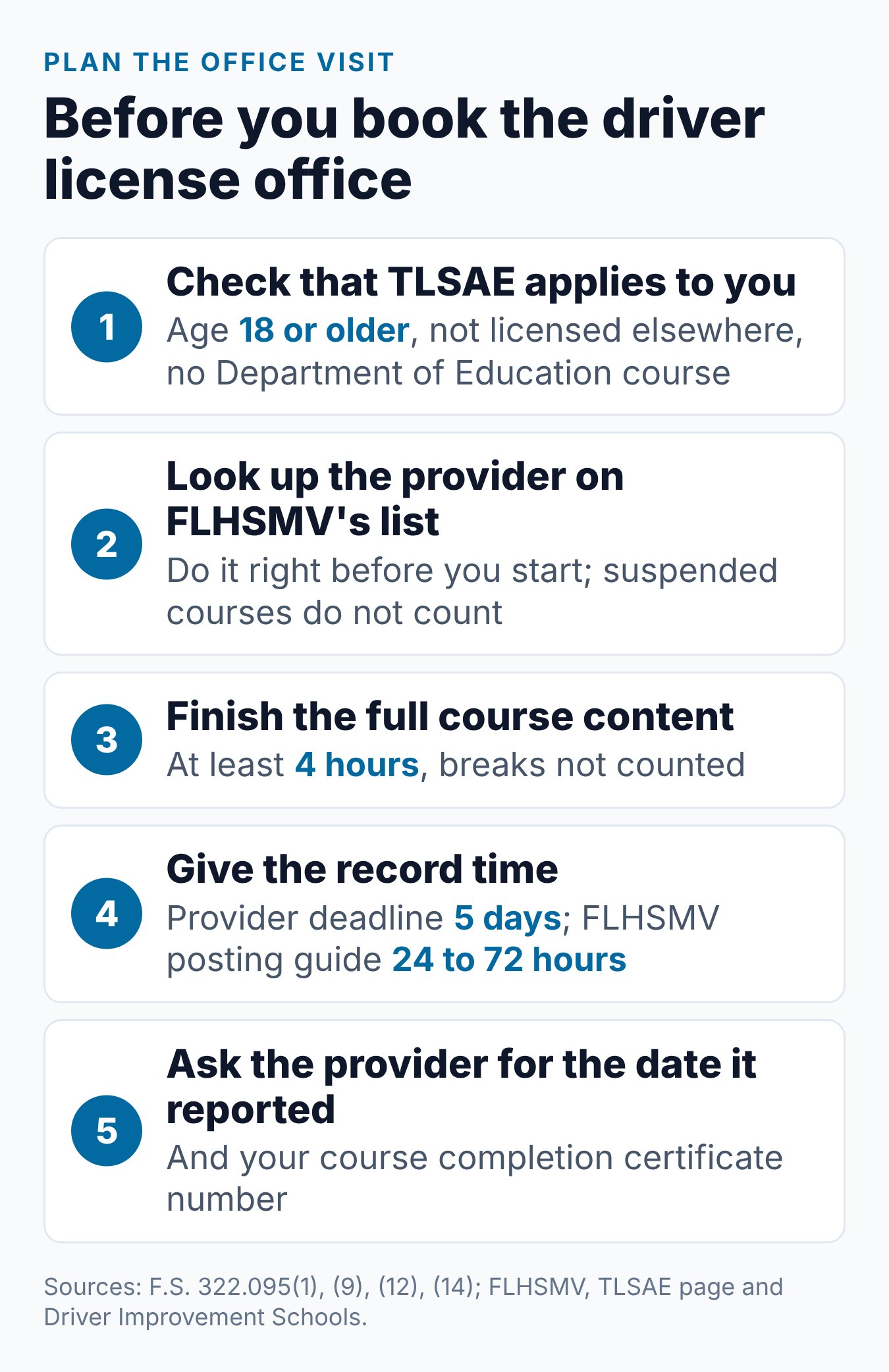
The rule is in F.S. 322.095(1). Each applicant for a driver license who is 18 years of age or older must complete the course. There are two exceptions:
- the applicant has been licensed in another jurisdiction, or
- the applicant has satisfactorily completed a Department of Education driver education course.
FLHSMV’s TLSAE page puts it in plain terms. Drivers over the age of 18 who have never held, or do not have in their possession, a driver license from any other state, country or jurisdiction must complete a 4-hour TLSAE course before applying for a license in Florida.
Note the words “do not have in their possession.” If you held a license elsewhere but no longer have it, read that FLHSMV wording closely or ask the driver license office.
Adults 18 and older do not need a learner’s license first. Teens under 18 take a different course, DETS, which is 6 hours. TLSAE still exists for adults.
FLHSMV names one more group. Drivers under 21 who received a notice of suspension for driving with a blood alcohol level of .02 to .05 must complete a TLSAE course to reinstate their license on a hardship basis.
The 4 Hour Drug and Alcohol Course Florida DMV Rule
The “4 hour” in searches comes straight from the law, which FLHSMV enforces. Under F.S. 322.095(9), courses are conducted with a minimum of 4 hours devoted to course content, minus a maximum of 30 minutes allotted for breaks.
So breaks do not count as content. A course that claims to cover the material in much less time is not following the rule.
For how those 4 hours are split online and in a classroom, see How Long Is the Florida Drug and Alcohol Course (TLSAE)?.
Only an Approved Course Counts
The department must approve the course and certify it before a provider offers it, under F.S. 322.095(2) and (3). FLHSMV publishes the approved TLSAE provider list on its TLSAE page.
The law also says the department shall not accept certificates from students who take a course after the course has been suspended or revoked, under F.S. 322.095(14). So check the list right before you start.
How to find a provider on that list and match it to a website is covered in How to Get an FLHSMV-Authorized TLSAE Course in Florida.
How Your Completion Reaches the Office
You never hand the course result to the state yourself. The provider does it, in two parts set out in F.S. 322.095.
The $3 assessment fee. Under F.S. 322.095(4), the school collects a $3 assessment fee from each person who attends. The provider sends that fee to the department to receive a unique course completion certificate number for the student.
The report. Under F.S. 322.095(12), course providers submit course completion information to the department through its Driver Improvement Certificate Issuance System within 5 days. That submission is free of charge to the student.
The electronic certificate, and what to check on it, is explained in Florida Drug and Alcohol Course Certificate: What It Is and What to Do With It.
What the Office Looks At
This is the part people worry about most. What does the clerk actually check?
FLHSMV’s Driver Improvement Schools page answers it. The course provider electronically submits completion information to FLHSMV, and it is accessible at all driver license issuing offices. A physical copy of the course completion certificate is not required when obtaining a license.
The same page goes further. FLHSMV does not accept paper certificates for any licensing purpose.
The law matches. Under F.S. 322.095(10), the only valid course completion certificate is the electronic one entered into the department’s system. A provider may not require a student to purchase a certificate.
So the office looks you up. It does not look at your paper.
Two Clocks: 5 Days and 24 to 72 Hours
Two official time frames apply to your record. They measure different things.
- Up to 5 days: the law gives the provider up to 5 days to submit your completion, under F.S. 322.095(12).
- 24 to 72 hours: FLHSMV says, “Please allow 24 to 72 hours for school completions to be posted,” on its Driver Improvement Schools page.
The first clock is the provider’s deadline to send. The second is FLHSMV’s guide for posting a completion once a school sends it. Neither is a promise for your record.
A practical plan is to finish the course first and book the office visit for later. Ask your provider when it reported your completion before you go.
What We Found on the Official Pages
We took the reader’s question, “What will the office see?”, and checked each step against the official pages. The pages were F.S. 322.095 and 322.12, and FLHSMV’s TLSAE, Driver Improvement Schools, Locations, Fees, What to Bring and Class E exam pages, as read on November 25, 2026.
The finding: the office side is spelled out clearly, but the fix for a missing record is not. Every step from course to counter has an official answer except the last one.
| Question at the office | What the official pages say |
|---|---|
| Who must take the course? | Applicants 18 or older, unless licensed elsewhere or done with a Department of Education course |
| Who reports the completion? | The course provider, through the department’s certificate system |
| How fast must it be sent? | Within 5 days, free of charge to the student |
| When does it post? | FLHSMV says allow 24 to 72 hours |
| Do I bring paper? | No; FLHSMV accepts no paper certificates for licensing |
| What if it is not there? | No official page read gives a step-by-step fix |
Two points stood out. First, the law and FLHSMV give two different time frames, and many readers mix them up.
Second, no official page read names a public lookup, phone line or form for a missing adult TLSAE completion. So this article does not suggest one.
If the Office Cannot Find Your Completion
Start with the course provider. The provider is the one that reports, so it is the one that can tell you what it sent and when.
Ask the provider:
- the date it submitted your completion
- your course completion certificate number
- whether your name and date of birth were entered as they appear on your identity documents
Then contact the driver license office and ask whether the completion now shows. Do not pay for another course until you have heard from both.
What to Bring Instead of a Certificate
Leave the certificate at home and bring documents instead. FLHSMV’s What to Bring page and its U.S. citizen list ask for originals:
- one identity document
- one Social Security document
- two documents that show your residential address
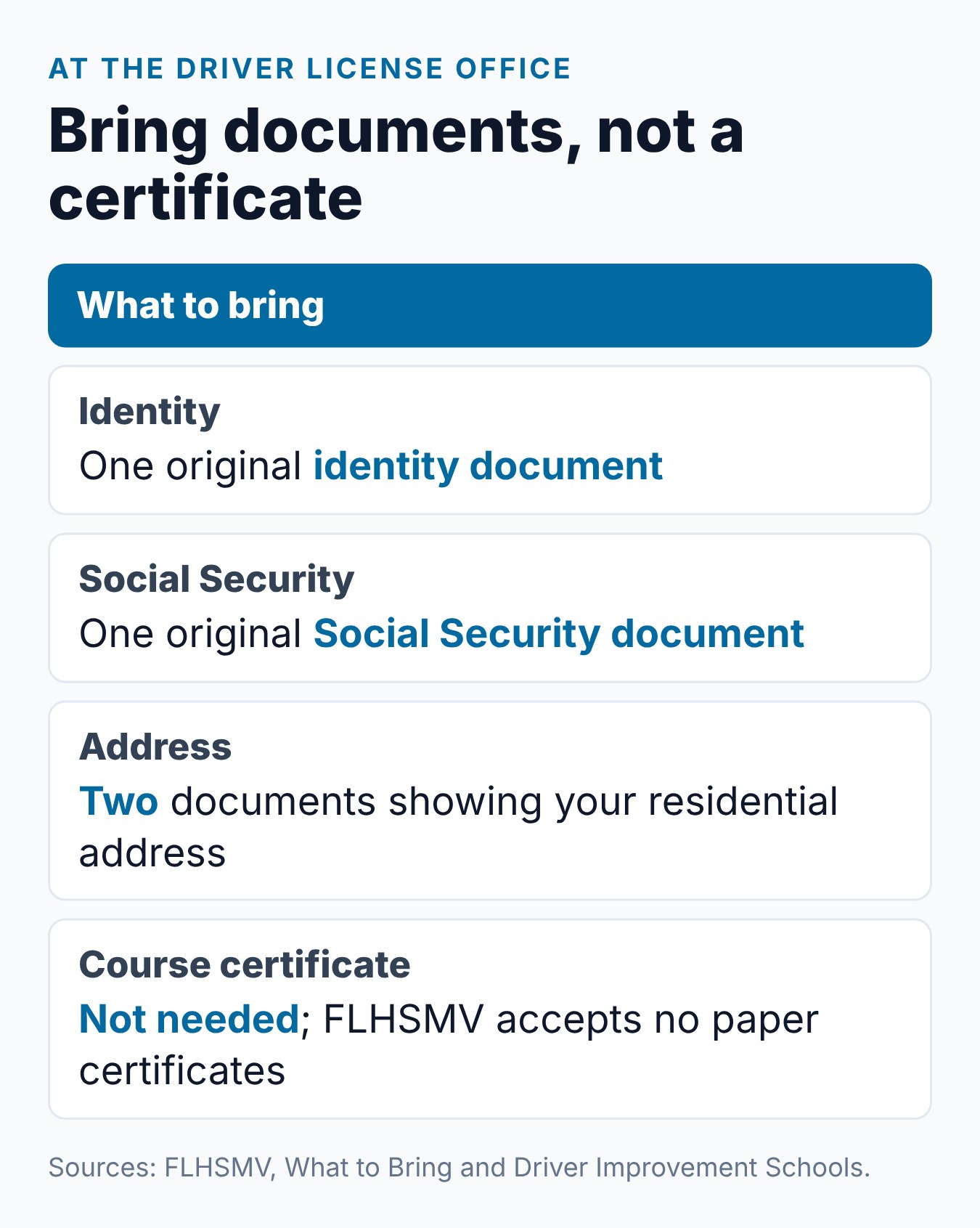
Check the FLHSMV page for the list that fits you before you go.
What Happens at the Office Visit
Once the record shows, the visit covers the tests in F.S. 322.12(3)(a) and on FLHSMV’s Class E Knowledge Exam & Driving Skills Test page:
- eyesight and hearing tests
- the Class E Knowledge Exam: 50 questions, 40 correct to pass, in English only since February 6, 2026
- the driving skills test
FLHSMV offers online knowledge testing to applicants under 18. Adults take the knowledge exam in person.
For every step of a first adult license, see First-Time Florida Driver’s License for Adults: The Complete Process.
Common Mistakes at the Office
These come straight from the official rules above:
- Bringing a paper certificate as proof. FLHSMV does not accept paper certificates for any licensing purpose.
- Going the same day you finish. The provider has up to 5 days to send, and FLHSMV says allow 24 to 72 hours to post.
- Calling the office first. The provider reports the completion, so ask it first.
- Taking an unapproved course. Only a course FLHSMV approved and certified counts.
- Skipping the course because you drove elsewhere. FLHSMV’s wording covers drivers who do not have another jurisdiction’s license in their possession, so ask the office if that is you.
- Forgetting the documents. Identity, Social Security and two address documents, as originals.
- Expecting an online knowledge exam. Online testing is for applicants under 18.
How Requirements Can Vary
Florida’s course and license rules apply statewide, but some details depend on where you live. Driver license services are often handled by your county tax collector’s office, and each office sets its own appointment process and hours. Some county school boards also offer driver education programs, such as DELAP courses, that can count instead of DETS.
FLHSMV can update course rules, forms, documents, and fees. Check FLHSMV and your county office for current requirements before your appointment.
Frequently Asked Questions
Is the drug and alcohol course the same as TLSAE?
Yes. The official name is Traffic Law and Substance Abuse Education, or TLSAE. FLHSMV requires it of first-time applicants 18 or older, with two exceptions.
Do I bring my drug and alcohol course certificate to the office?
No. The provider submits your completion electronically, and every issuing office can see it. FLHSMV does not accept paper certificates for any licensing purpose.
How long until the office can see my completion?
The provider has up to 5 days to submit it, and FLHSMV says to allow 24 to 72 hours for school completions to be posted. Neither is a promise for your record, so ask your provider when it reported.
Who does not need the course?
Under F.S. 322.095(1), you do not need it if you have been licensed in another jurisdiction or completed a Department of Education driver education course. FLHSMV’s page also covers drivers who do not have another license in their possession.
Is it really a 4-hour course?
Yes. The law sets a minimum of 4 hours of course content, minus a maximum of 30 minutes for breaks.
What if the office cannot find my course?
Contact your course provider first and ask the date it submitted your completion and the certificate number. Then ask the driver license office whether it shows.
Can I take the knowledge exam online as an adult?
No. FLHSMV offers online testing to applicants under 18, so adults take the Class E Knowledge Exam in person.
Conclusion
The Florida driver license office does not check a paper certificate for TLSAE; it checks the electronic record your provider sends to FLHSMV. Finish an approved course, give the record time to post, and bring your identity, Social Security and address documents. To see how one course lays out its details, visit the drug and alcohol course florida page.
Related Articles
- Florida Drug and Alcohol Course (TLSAE): The Complete Guide for Adults
- Florida Drug and Alcohol Course Certificate: What It Is and What to Do With It
- How to Get an FLHSMV-Authorized TLSAE Course in Florida
- How Long Is the Florida Drug and Alcohol Course (TLSAE)?
- Is the TLSAE Course Required in Florida? Who Must Take It
- Florida 4 Hour Drug and Alcohol Course: Who Needs It
Sources
- FLHSMV — Driver Education Courses
- FLHSMV — TLSAE Course Provider List
- FLHSMV — Driver Improvement Schools
- FLHSMV — Locations
- FLHSMV — Fees
- FLHSMV — What to Bring
- FLHSMV — What to Bring: U.S. Citizen
- FLHSMV — Class E Knowledge Exam & Driving Skills Test
- Florida Statutes — F.S. 322.095 (TLSAE)
- Florida Statutes — F.S. 322.12 (examinations)
Billy Forte is the owner of Driving Logic, a state-approved driver improvement course provider serving Florida and other U.S. states.
This article is general information, not legal advice. Florida licensing requirements, course rules, documents, and fees are set by FLHSMV and Florida law and can change. Use official FLHSMV and Florida statute sources for current requirements before you enroll in a course or visit a driver license office.