
Updated November 2026 · Reviewed by Billy Forte
A learners permit is the first driving credential a new driver gets, and it is issued by the state where the driver lives, so the requirements and steps to get one depend on that state’s own rules. Each state sets its own minimum age, course rules, documents, tests and fee, and many states use their own official name for the permit. To find the rules that apply to you, start at USAGov’s State Motor Vehicle Services directory, pick your state, and read your state agency’s permit page.
Key Facts
- Your state decides: the age, course, tests, fee and even the name of the permit come from your state. See what a learners permit is.
- Official names differ: Texas says Learner License and Florida says Learner’s License. See what each state calls it.
- Seven things to check: age, course, documents, parent role, tests, fee and appointment. See what to look up.
- Texas: a teen 15 to 17 applies at a Texas DPS driver license office after the first driver education hours. See the Texas permit.
- Florida: a teen at least 15 applies through FLHSMV after a required course and two tests. See Florida in brief.
What a Learners Permit Is
A learners permit lets a new driver practice on public roads before getting a full license. It is a first step, not a license to drive alone. In both Texas and Florida, the official pages say a permit driver must have a licensed adult in the car.
The permit is a state credential. USAGov, the federal government’s official guide, does not list one national permit; it sends readers to each state’s own motor vehicle agency for driver licenses.
That is why one answer cannot fit everyone. A rule that is true in one state may be false in the next one. The safe way to read any permit article, including this one, is to check each fact against your own state’s page.
Here is what stays the same in the two states covered below:
- It comes first. In Texas and Florida, a teen gets the permit before the license that allows solo driving.
- It has limits. Both states require a licensed adult in the car with a permit driver.
- It is for learning. The permit stage is when a new driver builds practice time.
Texas and Florida both put the permit inside a graduated driver license (GDL) program. Texas DPS calls the learner license Phase I of its GDL program. FLHSMV describes its GDL laws as limits for new drivers ages 15 through 17.
What Each State Calls It
“Learners permit” is an everyday phrase. It is how people talk and search, but it is often not the name on the state’s own website. In Spanish, the everyday words are “permiso de manejo.”
Here is what the Texas and Florida agencies call it:
- Texas: the Texas Department of Public Safety (DPS) calls it the Learner License on its page Texas Learner License as a Teen. The DPS page on choosing a driver education course also says “learner’s permit.”
- Florida: the Florida Department of Highway Safety and Motor Vehicles (FLHSMV) calls it the Learner’s License on its page about licensing requirements for teens.
The agency name changes too. Many people say “DMV” for any license office, but in Texas, driver licenses and permits come from Texas DPS. In Florida, they come from FLHSMV.
Why does the name matter? When you search your state agency’s site, the official name finds the right page faster. If “learners permit” turns up nothing, try “learner license,” “learner’s license” or “instruction permit,” and look for the page for teen drivers.
Learners Permit Requirements to Look Up in Your State
This section is a checklist, not a set of rules. Each item below is something to find on your own state agency’s page. The answer can be very different from one state to the next.
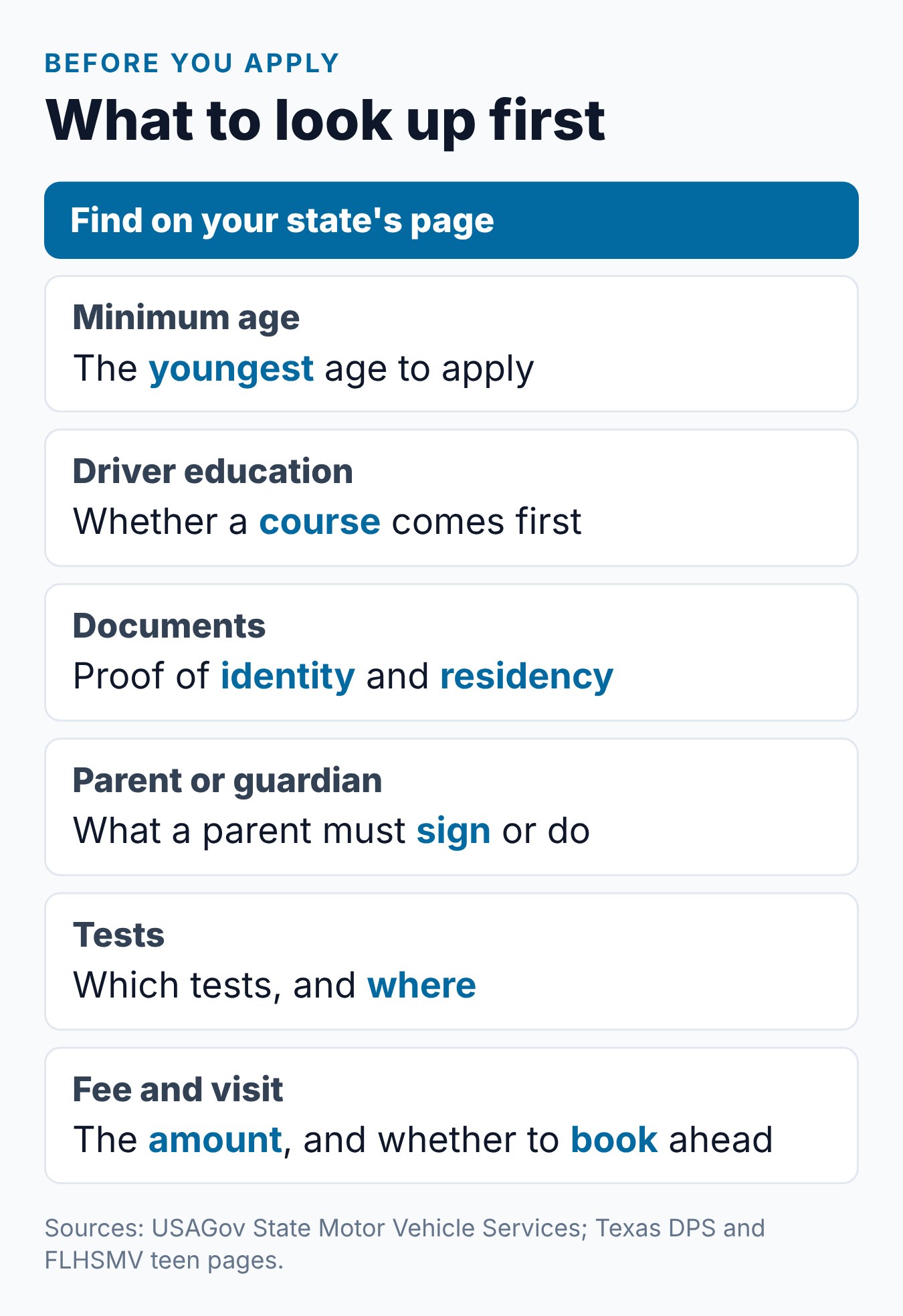
Look up these seven things before you go:
- Minimum age: the youngest age at which your state lets you apply.
- Driver education: whether you must take a course first, and how much of it.
- Documents: what your state accepts as proof of identity, residency and Social Security number, and whether it needs originals.
- A parent or guardian’s part: for a minor, whether a parent must come along, sign a form, or both.
- Tests: which tests are given and where you can take them. Texas and Florida both list a vision test and a knowledge test.
- The fee: the amount and the ways to pay.
- The appointment: whether you must book ahead, and how.
Write down what you find, with the page address and the date you read it. Rules and fees can change. A dated note makes it easy to check again before the visit.
Be careful with lists that claim to show “every state’s rules” on one page. A short summary can leave out a step, or show a rule that has since changed. The state agency’s own page is the one that counts.
Also check for a page made for teen drivers. Both Texas DPS and FLHSMV keep separate teen pages with steps that adults do not follow.
Steps to Get a Learners Permit in Any State
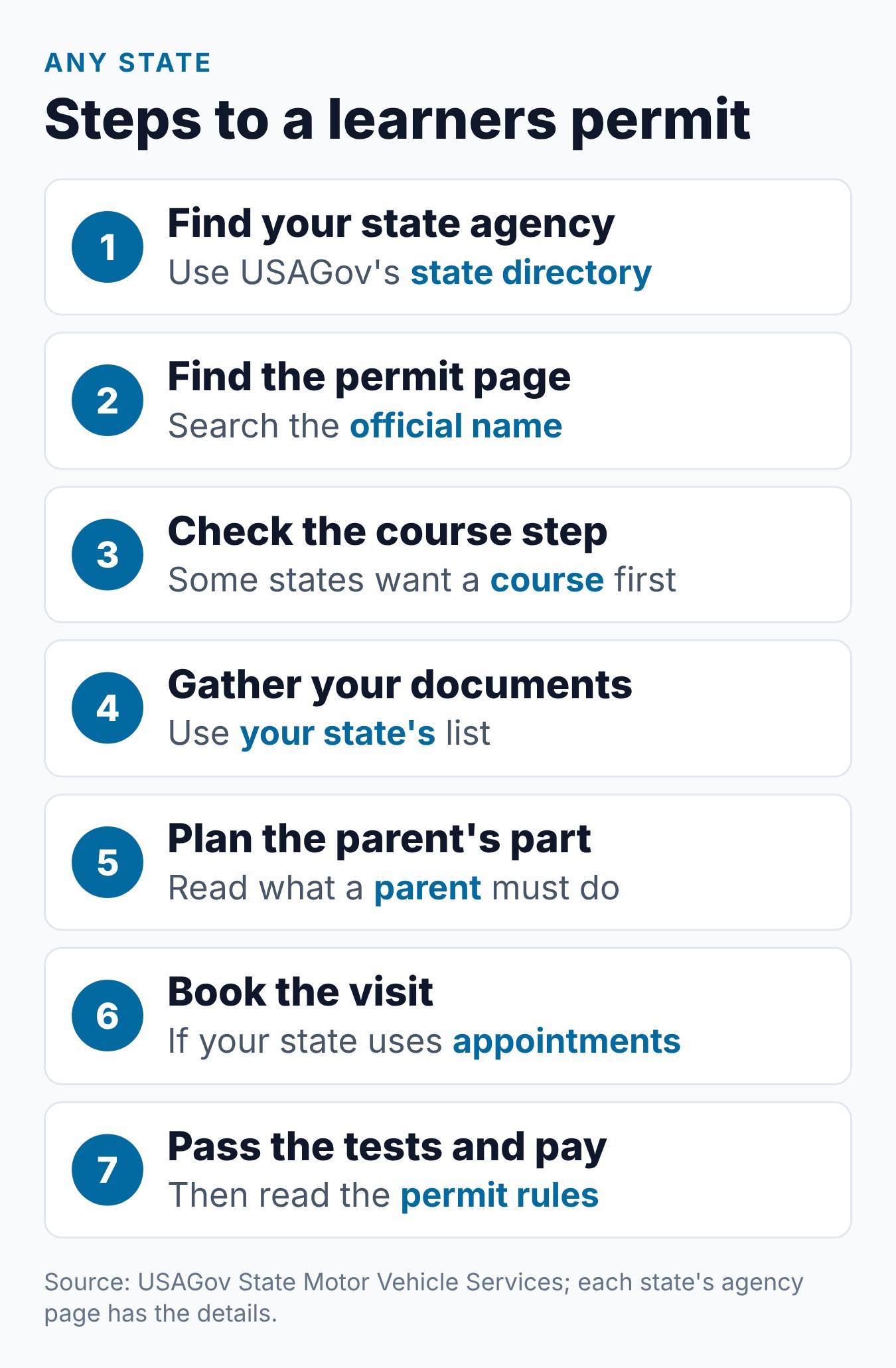
The steps below are the order of the work, not one state’s process. Your state’s page tells you what each step means where you live.
- Find your state agency. Open USAGov’s State Motor Vehicle Services page and choose your state.
- Find the permit page. Look for the page for new or teen drivers, using your state’s official name for the permit.
- Check if a course comes first. Some states require driver education, or part of it, before the permit.
- Gather your documents. Use your state’s list, not a list from another state.
- Plan the parent’s part. For a minor, read what the parent or guardian must sign or do.
- Book the visit, if needed. Read how your state handles appointments.
- Pass the tests and pay. Then read the rules that come with the permit before the first drive.
After the permit, read your state’s rules for the next step too. In Texas and Florida, the permit has a minimum holding time before the next license. Knowing it early helps you plan the practice drives.
The Learners Permit in Texas
Texas splits the work between two agencies. The Texas Department of Licensing and Regulation (TDLR) licenses driver education providers, and its license search lists in-person, online and parent-taught providers. Texas DPS takes the application, gives the exams and issues the learner license.
People often search for the “Texas DMV,” but in Texas the driver license office is run by DPS. For the full Texas process in one place, read the Texas learner’s permit guide.
Who Can Apply in Texas
The DPS learner license page lists the requirements for teens. The teen must be 15 to 17 years old. The teen must also finish the required classroom hours: 6 hours with the concurrent method or 24 hours with the block method.
A teen can start the classroom part at 14 but cannot apply until at least 15, per DPS. The teen also brings school proof: a high school diploma, a GED or a Verification of Enrollment and Attendance (VOE) form.
The steps at 15, in order, are in how to get a Texas learner’s permit at 15.
What Happens at the DPS Office
DPS offers in-office driver license services by appointment only. Appointments are made at txdpsscheduler.com, and the DPS appointments page says they can be booked up to six months ahead. Booking tips are in the DPS appointment guide.
The teen comes with a parent or legal guardian, or brings an application the parent or guardian signed in front of a notary. The teen brings the documents DPS lists, including the course provider’s driver education certificate (DE-964 or DEE-964, or DE-964E from a public school). The full list is in the Texas learner’s permit documents checklist.
At the office, the teen passes a vision exam. The knowledge exam is taken there too, unless the teen passed it during the classroom part of the course. The DPS fee page lists the learner license under 18 at $16.
Texas Rules After the Permit
DPS lists these rules for the Texas learner license:
- A licensed adult 21 or older must sit in the front passenger seat.
- No cell phone use, including hands-free devices, unless it is an emergency.
- Six months: the teen holds it at least six months before the next license, unless the teen turns 18.
- It expires on the 18th birthday.
Adults follow a different path. The DPS page Apply for a Texas Driver License lists a six-hour adult driver education course for first-time applicants 18 through 24 and no course for 25 and older; the learner’s permit guide for adults explains that path.
Florida in Brief
In Florida, the agency is FLHSMV, and the permit is called a Learner’s License. FLHSMV’s page on licensing requirements for teens lists what a teen needs:
- Age: at least 15 years old.
- Parent: a signed or notarized Parental Consent Form if under 18.
- Course: proof of finishing the Driver Education Traffic Safety (DETS) course.
- Tests: a vision and hearing test at a service center, and the Class E Knowledge Exam.
- Documents: proof of identity, Social Security number and home address.
The same page says a Florida learner’s license driver must always be with a licensed driver 21 or older. The teen holds it at least 12 months or until 18, whichever comes first.
For the full Florida picture, read the Florida learner’s permit guide. For the steps in order, read how to get a Florida learner’s permit.
Texas and Florida Side by Side
On November 27, 2026, the Texas DPS teen learner license page and the FLHSMV teen licensing page were read side by side. The table shows only what each page said that day. It shows how much two states can differ.
| What to check | Texas (DPS) | Florida (FLHSMV) |
|---|---|---|
| Official name | Learner License | Learner’s License |
| Youngest age to apply | 15 | 15 |
| Course before the permit | First 6 classroom hours (concurrent) or all 24 (block) | DETS course |
| Adult in the car | Licensed adult 21 or older, front passenger seat | Licensed driver 21 or older, always |
| Minimum time to hold it | At least 6 months, unless the teen turns 18 | At least 12 months, or until 18 |
| Tests named on the page | Vision exam and knowledge exam | Vision and hearing test, Class E Knowledge Exam |
Two things stand out. Both states let a teen apply at 15 and want a licensed adult 21 or older in the car. But Florida’s minimum holding time on that page is twice as long as Texas’s, and each state names a different course.
A family that moves from one of these states to the other cannot assume the old rules still apply. The same is true for every other state.
Moving to a New State With a Permit
A permit is tied to the state that issued it. When a teen moves, the new state’s rules take over. Before driving in the new state, read the new state agency’s page for drivers who move there.
Texas gives one clear example. Its Graduated Driver License page says teens who transfer from another state must get a Texas learner license and complete the six-month holding period, regardless of prior licensure, or wait until 18.
Other states set their own rules for newcomers. Use the USAGov directory to find the new state’s agency, then look for its new-resident page.
Common Mistakes With a Learners Permit
Each mistake below goes against a point on the official pages read for this article:
- Using another state’s rules. Each state sets its own; check your state agency’s page.
- Searching only for “learners permit.” The official name may be learner license or learner’s license.
- Calling the wrong agency. In Texas, DPS issues the permit, and TDLR licenses the course providers.
- Skipping the course step. Texas and Florida both list a course before the permit.
- Coming without a parent. Both states list a parent or guardian’s part for a minor.
- Driving alone. In both states, a licensed adult 21 or older must be in the car.
How Requirements Can Vary
Texas driver education rules come from TDLR, and driver license rules come from Texas DPS. They apply statewide, but what you need depends on the student’s age, the course method, and whether the classroom part comes from a parent-taught course, a driving school, or a public school.
Fees, forms, and office procedures can change. Check the TDLR parent-taught pages and the DPS driver license pages before each step, and follow the instructions from your course provider.
Frequently Asked Questions
What is a learners permit?
It is the first driving credential a new driver gets, and it allows supervised practice before a full license. Your state issues it and sets its rules.
Is a learners permit the same in every state?
No. Each state sets its own age, course, tests, fee and name for it. Check your state agency’s page through USAGov’s State Motor Vehicle Services directory.
What is a learners permit called in Texas?
Texas DPS calls it the Learner License, Phase I of the Graduated Driver License program. Its driver education page also uses “learner’s permit.”
How old do you have to be for a learners permit in Texas or Florida?
In Texas, DPS lists ages 15 to 17 for the teen learner license. In Florida, FLHSMV lists at least 15 years old for the learner’s license.
Where do I find my state’s learners permit rules?
Start at USAGov’s State Motor Vehicle Services page and choose your state. It sends you to your state’s own agency, where the permit page lists the current rules.
Can a permit driver drive alone?
Not in Texas or Florida. Both states require a licensed adult 21 or older in the car; in Texas, that adult sits in the front passenger seat.
Conclusion
A learners permit is the first credential on the road to a driver license, and your own state sets every rule for it. Start with USAGov’s state directory, then use your state agency’s page for the age, course, documents, tests and fee. In Texas, the first step to a teen permit is the first hours of a TDLR-licensed teen driver education course, and you can read about texas drivers ed on the Driving Logic course page.
Related Articles
- Texas Learner’s Permit: How to Get It, What You Need, and What It Allows
- Texas Permit: How the Texas Drivers Permit Works by Age
- How to Get a Texas Learner’s Permit at 15: Step-by-Step Guide
- Texas Learners Permit Checklist: What to Bring to DPS
Sources
- USAGov — State Motor Vehicle Services
- Texas DPS — Texas Learner License as a Teen
- Texas DPS — Choosing a Driver Education Course
- Texas DPS — Graduated Driver License (GDL) and Hardship License
- Texas DPS — Apply for a Texas Driver License
- Texas DPS — Driver License Services Appointments
- Texas DPS — Driver License Fees
- TDLR — Driver Education and Safety
- TDLR — Parent-Taught Driver Education
- FLHSMV — Licensing Requirements for Teens, Graduated Driver License Laws and Driving Curfews
Billy Forte is the owner of Driving Logic, a state-approved driver improvement course provider serving Texas and other U.S. states.
This article is general information, not legal advice. Texas driver education and licensing rules are set by TDLR, Texas DPS, and Texas law, and can change. Check the official TDLR and DPS websites for current requirements.