
Updated November 2026 · Reviewed by Billy Forte
Speeding means driving faster than the law allows for that road and those conditions, and a speeding ticket is a notice to answer that charge in a named court by a set date. So the answer to what to do if you get a speeding ticket starts with the paper itself: read it for the court, the charge and the date, and respond before that date. Each state writes its own speed law and court rules, so the court on your ticket is the one place that can tell you which choices you have.
Key Facts
- What speeding is: state laws ban driving faster than is “reasonable and prudent,” and listed speed limits back that rule up. See what counts as speeding.
- What the ticket is: a notice to answer a charge in a named court by a set date. See what the ticket asks of you.
- First steps: read it, find the court and the date, do not ignore it, check your choices, ask about a course, and keep copies. See the six steps.
- Course options: a course is something a court or state may allow, and the rules differ by state. See course options.
- Your state: Driving Logic has a choices guide for seven states. See state-by-state guides.
What Counts as Speeding
Every state writes its own speed law. There is no single national rule that says what speeding is or how a ticket is handled. Two state laws show how these rules are usually built.
Arizona: How One State Writes the Rule
Arizona’s basic speed law is A.R.S. 28-701. It says a person “shall not drive a vehicle on a highway at a speed greater than is reasonable and prudent under the circumstances, conditions and actual and potential hazards then existing.” The same law says a driver must control speed as needed to avoid a crash.
The law then lists speeds that count as prima facie evidence that a speed is too fast. Prima facie means the speed is treated as proof unless something shows otherwise. The listed speeds are:
- 15 miles per hour approaching a school crossing.
- 25 miles per hour in a business or residential district.
- 65 miles per hour in other locations.
Arizona’s law also says drivers must slow down below those speeds when conditions call for it. Its examples include intersections, railroad crossings, curves, hill crests, narrow or winding roads, and special hazards from people, other traffic, weather or the road.
So in Arizona, a driver can be speeding even below the posted number if the speed is not safe for the conditions.
Texas: The Same Idea in Texas Law
Texas uses a similar structure. Transportation Code Sec. 545.351 says an operator “may not drive at a speed greater than is reasonable and prudent under the circumstances then existing.” It also lists places where a driver must slow down, such as intersections, curves and hill crests.
Sec. 545.352 then lists the speeds that are lawful unless a special hazard calls for a slower speed. A speed over those limits is prima facie evidence that it is “not reasonable and prudent” and unlawful. Two examples from the list:
- 30 miles per hour in an urban district on a street other than an alley.
- 70 miles per hour on a highway numbered by Texas or the United States outside an urban district.
Transportation Code Sec. 542.301 says breaking one of these rules of the road is an offense. It is a misdemeanor unless the law says otherwise. For what that label means in Texas, see whether a speeding ticket is a misdemeanor in Texas.
When the Charge Is More Serious
Some states also have a higher-level speeding charge, such as criminal or reckless speeding. That is a different kind of case from a basic speeding ticket. It can carry different court steps, so it may be worth talking to a lawyer.
If you were cited in Arizona for that kind of charge, read criminal speeding in Arizona first.
What a Speeding Ticket Asks You to Do
A speeding ticket is not a bill. It is a notice that you have been charged and that you must answer in a certain court by a certain date. The ticket usually tells you how to do that.
In Texas, the law calls the ticket a notice to appear. The date on it is often called the answer date or appearance date. Texas law even sets some of the words that must be on the notice.
Under Code of Criminal Procedure Art. 45A.354, a Texas notice for a traffic offense covered by the course rules must say, in substance: “You may be able to require that this charge be dismissed by successfully completing a driving safety course or a motorcycle operator training course. You will lose that right if, on or before your appearance date, you do not provide the court with notice of your request to take the course.”
That one sentence shows why the date matters so much. In Texas, a choice can be lost just because the date passes.
Other states use their own names and forms. Still, every ticket points you to a court and a date. Those two facts drive everything else.
What to Do if You Get a Speeding Ticket, Step by Step
These six steps are true in every state. They do not tell you whether to pay, contest the ticket or ask for a course. That choice is yours, and the court explains which choices apply to you.
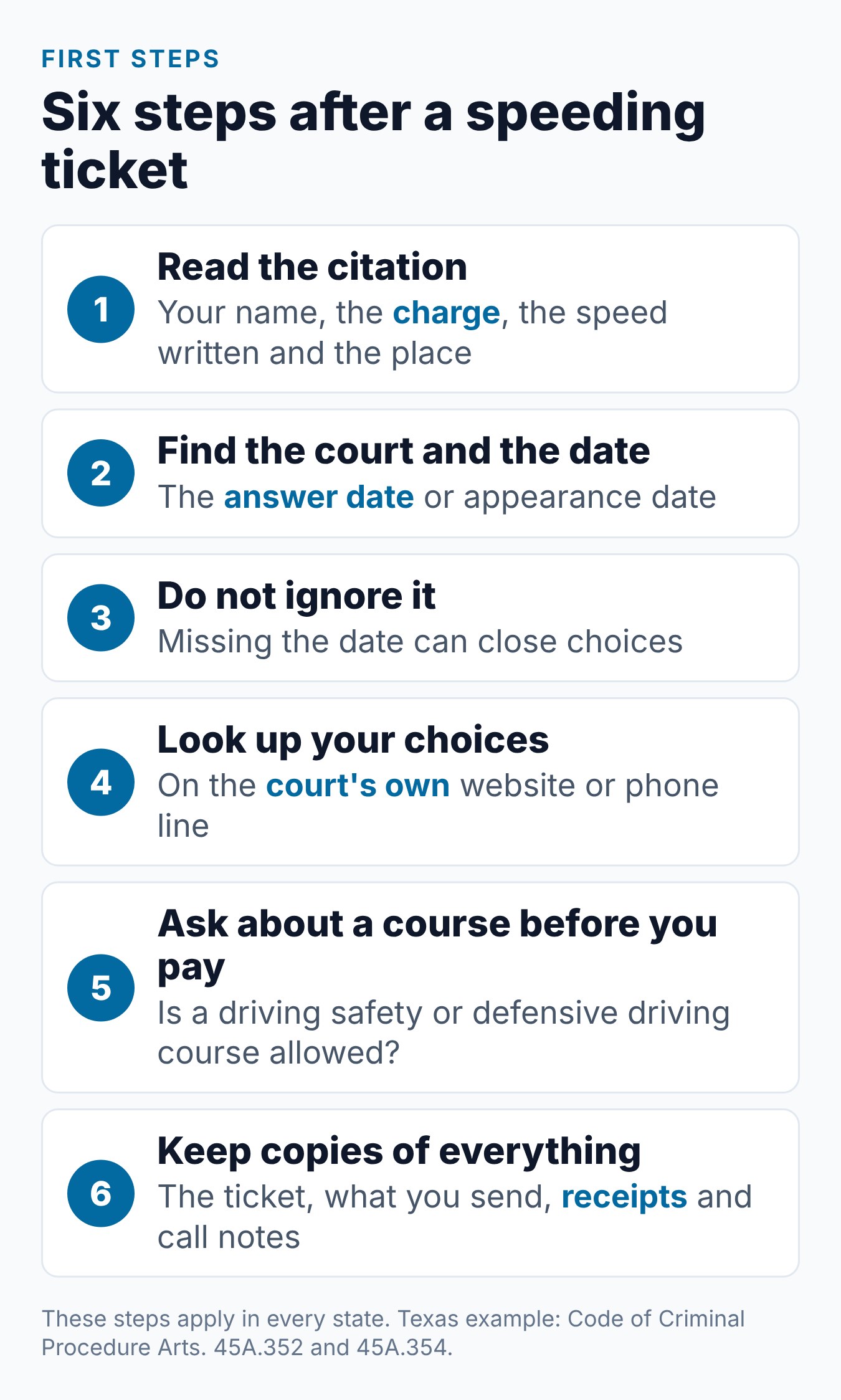
- Read the citation. Look for your name, the charge, the speed written down and the place of the stop. Note anything that looks wrong.
- Find the court and the date. The ticket names the court that has your case. It also gives an answer date or an appearance date.
- Do not ignore it. A ticket does not go away if you set it aside. Missing the date can close choices you might have had.
- Look up your choices with the court. Use the court’s own website or phone line. The court can tell you how to answer, what is required and whether you must appear.
- Ask about a course before you pay. Ask whether a driving safety or defensive driving course is allowed for your ticket. In Texas, the course request goes with your plea and is due on or before the answer date.
- Keep copies of everything. Save the ticket, anything you send, and any receipts or tracking numbers. Note the date and the name of anyone you speak with.
Why the Date on the Ticket Matters
The date on the ticket is the deadline that controls the most choices. Texas law shows this clearly, so it is a useful example.
Under Art. 45A.352, a Texas judge must require the driving safety course when every condition in the law is met. One condition is timing.
On or before the answer date, the driver must plead guilty or no contest and ask for the course. The law allows the request:
- in person or through a lawyer;
- by certified mail, return receipt requested, postmarked by the answer date; or
- through the court’s e-mail address or online portal, if the court allows it.
After that date, the right is gone. But the same article says the court may still grant a course request before the final disposition of the case. The court may say yes, but it does not have to.
The law also says that a course request made at the time and place you must appear counts as an appearance under your promise to appear. So asking on time keeps you in step with the court.
Other states set their own deadlines. That is why step 2 is to find the date and step 4 is to ask the court what it needs by then.
Course Options Depend on the State and the Court
A course is something a court or a state may allow. It is not a right everywhere, and the rules differ by state. In every case, the court decides whether a course applies to your ticket.
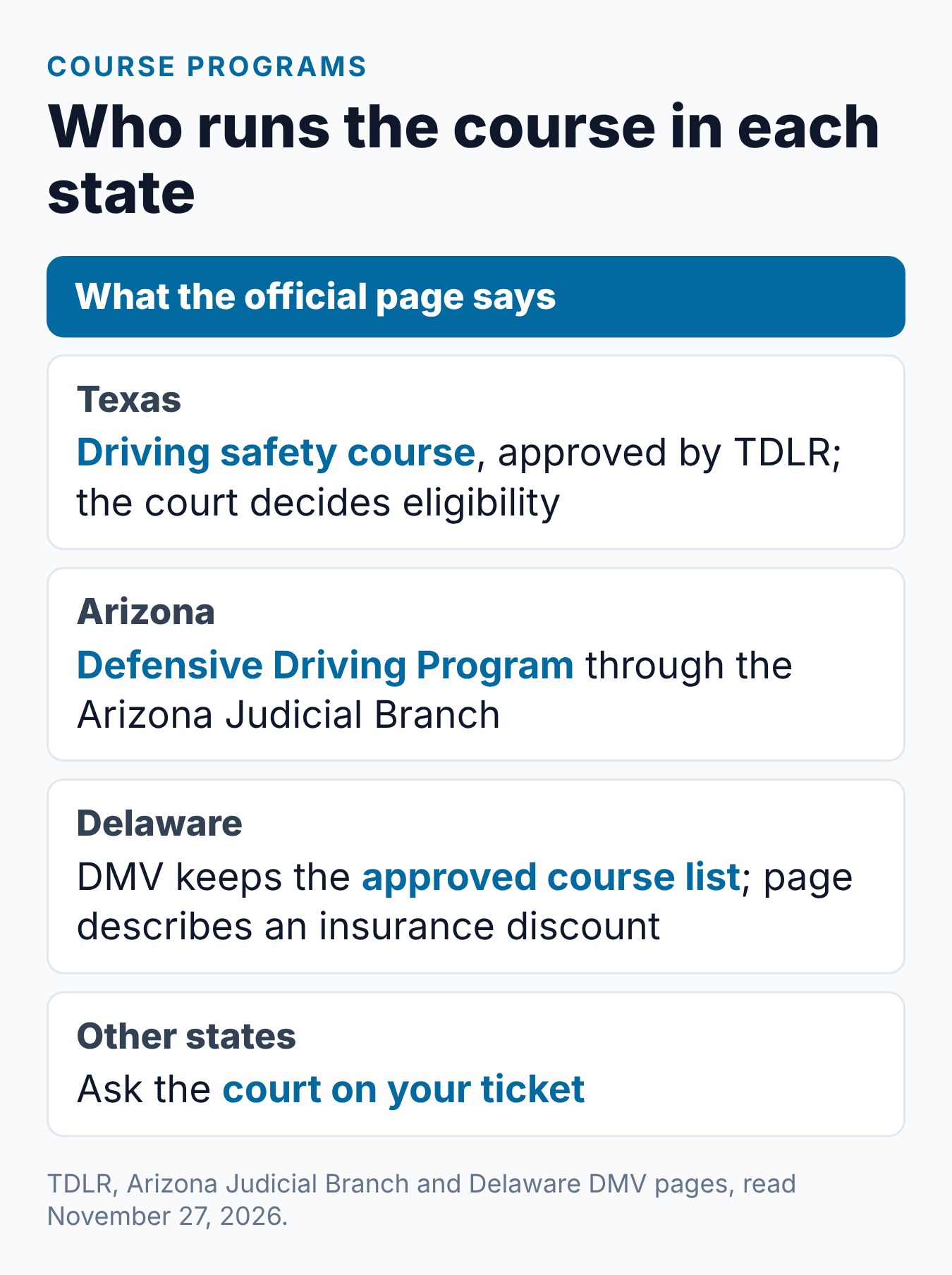
Texas: Driving Safety Course
In Texas, “defensive driving” and “driving safety course” mean the same course. The law calls it a driving safety course, and it is approved by the Texas Department of Licensing and Regulation (TDLR), not by Texas DPS.
TDLR’s Taking a Driving Safety Course page says any licensed provider may offer a 6-hour course for ticket dismissal or insurance discounts. You must first get notice from the court that you are eligible. You still pay any fines and fees tied to the ticket.
Chapter 45A also limits who has the right to the course. It does not apply to anyone who holds a commercial driver’s license, or held one when the offense happened. It also does not cover speeding 25 mph or more over the limit, or 95 mph or more.
TDLR’s news post on SB 296 explains a change that took effect September 1, 2025. If several eligible charges come from the same criminal transaction, one completed course can make each of them eligible for dismissal.
Arizona: Defensive Driving Program
In Arizona, the program is run through the court system. The Arizona Judicial Branch’s Defensive Driving FAQ is written for defensive driving school students. Its Defensive Driving Unit points drivers to a list of certified Defensive Driving Schools.
Delaware: Defensive Driving Courses
In Delaware, the Division of Motor Vehicles keeps the list of approved defensive driving courses. On November 27, 2026, its page described the course as a way to get an auto insurance discount. It did not describe a ticket dismissal.
Where the Choices Are Explained State by State
Driving Logic has a full guide to the choices after a ticket in these states:
- Texas: Texas speeding ticket options: pay, contest, or take defensive driving
- Arizona: Arizona traffic ticket options
- Indiana: Indiana speeding ticket: what to know before you pay or contest it
- Missouri: Missouri speeding ticket options: pay, contest, or request DIP
- Tennessee: Tennessee traffic ticket options: pay, contest, or ask about driving school
- Virginia: Virginia speeding ticket: what to know before you pay or go to court
- Delaware: Delaware speeding ticket: your options
For a Texas ticket, the Texas speeding ticket guide is the place to start.
If your state is not listed, contact the court named on your ticket. To find your state’s driver license agency, use the USA.gov state motor vehicle services page. It lets you pick your state or territory.
Keep a Paper Trail
Good records protect you if a question comes up later. They are also the easiest step to do well.
Keep these items in one place:
- The ticket itself, or a clear photo of both sides.
- Anything you send the court, such as a plea or a course request.
- Proof of when you sent it. In Texas, a mailed course request goes by certified mail, return receipt requested, so keep the receipt.
- Court replies, including any notice that you are eligible for a course.
- Course papers. TDLR says your Texas certificate of completion should reach you within 14 days of finishing, and that it is your job to send it to the court.
Write down the date of each call. Note the name of the person you talked to. If the court gives you a new date, add it to your calendar.
Common Mistakes to Avoid
Each point below comes from the official pages listed in Sources:
- Treating the ticket like a bill. It is a notice to answer a charge in a court by a date.
- Waiting past the date. In Texas, the course right ends if the request is not made on or before the date.
- Paying before asking about a course. Ask the court first if a course might matter to you.
- Assuming the posted number is the only rule. Arizona and Texas law both say speed must be reasonable and prudent for the conditions.
- Using another state’s rules. Each state writes its own law, so a friend’s ticket in another state is not a guide.
- Losing the paperwork. Without copies and receipts, it is hard to show what you sent and when.
What We Found on the Official Pages
On November 27, 2026, we read the official pages below. Each row sums up what one page said about speed limits or ticket deadlines.
| Page | Publisher | What it said |
|---|---|---|
| A.R.S. 28-701 | Arizona Legislature | Speed must be reasonable and prudent; listed speeds are prima facie evidence |
| Transportation Code Ch. 545 | Texas Legislature | Same reasonable-and-prudent rule; lawful speeds listed by type of road |
| Transportation Code Ch. 542 | Texas Legislature | Breaking a rule of the road is an offense and a misdemeanor unless stated otherwise |
| Code of Criminal Procedure Ch. 45A | Texas Legislature | Course request with a plea on or before the answer date |
| USA.gov state motor vehicle services | U.S. government | Links to each state’s motor vehicle agency |
Not one page offered a national rule. Each one covered its own state, or pointed to the state agencies.
How Requirements Can Vary
The driving safety course rules come from Texas law and TDLR and apply statewide. Each justice or municipal court still sets its own fees, filing steps and contact methods, and the facts of your citation decide which options you have.
Laws, fees and court procedures can change. Check your citation, ask the court that handles your case, and use the TDLR and Texas DPS websites for current rules before you act.
Frequently Asked Questions
What should I do first if I get a speeding ticket?
Read the ticket for the court, the charge and the date. Then contact that court before the date to learn how to answer. Keep a copy of the ticket.
What counts as speeding?
Driving faster than the law allows for that road and those conditions. Arizona and Texas law both say speed must be reasonable and prudent, and both list speeds that are treated as proof a speed was too fast.
Can I just ignore a speeding ticket?
No. A ticket is a notice to answer a charge by a set date. Missing that date can close choices, such as the Texas right to ask for a driving safety course.
Should I pay the ticket or fight it?
That choice is yours, and the court explains which choices apply. Ask the court, or talk to a lawyer about your own case. The state guides above explain the choices in seven states.
Can a course dismiss my speeding ticket?
Sometimes, but it depends on the state and the court. In Texas, a driver who meets every condition in the law and asks on time has a right to the course. The court dismisses the charge after the driver finishes the course and turns in the required papers within 90 days.
What if my state is not covered here?
Contact the court named on your ticket. You can find your state’s motor vehicle agency through the USA.gov state motor vehicle services page.
Conclusion
A speeding ticket is a notice to answer a charge in a named court by a set date. Read it, find that court and that date, and ask the court about your choices before you pay. If you have a Texas ticket and the court allows the course, the texas driving safety course from Driving Logic is one option to consider.
Related Articles
- Texas Speeding Ticket: Costs, Record Impact, and What to Know
- Texas Speeding Ticket Options: Pay, Contest, or Take Defensive Driving
- Texas Speeding Ticket Court: Can You Contest It?
- Texas Speeding Ticket Out of State: What Happens Next
Sources
- TDLR — Taking a Driving Safety Course
- Texas Code of Criminal Procedure Chapter 45A (PDF)
- Texas DPS — How to Order Your Driver Record
- Texas Code of Criminal Procedure Chapter 45A (web page)
- Texas Transportation Code Chapter 545 — Operation and Movement of Vehicles
- Texas Transportation Code Chapter 542 — General Provisions
- TDLR — SB 296 and driving safety course dismissal
- Arizona Revised Statutes 28-701 — Reasonable and prudent speed
- Arizona Judicial Branch — Defensive Driving FAQ
- Delaware DMV — Defensive Driving Courses
- USA.gov — State motor vehicle services
Billy Forte is the owner of Driving Logic, a state-approved driver improvement course provider serving Texas and other U.S. states.
This article is general information, not legal advice. Texas traffic and driving safety course rules are set by Texas law, TDLR, Texas DPS and each court, and they can change. Check with the court on your citation and the official TDLR and DPS websites for current requirements, and talk to a Texas lawyer about your specific case.