
Updated November 2026 · Reviewed by Billy Forte
To prepare for the driving test in the United States, find out which test you need and study your own state’s official driver handbook, because there is no single national driving test and each state’s driver license agency sets its own rules. The phrase usually covers two different tests: a knowledge test on traffic laws and road signs, and a road test where an examiner watches you drive. The names, steps and rules vary by state, so your state agency’s website is the place to confirm them.
Key Facts
- No national test: Each state’s own agency gives its driving tests. See how to find your state’s rules.
- Two tests: A knowledge test on laws and signs, and a road test behind the wheel. See the two tests.
- Florida: FLHSMV gives the Class E Knowledge Exam and the Class E Driving Skills Test, in English only since February 6, 2026. See Florida.
- Texas: DPS lists a vision exam, a written knowledge test and a driving skills test. See Texas.
- How to prepare: Use your state’s handbook and the practice material your state agency offers. See how to prepare.
Knowledge Test and Road Test: Two Different Tests
When people say “driving test,” they can mean two different things. Knowing which one you need saves you from studying for the wrong test.
- The knowledge test checks what you know. It is a written or computer test on traffic laws, safe driving and road signs. In Florida, for example, you pass it to get a learner’s license.
- The road test checks what you can do. An examiner rides with you and watches how you handle the car. In Florida, it comes after you hold a learner’s license for 12 months or turn 18.
Each state uses its own names for these tests. People also call them the permit test or written test, and the road exam or behind-the-wheel test. The table below shows the names the official Florida and Texas pages use, and other states may use different words.
| Kind of test | Florida name (FLHSMV) | Texas name (DPS) |
|---|---|---|
| Knowledge test on laws and signs | Class E Knowledge Exam | Written knowledge test |
| Behind-the-wheel test | Class E Driving Skills Test | Practical driving skills test |
| Eye check | Vision and hearing test (teen learner’s license) | Vision exam |
| Agency that runs licensing | Florida Highway Safety and Motor Vehicles (FLHSMV) | Texas Department of Public Safety (DPS) |
Many people search for “the DMV” when they mean this agency. Florida’s agency is FLHSMV, and driver license services are often handled by county tax collector offices. In Texas, licenses are handled by the Department of Public Safety (DPS).
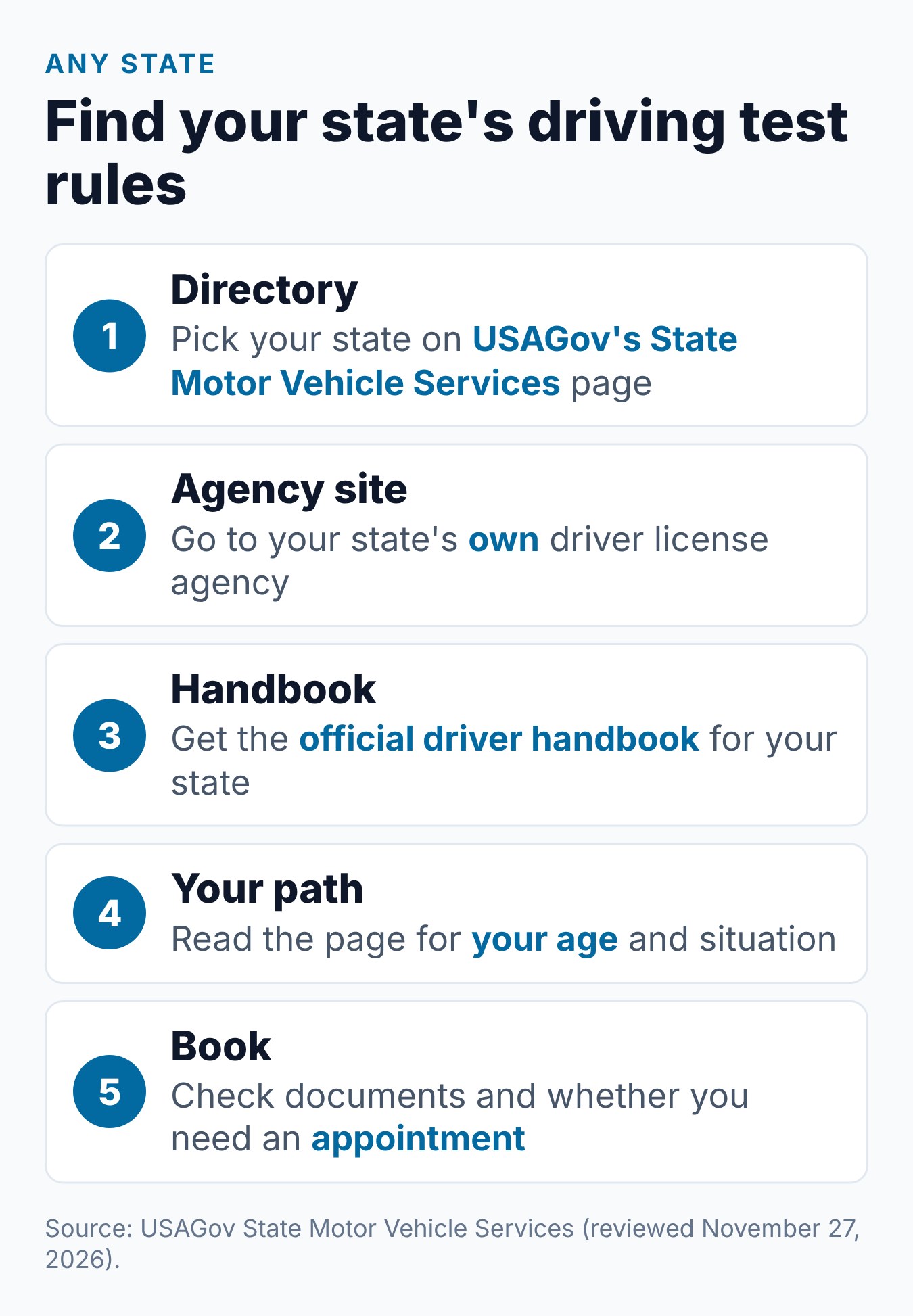
How to Find Your State’s Driving Test Rules
The rules that matter are the ones your own state publishes. A website about another state can be right for that state and wrong for yours.
The federal government’s USAGov State Motor Vehicle Services page lets you pick your state or territory from a list. It then points you to that state’s own motor vehicle agency. USAGov describes these agencies as the place to get or renew a driver’s license and handle other licensing services.
Once you are on your state’s site, look for these pages:
- The official driver handbook. This is the main study book for the knowledge test.
- The license or permit page for your age. Teens and adults often follow different paths.
- The testing page. It should say which tests you take, where you take them and how to sign up.
- The “what to bring” page. It lists the documents you need at the office.
- Appointments. Check whether you must book ahead. Texas DPS, for example, serves in-office customers by appointment only.
Read the page that matches your situation. A first license, a move from another state and a renewal can each have different steps.
Why a Generic Checklist Is Not Enough
Lists that claim to cover “every state” can mix rules from different places. Florida lets applicants under 18 take the knowledge exam online, and your state may not. Florida and Texas both require a course for some new drivers, and your state’s rule may differ.
That is why this guide gives details only for Florida and Texas, where Driving Logic has full articles. For any other state, the state agency’s own pages are the final word.
The Driving Test in Florida
In Florida, the agency is FLHSMV. Its pages describe two tests for a regular Class E license: the Class E Knowledge Exam and the Class E Driving Skills Test.
The Class E Knowledge Exam
FLHSMV’s Class E Knowledge Exam and Driving Skills Test page says you must pass the knowledge exam to get a learner’s license. It has 50 multiple-choice questions on Florida traffic laws, safe driving and traffic controls. You need 40 correct, or 80 percent, to pass.
FLHSMV lists three ways to take it:
- In person at a service center.
- Online through an approved third-party administrator, for applicants under 18 only. A Parent Proctoring Form is required, notarized or signed in front of a driver license examiner.
- At school through a high school driver education class in the DELAP program.
Our pillar guide, Florida Permit Test: What to Expect and How to Prepare, explains what is on this exam and how to study for it.
The Class E Driving Skills Test
The Class E Driving Skills Test is Florida’s road test. FLHSMV says it is a series of maneuvers, such as a three-point turn, parking on a grade and stopping quickly. To qualify, you must hold your learner’s license for one year (12 months) or be 18 years old.
The car you bring must have a valid registration and proof of insurance. It must also pass a basic inspection by the examiner, and no other passengers may ride along.
You can take the test at a service center, with a driver license exam provider or through a third-party administrator. Our article on the Florida drivers license test explains each exam in the Florida process.
English Only Since February 6, 2026
FLHSMV’s news release of January 30, 2026 says that “beginning Friday, February 6th, all driver license knowledge and skills examinations will be administered exclusively in English.” The release says this applies to all license classes, including exams given orally. Language translation services are no longer permitted for knowledge or skills exams.
FLHSMV’s exam page agrees: “Class E knowledge examinations are available in English only.” The two pages read for this guide do not disagree on this point.
Keep two things apart.
FLHSMV still posts its driver handbook in English, Spanish (Español) and Kreol on its Handbooks and Manuals page, and some courses are offered in other languages. Studying in Spanish can help you learn the rules, but it does not change the language of the state exam. Before test day, confirm current rules with FLHSMV or your county tax collector office.
Where the DETS Course Fits
FLHSMV’s DETS page says that, as of August 1, 2025, anyone under 18 who has never held a license anywhere must finish a 6-hour Driver Education Traffic Safety (DETS) course before applying for a license. For teens, that course comes before the learner’s license. A DELAP course from some county school boards may substitute.
Adults are different. FLHSMV’s TLSAE page says drivers over 18 who have never held a license must finish a 4-hour Traffic Law and Substance Abuse Education (TLSAE) course first. TLSAE is still required for them.
Neither course is the state’s knowledge exam. The course is one step, and the Class E Knowledge Exam is a separate step. For the full teen path, see How to Get a Florida Learner’s Permit Step by Step.
The Driving Test in Texas
In Texas, the agency is the Department of Public Safety (DPS). Its Apply for a Texas Driver License page lists the steps for a first license.
At the driver license office, DPS says you must pass a vision exam. You must also pass “the written knowledge and a practical driving skills test.” DPS says you may complete the testing at the DPS office or with a third-party provider.
DPS also lists items to have ready for testing:
- Impact Texas Driver (ITD) certificate if you will take a driving test. DPS says it must be dated within 90 days of your driving skills test.
- A six-hour adult driver education course if you are 18 through 24 and applying for your first Texas license. DPS says there is no driver education requirement at 25 and older.
- Proof of insurance for each vehicle you own, or a statement that you do not own one.
DPS’s appointments page says all in-office driver license services are by appointment only. Appointments can be made up to six months ahead.
Driving Logic has three Texas articles that go deeper:
- Texas Driving Test: What to Expect and How to Prepare covers the road test and how it is graded.
- Texas DPS Written Knowledge Test covers the knowledge test for adults.
- Texas Learner’s Permit Knowledge Test covers the knowledge test a teen passes before a learner license.
For Texas course pages, see Driving Logic’s Texas adult driver education course and parent-taught teen driver education pages.
How to Prepare for the Driving Test in Any State
Good preparation looks the same almost everywhere, even when the rules differ. Start with official material, then check the details for your state.
- Study the official handbook. It is written by the agency that writes the test. Read it in short sessions instead of all at once.
- Use the agency’s own practice material. FLHSMV, for example, points to a Class E Knowledge Practice Test along with its handbook. Check whether your state offers something similar.
- Learn signs by shape and color. FLHSMV’s teen page, for example, says Florida’s exam covers traffic laws and traffic signs.
- Practice the road test skills with a licensed adult. Work on turns, stops, lane position, backing and parking in quiet areas first.
- Check the vehicle early. In Florida, the examiner inspects the car before the road test. Fix lights, signals or tires before test day.
Then confirm the details with your state agency before test day. These are things to check, not facts that apply in every state.
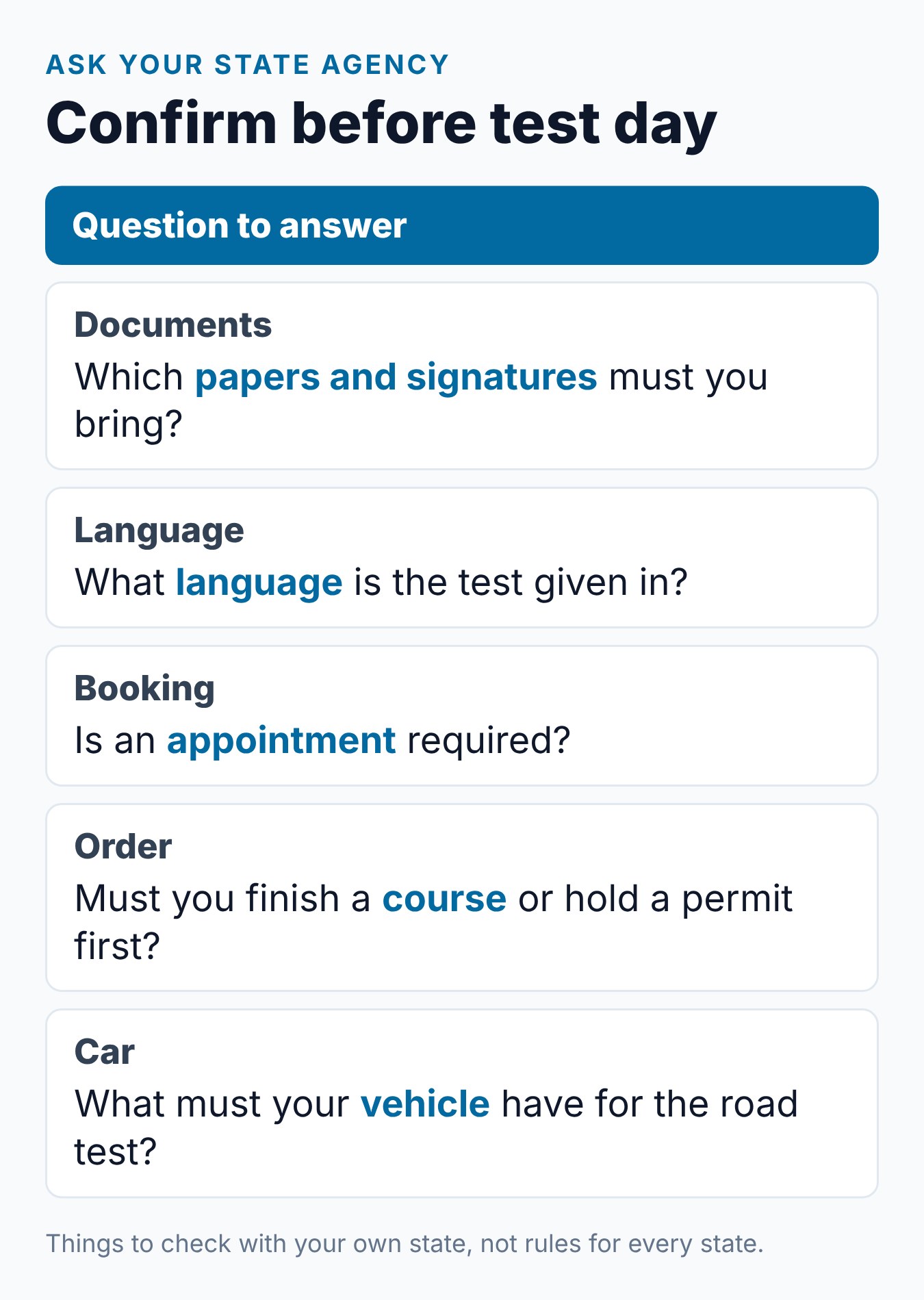
- What to bring: Which documents, forms and signatures does your state ask for?
- Language: What language is the test given in? Florida, for example, gives these exams in English only.
- Appointment: Do you need to book ahead, and how far ahead?
- Order of steps: Must you finish a course or hold a permit for a set time first?
- Vehicle: Must you bring your own car for the road test, and what papers must it have?
Study Tips That Work for Both Tests
For the knowledge test, test yourself after each handbook chapter. Write down the questions you miss and go back to that part of the handbook.
For the road test, practice the same skills many times until they feel routine. Ask the licensed adult with you to point out habits like rolling stops or late turn signals.
Common Mistakes to Avoid
These mistakes come from the official rules above. Each one can cost you a trip to the office.
- Studying another state’s rules. Practice questions from another state can have different laws and wording. Use your own state’s handbook.
- Mixing up the two tests. Passing the knowledge test does not mean you are ready for the road test, and the reverse is also true.
- Thinking a course replaces the exam. In Florida, DETS and TLSAE are courses you finish first. They are not the Class E Knowledge Exam.
- Assuming a Spanish study guide means a Spanish exam. In Florida, the exams are in English only, even though a Spanish handbook exists.
- Skipping the appointment check. Texas DPS serves in-office customers by appointment only.
- Bringing a car that is not ready. In Florida, a car with defects or an expired tag can stop the road test before it starts.
How Requirements Can Vary
Florida’s course and license rules apply statewide, but some details depend on where you live. Driver license services are often handled by your county tax collector’s office, and each office sets its own appointment process and hours. Some county school boards also offer driver education programs, such as DELAP courses, that can count instead of DETS.
FLHSMV can update course rules, forms, documents, and fees. Check FLHSMV and your county office for current requirements before your appointment.
Frequently Asked Questions
Is there a national driving test in the United States?
No. Each state’s own driver license agency gives its tests and sets its rules. USAGov’s State Motor Vehicle Services page helps you find your state’s agency.
What is the difference between the knowledge test and the road test?
The knowledge test is a written or computer test on traffic laws and road signs. The road test is a behind-the-wheel test where an examiner watches you drive.
Can I take the Florida driving test in Spanish?
No. FLHSMV says that since February 6, 2026, all driver license knowledge and skills exams are given in English only, and translators are not allowed. You can still study with FLHSMV’s Spanish handbook.
What tests does Texas require for a first driver license?
DPS lists a vision exam, a written knowledge test and a practical driving skills test. You can take the testing at a DPS office or with a third-party provider.
Does a driver education course replace the knowledge test?
In Florida, no. DETS for teens under 18 and TLSAE for adults over 18 are courses finished before you apply, and the Class E Knowledge Exam is a separate step.
How should I study for the driving test?
Start with your state’s official driver handbook and any practice material your state agency offers. Then practice driving skills with a licensed adult and check your state’s test-day rules.
Conclusion
There is no single national driving test, so start by finding out which test you need and what your own state requires. Your state’s handbook and agency pages are the best study tools and the final word on the rules. In Florida, teens under 18 finish DETS before the learner’s license, and every exam is given in English only. To see the course for Florida teens, visit the online Florida DETS course page.
Related Articles
- Florida Permit Test: What to Expect and How to Prepare
- Florida Drivers License Test: Which Exams You Must Pass
- Florida DMV Permit Test: Taking It at a License Office
- Florida Permit Practice Test: How to Prepare for the 50-Question Exam
Sources
- USAGov — State Motor Vehicle Services
- FLHSMV — Class E Knowledge Exam and Driving Skills Test
- FLHSMV — Licensing Requirements for Teens
- FLHSMV — News release, January 30, 2026: driver license exams in English only
- FLHSMV — Handbooks and Manuals
- FLHSMV — Driver License Exams
- FLHSMV — Driver Education Traffic Safety (DETS)
- Texas DPS — Apply for a Texas Driver License
- Texas DPS — Driver License Services Appointments
- FLHSMV — Driver Education Courses
- Florida Statutes — F.S. 322.1615 (DETS)
- Florida Statutes — F.S. 322.095 (TLSAE)
- FLHSMV — TLSAE Course Provider List
- FLHSMV — Parental Consent Form HSMV 71142
Billy Forte is the owner of Driving Logic, a state-approved driver improvement course provider serving Florida and other U.S. states.
This article is general information, not legal advice. Florida licensing requirements, course rules, documents, and fees are set by FLHSMV and Florida law and can change. Use official FLHSMV and Florida statute sources for current requirements before you enroll in a course or visit a driver license office.