
Updated November 2026 · Reviewed by Billy Forte
Here is how to get a drivers license in the United States: you apply to the licensing agency of the state where you live, and you follow that state’s steps. Licenses are issued by states, so the documents, the tests and the fees change from one state to the next. The order of the work is similar, though, and your state’s own agency page lists the exact steps.
Key Facts
- Who issues it: your state, through its own licensing agency. See who issues a license.
- The usual order: agency, course check, documents, appointment, tests, license. See the steps in order.
- Where to read your state’s list: USAGov’s state directory. See finding your state’s steps.
- Texas: Texas DPS lists three stages: gather documents, visit an office, then the final steps. See the steps in Texas.
- Texas ages 18 through 24: a six-hour adult course comes before a first license. See the course step.
- Florida: a first-time applicant takes a TLSAE course first. See Florida in brief.
Who Issues a Drivers License
A drivers license comes from a state, not from a national office. USAGov, the federal government’s official guide, calls them state-issued driver’s licenses.
That same USAGov page says your state decides the process and the documents for a REAL ID card. It tells readers to visit their state’s licensing agency website to learn how to apply.
Because of that, two people in two states can follow very different paths. The ages, the courses and the tests are set by each state.
Each state also names its agency in its own way. People often call it the “DMV,” but the name changes:
- In Texas, the Texas Department of Public Safety (DPS) issues driver licenses, not a DMV.
- In Florida, the agency is the Florida Department of Highway Safety and Motor Vehicles (FLHSMV).
Texas law shows the state role clearly. Transportation Code Sec. 521.021 says a person may not drive on a Texas highway without a license issued under that chapter. The same chapter names DPS as the agency that issues it.
How to Get a Drivers License: The Steps in Order
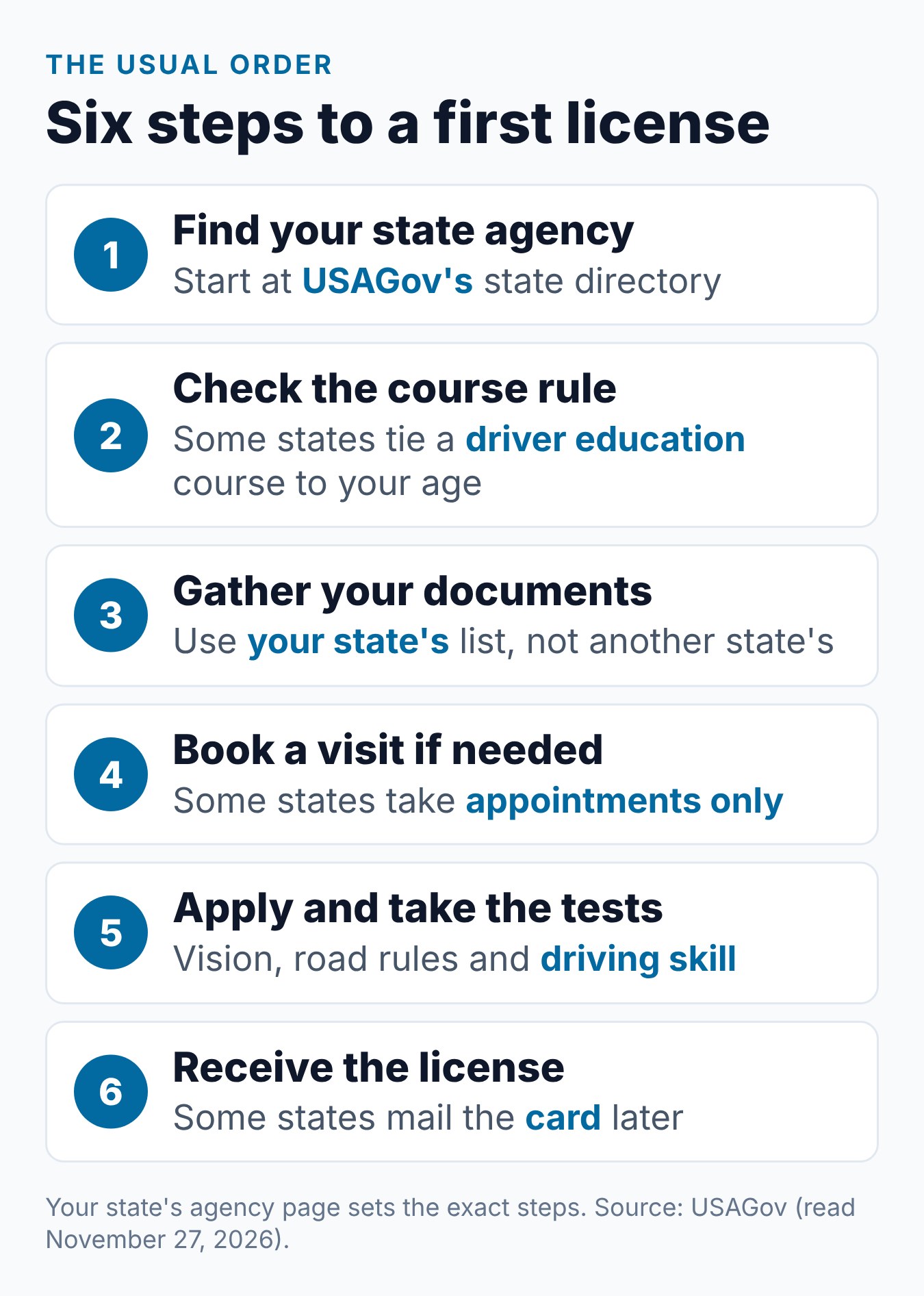
Most first-time applicants work through six stages. Treat this as a map, not a rule. Your state’s page decides which stages apply to you and in what order.
1. Find your state’s licensing agency.
Start at USAGov’s State Motor Vehicle Services page and pick your state. Follow the link to the agency that handles driver licenses.
2. Check whether you need driver education first. Some states tie a course to your age.
Look for a driver education or new driver section on the agency’s page.
3. Gather the documents your state lists. States ask for proof of who you are and often much more.
Use the agency’s own list, not a list from another state.
4. Make an appointment if your state uses them. Some states book every office visit ahead of time.
For how booking works, see Drivers License Appointment: How to Book One in Your State.
5. Apply and take the tests your state requires. Tests often cover vision, road rules and driving skill.
Your state’s page says which tests you need and where you may take them.
6. Receive your license. Some states give you a paper license first and mail the card later.
Check your state’s page for how it delivers the card.
What each state asks for at step 3 is a topic of its own. See Drivers License Requirements by State: What You Need.
How to Find Your State’s Steps
Your state’s licensing agency is the only page that can tell you its rules. Getting to the right page takes a minute.
Start at the USAGov directory and pick your state or territory. Then look for words such as “new driver,” “first license” or “apply for a license.”
FLHSMV’s Locations page notes that all 50 states and Washington, DC have websites with motor vehicle information. It also says some states have separate agencies for driver licensing and vehicle registration. Make sure the page you land on handles licenses.
When you find the right page, check four things:
- the age groups it describes and which one you are in
- any course you must finish before you apply
- the document list for a first license
- where the vision, knowledge and driving tests happen
Write the answers down before you book anything. It keeps you from doing a step out of order.
The Steps in Texas
Texas is the state this site covers in detail. Every step below comes from the DPS Apply for a Texas Driver License page, read on November 27, 2026.
DPS sorts the process into three stages.
Stage 1: Gather Your Papers and Finish Earlier Steps
DPS’s first stage is about what to bring and what to finish before the office visit. It lists proof of identity, proof of Texas residency, a Social Security number and proof of insurance, among other items.
DPS also suggests its REAL ID Document Check tool, which asks questions and builds a personal list. For each document in detail, see What Documents Do You Need for Your First Texas Driver’s License?
If you are not a U.S. citizen, Texas asks for proof of lawful presence. That topic is covered in Texas Driver’s License for Immigrants and Non-Citizens.
Texas: The Course Step by Age
Whether you need a course depends on your age. Texas law and DPS sort applicants like this:
| Your age | Course before a first Texas license | Where this comes from |
|---|---|---|
| 15 to 17 | A driver education course approved by TDLR | Transportation Code 521.204 |
| 18 through 24 | A six-hour adult driver education course | DPS Apply page; Transportation Code 521.1601 |
| 18 or older, moving in with a valid out-of-state license | DPS waives the adult course | DPS Apply page |
| 25 and older | No driver education requirement | DPS Apply page |
The adult course must be approved by the Texas Department of Licensing and Regulation (TDLR). TDLR’s Do I Need Driver Education page asks your age and whether you hold another state’s license.
The adult course is not defensive driving. Defensive driving is a separate course used for tickets or insurance.
Stage 2: Visit a DPS Office
Next, DPS says to book an appointment at a driver license office. At the office, DPS lists these steps:
- turn in the application, which you can fill out online or at the office
- show your documents to the license and permit specialist
- give your signature and thumbprints
- have your picture taken
- pay the application fee
- pass the vision exam
- pass the knowledge test and a driving skills test
DPS’s Driver License Fees page lists $33 for a new license at ages 18 to 84.
Texas: Where the Tests Can Happen
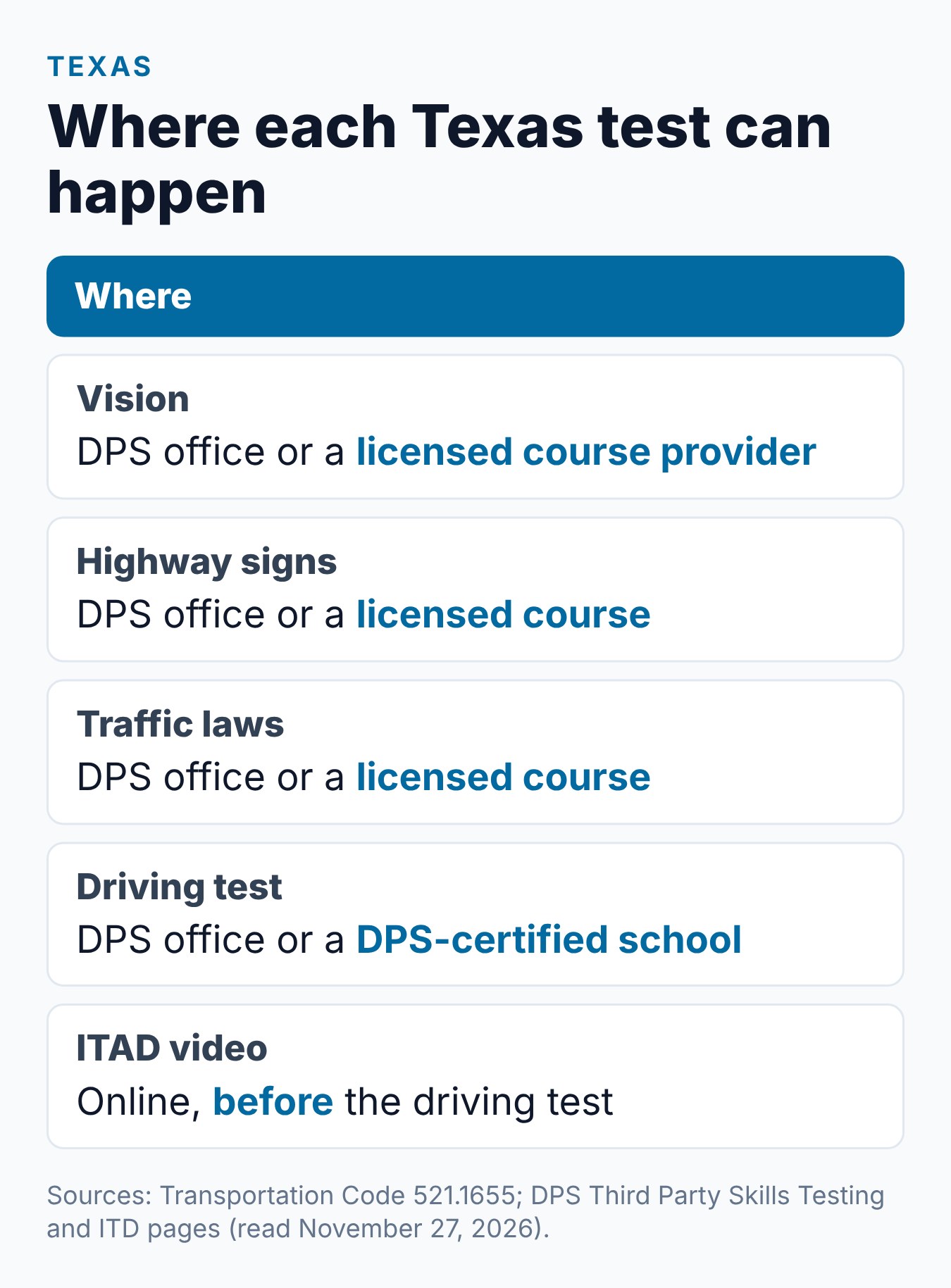
DPS says you may complete the testing at a DPS office or with a third-party provider.
Knowledge parts. Transportation Code Sec. 521.1655 lets a licensed driver education provider give its own students the highway sign and traffic law parts of the exam. An in-person or online provider may also give the vision part. A test given this way counts for those parts.
Driving test. DPS runs a Third Party Skills Testing program. It lets driver education schools that DPS has certified give the driving test for a Class C license.
DPS says it does not regulate what those schools charge for the test.
Impact Texas Drivers. DPS lists an Impact Texas Drivers (ITD) certificate for anyone taking a driving test. Adults watch Impact Texas Adult Drivers (ITAD), a one-hour video on distracted driving, at impacttexasdrivers.dps.texas.gov.
The certificate must be dated within 90 days of the driving test.
For what happens during the road test, see Texas Driving Test: What to Expect and How to Prepare.
Stage 3: Temporary License and Card
Once DPS issues the license, you get a temporary license that lets you drive legally. DPS asks you to check it for mistakes before you leave.
DPS says the card typically arrives by mail within 2 to 3 weeks.
For the whole Texas path at 18 in one place, see How to Get a Texas Driver’s License at 18: The Complete Step-by-Step Guide. To book the DPS visit, see How to Book a Texas DPS Appointment for Your First Driver’s License.
Florida in Brief
In Florida, FLHSMV handles driver licenses.
FLHSMV’s Class E Knowledge Exam and Driving Skills Test page lists these points:
- A course first. Anyone never issued a license in any state or country must finish a Traffic Law and Substance Abuse Education (TLSAE) course before applying.
- The knowledge exam. It has 50 multiple-choice questions, and you pass with 40 correct, or 80 percent. FLHSMV says it is given in English only.
- The driving test. You must hold a learner’s license for 12 months or be 18 years old to qualify for the license.
Teens in Florida start with a learner’s license. See How to Get a Florida Learner’s Permit Step by Step.
Texas and Florida Side by Side
This table shows why the same question gets two answers. Each cell comes from the official pages read for this guide.
| Point | Texas | Florida |
|---|---|---|
| Licensing agency | Department of Public Safety (DPS) | Dept. of Highway Safety and Motor Vehicles (FLHSMV) |
| Course for a first adult license | Six-hour adult course at ages 18 through 24 | TLSAE course if never licensed anywhere |
| Teen learner license | Ages 15 to 17 (Transportation Code 521.222) | At least 15 years old |
| Who else may give the driving test | DPS-certified driver education schools | A driver license exam provider or third-party administrator |
What the Official Pages Show
For this guide, USAGov, Texas DPS, TDLR, the Texas Transportation Code and FLHSMV pages were read on November 27, 2026. The question was how a first license works when the reader’s state is unknown.
What came through clearly:
- No national process. USAGov sends every reader to a state agency and says the state decides the process.
- Order is similar, details are not. Both Texas and Florida put a course, documents and tests before the license, but each sets different rules.
- Third parties help with tests. Both states let approved outside providers give some tests, under state rules.
One FLHSMV page for first-time drivers that older guides link to returned “Page Not Found” during this review. The Class E exam page above was used instead.
Common Mistakes to Avoid
These come from the official pages above:
- Following another state’s steps. Each state sets its own process.
- Booking before the course. In Texas, ages 18 through 24 need the adult course for a first license.
- Confusing the courses. The Texas adult course is not defensive driving.
- Letting the ITAD certificate expire. In Texas it must be dated within 90 days of the driving test.
- Leaving with a wrong temporary license. DPS asks you to check it before you go.
- Using a vehicle office. Make sure the agency you found issues licenses.
How Requirements Can Vary
Texas driver license rules come from state law, Texas DPS rules and TDLR rules, and they apply statewide. What you need still depends on your age, whether you hold a license from another state, and which tests you have already passed.
Laws, fees and office procedures can change. Check the Texas DPS and TDLR websites for current rules before you book an appointment or enroll in a course.
Frequently Asked Questions
How do you get a drivers license in the United States?
You apply to the licensing agency of your state and follow its steps. USAGov’s State Motor Vehicle Services page links to each state’s agency.
Is there a federal drivers license?
No federal license is listed by USAGov. It describes driver’s licenses as state-issued and says your state decides the process.
What is the usual order of steps?
Find your agency, check for a required course, gather documents, book if needed, take the tests and receive the license. Your state’s page sets the exact order.
Do adults need driver education in Texas?
Yes, at ages 18 through 24 for a first Texas license. DPS lists no driver education requirement at 25 and older.
Can I take the Texas driving test somewhere other than DPS?
Yes. DPS lets driver education schools it has certified give the driving test for a Class C license.
How long until the Texas card arrives?
DPS says the card typically arrives by mail within 2 to 3 weeks. You drive on the temporary license until then.
What do first-time Florida drivers take first?
FLHSMV says anyone never licensed in any state or country must finish a TLSAE course before applying.
Conclusion
How to get a drivers license depends on your state, because each state issues its own and sets the steps. Start at USAGov, find your state’s agency and follow its list in order. In Texas, DPS lays out three stages, and ages 18 through 24 start with an adult course. If that is you, begin with texas adult drivers ed.
Related Articles
- How to Get a Texas Driver’s License at 18: The Complete Step-by-Step Guide
- Drivers License Requirements by State: What You Need
- Drivers License Appointment: How to Book One in Your State
- Texas Drivers License: Types, Ages, Cost and How to Apply
- Texas Drivers License Office: Where to Get Your License
Sources
- Texas DPS — Apply for a Texas Driver License
- TDLR — Do I Need Driver Education?
- Texas Transportation Code Chapter 521 (PDF)
- USAGov — State Motor Vehicle Services
- USAGov — How to Get a REAL ID
- Texas Transportation Code Chapter 521 (HTML)
- Texas DPS — Driver License Fees
- Texas DPS — Third Party Skills Testing Program
- Texas DPS — Impact Texas Drivers (ITD) Program
- Impact Texas Drivers
- FLHSMV — Class E Knowledge Exam and Driving Skills Test
- FLHSMV — Locations
Billy Forte is the owner of Driving Logic, a state-approved driver improvement course provider serving Texas and other U.S. states.
This article is general information, not legal advice. Texas driver license and driver education rules are set by Texas law, Texas DPS and TDLR, and they can change. Check the official DPS and TDLR websites for current requirements before you apply.