
Updated November 2026 · Reviewed by Billy Forte
A Texas drivers license is issued by the Texas Department of Public Safety (DPS), and most first-time adult drivers get a Class C license by applying at a DPS driver license office. A new Class C license costs $33 for ages 18 to 84 and expires after eight years. First-time applicants who are 18 through 24 must also finish a six-hour adult driver education course.
Key Facts
- Who issues it: the Texas Department of Public Safety, not a motor vehicle department. See who issues the license.
- The usual class: Class C covers cars and other vehicles that are not in Class A or Class B. See the license classes.
- Age rules: driver education depends on whether you are under 18, 18 through 24, or 25 and older. See what each age group needs.
- The fee: $33 for a new license at ages 18 to 84, with a $1 administrative fee included. See the fee table.
- How to apply: documents, an appointment, form DL-14A, a photo, the fee and three exams. See the short list.
- One card only: you may hold a driver license or an ID card, but not both. See license or ID.
Who Issues a Texas Drivers License
The Texas driver license law is Chapter 521 of the Transportation Code. In that chapter, “Department” means the Department of Public Safety, under Section 521.001.
The same section says a driver’s license is an authorization issued by the department to operate a motor vehicle. So DPS is the agency that issues the card and gives the tests at its offices.
Many people search for the DMV, but in Texas the Department of Public Safety issues driver licenses. The Texas Department of Motor Vehicles is a different agency, and it handles vehicle registration.
DPS makes that split clear on its Moving to Texas page. It tells new residents to register their vehicles with the Texas Department of Motor Vehicles before they apply to DPS for a license.
Who Needs One
The rule is one sentence long. Under Section 521.021, a person may not operate a motor vehicle on a highway in this state unless the person holds a driver’s license, or the law expressly exempts them.
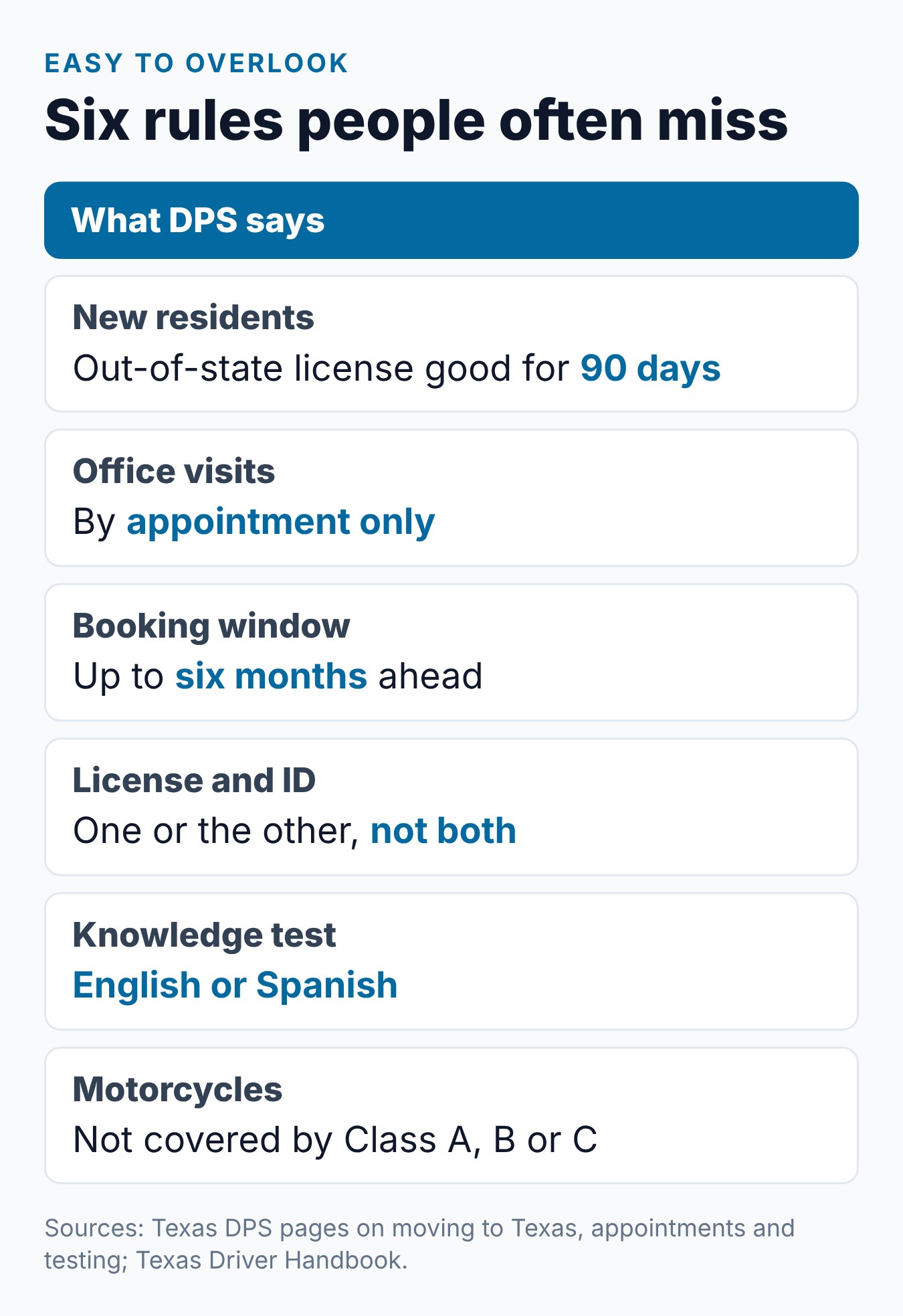
New residents get a short grace period. DPS says you can legally drive with a valid, unexpired driver license from another U.S. state for up to 90 days after moving to Texas.
After that, a new resident needs a Texas license. Our guide for new Texas residents covers that switch.
One Card, Three Spellings
You will see the name written three ways. The statute says “driver’s license,” DPS pages say “driver license,” and most people type “drivers license.”
All three mean the same card. Whether you search Texas drivers license or drivers license Texas, the agency and the rules below are the same.
Types of Texas Driver Licenses
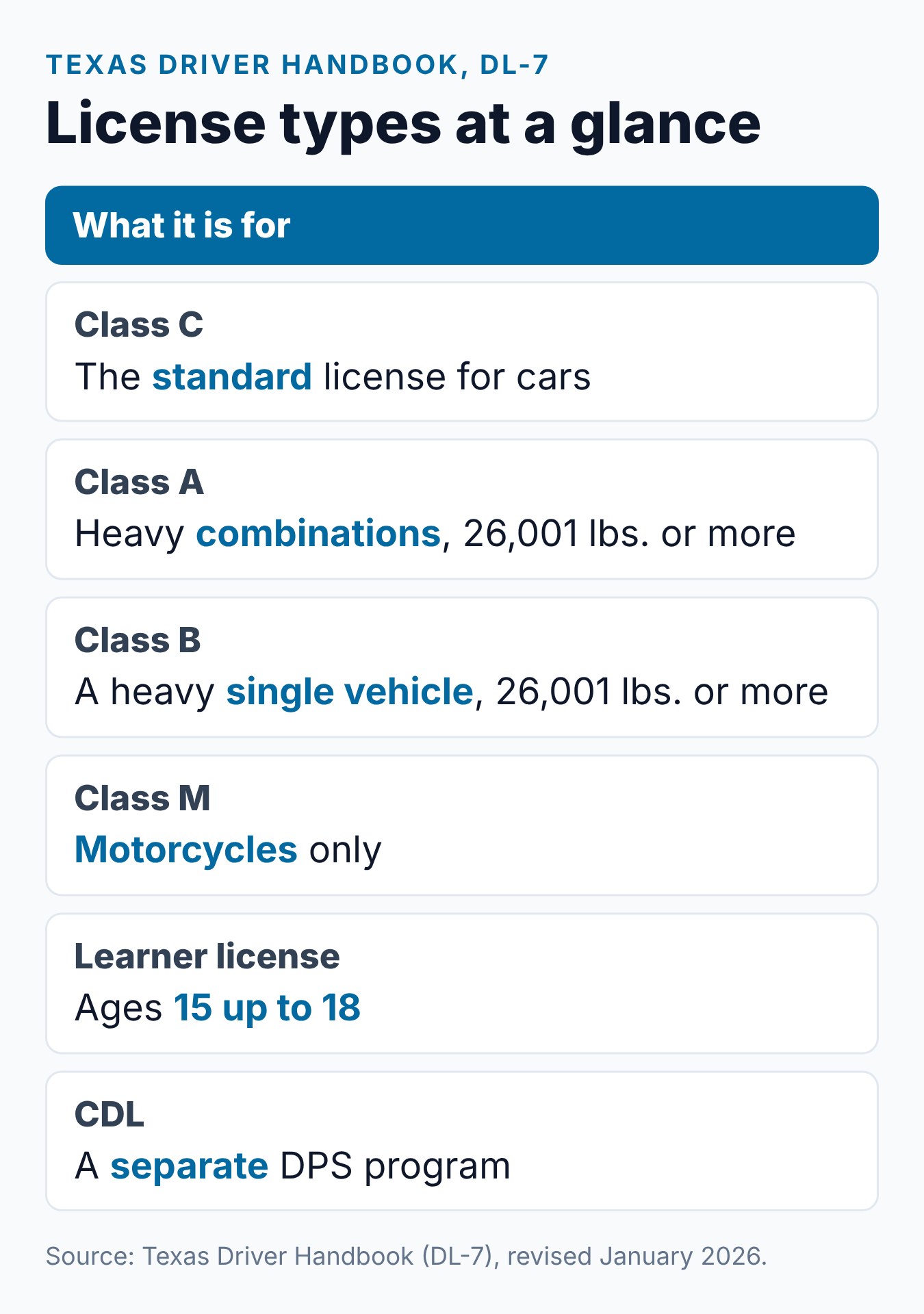
The Texas Driver Handbook (DL-7, revised January 2026) lists the license types. For most people the answer is Class C.
- Class C: the standard license. It covers a single vehicle or a combination of vehicles that is not in Class A or Class B.
- Class A: for heavy combinations with a gross combination weight rating of 26,001 lbs. or more, when the towed vehicle is rated over 10,000 lbs.
- Class B: for a single vehicle with a gross vehicle weight rating of 26,001 lbs. or more.
- Class M: the motorcycle license. The handbook says you must pass a state approved motorcycle operator training course before you apply.
- Learner license: for student drivers ages 15 up to 18. It expires on the 18th birthday.
One line in the handbook surprises people. A Class A, Class B or Class C license does not permit a person to drive a motorcycle.
Commercial driver licenses are a separate DPS program. If you plan to drive a commercial vehicle for work, ask DPS about a CDL.
What About Adults Who Want to Practice?
Adults do not get a learner license. The handbook says applicants 18 and older who wish to legally practice driving are issued a Class C license with the same restrictions as a learner license.
That means an adult can go straight to the license process. Our guide on getting a license at 18 without a permit explains how that works.
What Each Age Group Needs
Texas sorts first-time applicants by age. The driver education rule is different in each group.
| Your age | Driver education | What else to know |
|---|---|---|
| Under 18 | A full driver education course | A learner license held for at least six months before a provisional license |
| 18 through 24 | A six-hour adult driver education course | Required for a first Texas driver license |
| 25 and older | None required | The DPS steps and exams still apply |
| New resident, 18 or older | Waived | Only if you surrender a valid, unexpired license from another state |
The adult rows come from the DPS page Apply for a Texas Driver License. The teen row comes from TDLR’s page and the Graduated Driver License section of the handbook.
TDLR, the Texas Department of Licensing and Regulation, says the same thing on its page Do I Need to Take Driver Education in Texas?. People over 25 are not required to take a driver education course to apply.
The Six-Hour Adult Course
If you are 18 through 24 and this is your first Texas license, the course is on your list. DPS names it “a six-hour adult Driver Education course.”
It is a driver education course, not defensive driving. TDLR licenses the providers that teach it, and DPS lists it with the items to gather before you apply.
Finish the course before your office visit. Our adult driver education course guide explains the course and its certificate.
Under 18 and 25 or Older
Teens follow the Graduated Driver License program. They start with a learner license, hold it at least six months, and then move to a provisional license.
That path has its own guide. See how to get a Texas driver’s license at 16 for the teen steps.
At 25 and older there is no driver education requirement. The rest of the process is covered in our guide to a first license over 25.
What a Texas Drivers License Costs
DPS posts every amount on its Driver License Fees page. Each fee below includes a $1 administrative fee.
| Who and what | DPS fee | When it expires |
|---|---|---|
| Under 18, a new license | $16 | On your 18th birthday |
| Ages 18 to 84, a new license or a renewal | $33 | After eight years |
| Age 85 and older | $9 | After two years |
| Under 18, a learner license | $16 | On your 18th birthday |
| A replacement license | $11 | The expiration date does not change |
For most adults the number to remember is $33. DPS says its offices accept credit cards, cash, checks and money orders.
Course fees and third-party test fees are separate from the DPS fee. Each provider sets its own, so ask before you pay.
Our article on how much a first Texas driver’s license costs adds up the full cost. It also covers when you pay again.
How to Apply, in Short
DPS lays out the process in three steps on its application page. Here is the short version for an adult.
- Gather your documents. DPS lists proof of U.S. citizenship or lawful presence, Texas residency, identity, and your Social Security number.
- Show insurance. Bring proof of insurance for each vehicle you own, or a statement that you do not own one.
- Book an appointment. DPS driver license offices work by appointment.
- Complete the application. The form is DL-14A, and DPS says it is available online or at the office.
- Give biometrics and a photo. DPS takes your signature and thumbprints, then your picture.
- Pay the fee. See the table above.
- Pass three exams. They are the vision exam, the written knowledge test and the driving skills test.
DPS says you may complete the testing requirements at the DPS office or with a third-party provider. For the driving skills test you also need an Impact Texas Drivers certificate dated within 90 days.
When the license is issued, you leave with a temporary license. DPS says the card will typically arrive by mail within 2-3 weeks.
Where the Details Live
This page is the overview. Each step has its own guide with the full detail.
- The full walk-through: How to Get a Texas Driver’s License at 18 is the step-by-step guide for a first license at 18.
- The paperwork: see what documents you need for your first license.
- The checklist: see the first-time requirements to check before your visit.
Appointments: Where and When
DPS offers all in-office driver license services by appointment only. That is the first line of its Driver License Services – Appointments page.
You book at txdpsscheduler.com. DPS says appointments may be scheduled up to six months in advance.
If your local office is not listed, DPS says it has no open appointments right now. Our guide on how to book a Texas DPS appointment covers what to try next.
License or ID Card, Not Both
Texas issues a driver license and an ID card, and you can hold only one. DPS says REAL ID and Texas law only permit a person to hold a driver license or identification card, but not both.
The law behind it is Section 521.183 of the Transportation Code. A person is not entitled to receive a driver’s license until they surrender each Texas ID card they hold.
So if you have a Texas ID now, plan to turn it in when you apply. Our comparison of the Texas ID card and the driver’s license explains which card fits which need.
Tests and Language
The knowledge test comes in two languages. DPS says it can only offer the driver license knowledge test in English or Spanish, on its page Testing in Other Languages.
There is one limit in either language. You must be able to understand road signs written in English to pass.
The driving test is a different matter. DPS says a driving test in Spanish may not be available at every driver license office.
Our guide on the Texas driving test covers what to expect on test day.
Renewing or Replacing a License
You may not need an office visit for these. DPS lists renewing a license, changing an address and other services on its Online Services page.
Start there before you book an appointment. The page shows which services you can do online and links to each one.
DPS adds a warning on that page. It names its official partner sites and notes that other websites not affiliated with DPS may offer these services for a higher cost.
What We Found on the Official Pages
We read the DPS pages, the TDLR page, Chapter 521 and the handbook on November 26, 2026. Three things stood out.
- The class does not change the price. The handbook’s tables for Class A, Class B and Class C each show the same adult fee, $32 plus a $1 fee, and the same eight-year term.
- The age rule appears in three places. The DPS application page, the TDLR page and the handbook’s class tables all tie driver education to ages 18 through 24.
- The name is never the same twice. The statute, DPS and searchers each spell the card’s name a different way, which makes official pages harder to find.
The third point is a practical one. If a search does not bring up a DPS page, try the DPS spelling, “driver license.”
Common Mistakes to Avoid
Each of these comes from a rule on an official page.
- Looking for a DMV office. Driver licenses come from DPS, so book with DPS.
- Skipping the course at 18 through 24. DPS lists the six-hour adult course for a first Texas license in that age group.
- Walking in without an appointment. All in-office services are by appointment only.
- Keeping a Texas ID. You must surrender it when you get a license.
- Letting the 90 days run out. A new resident’s out-of-state license only covers the first 90 days.
- Assuming a car license covers a motorcycle. It does not, and Class M is separate.
How Requirements Can Vary
Texas driver license rules come from state law, Texas DPS rules and TDLR rules, and they apply statewide. What you need still depends on your age, whether you hold a license from another state, and which tests you have already passed.
Laws, fees and office procedures can change. Check the Texas DPS and TDLR websites for current rules before you book an appointment or enroll in a course.
Frequently Asked Questions
Who issues a Texas driver license?
The Texas Department of Public Safety issues it. In the driver license law, “Department” means the Department of Public Safety.
Which class of license do most drivers need?
Most drivers need Class C. It is the standard license for vehicles that are not in Class A or Class B.
How much is a Texas driver license?
A new license costs $33 for ages 18 to 84 and expires after eight years. The amount includes a $1 administrative fee.
Do I need driver education to get a license?
It depends on your age. First-time applicants 18 through 24 need a six-hour adult course, and people 25 and older have no driver education requirement.
Can I have a Texas driver license and a Texas ID card?
No. DPS says a person may hold a driver license or an ID card, but not both.
How long can I drive on an out-of-state license?
DPS says up to 90 days after moving to Texas. The license must be valid and unexpired.
Is the knowledge test given in Spanish?
Yes. DPS offers the driver license knowledge test in English or Spanish, and you must understand road signs written in English.
How long does the card take to arrive?
DPS says the card will typically arrive by mail within 2-3 weeks. You get a temporary license at the office to use while you wait.
Conclusion
A Texas driver license comes from DPS, and most drivers need Class C. The fee is $33 for ages 18 to 84, and the card lasts eight years. Your age decides whether you need driver education first. If you are 18 through 24, start with texas adult drivers ed, then book your DPS appointment.
Related Articles
- How to Get a Texas Driver’s License at 18: The Complete Step-by-Step Guide
- How Much Does It Cost to Get Your First Texas Driver’s License?
- Texas Driver’s License Requirements: Everything You Need Before Your DPS Appointment
- Texas Driver’s License vs. Texas ID Card: Which One Do You Need?
- Texas Drivers License Office: Where to Get Your License
- How to Get a Drivers License: Steps in the United States
Sources
- Texas DPS — Apply for a Texas Driver License
- TDLR — Do I Need Driver Education?
- Texas Transportation Code Chapter 521 (PDF)
- Texas Transportation Code Chapter 521 (web page)
- Texas DPS — Driver License Fees
- Texas DPS — Texas Driver Handbook, DL-7, revised January 2026 (PDF)
- Texas DPS — Moving to Texas: A Guide to Driver Licenses and IDs
- Texas DPS — Driver License Services – Appointments
- Texas DPS — Testing in Other Languages
- Texas DPS — Online Services
Billy Forte is the owner of Driving Logic, a state-approved driver improvement course provider serving Texas and other U.S. states.
This article is general information, not legal advice. Texas driver license and driver education rules are set by Texas law, Texas DPS and TDLR, and they can change. Check the official DPS and TDLR websites for current requirements before you apply.