
Updated June 2026 · Reviewed by Billy Forte
After a Texas speeding ticket you have three main options: pay it and accept a conviction, contest it in court by pleading not guilty, or — if eligible and the court approves — request a Driver Safety Course to have it dismissed under CCP Art. 45.0511. Paying is fastest but records a conviction; contesting can lead to dismissal, reduction, or a finding of guilt; the course route keeps an eligible ticket off your record entirely. Deferred disposition is sometimes available too, so confirm what your court allows before the appearance date, because the DSC request must come before that date.
Applies to Texas. Court rules and deadlines vary by county.
Key Facts
- Pay: A guilty or no-contest plea records a conviction and ends the case quickly.
- Contest: Pleading not guilty leads to a hearing where the ticket may be dismissed, reduced, or upheld.
- Driver Safety Course: For an eligible ticket, completing the course results in dismissal with no conviction.
- Request before the appearance date: The DSC option must be requested before the appearance date (CCP Art. 45.0511).
- Deferred disposition: A probation-style alternative under CCP Art. 45.051 that some courts offer.
- No points either way: Texas has no points system; the stakes are the conviction and your insurance.
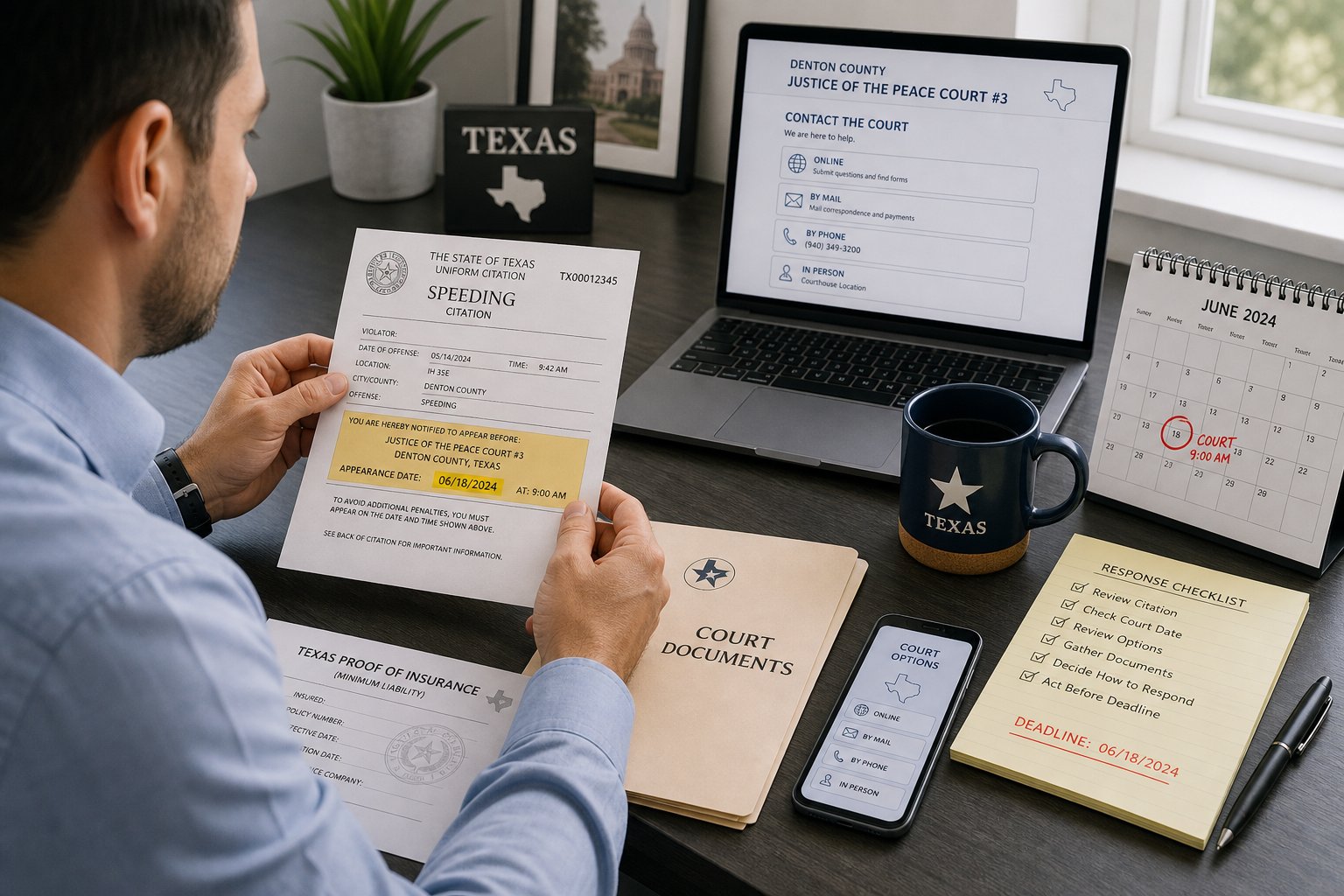
What To Do Right After You Get A Texas Speeding Ticket
First, do not ignore the ticket. In Texas, signing the citation is only a promise to appear. It is not an admission of guilt.
Next, find the appearance date on the citation. You must contact the court listed on the ticket by that date. Courts may let you respond online, by mail, by phone, or in person.
Then confirm the right court. The ticket itself usually lists it. If you need license or record details, you can also check with Texas DPS.
A few basic steps matter right away:
- Read the citation for the court name and deadline
- Keep a copy of the ticket
- Check whether the charge is a moving violation for speeding
- Gather your proof of insurance
- Decide which option you want to ask the court about
If you may want ticket dismissal, act fast. For a DSC request, timing is critical. You must ask the court before the appearance date on the citation. That deadline matters.
Also, do not assume every court uses the same process. Fine amounts, forms, and filing steps can differ by city and county. So the safest move is to contact the exact court on your ticket right away and ask what options they allow for your case.
The Main Texas Speeding Ticket Options Explained
A Texas traffic ticket usually gives you three practical paths: pay it, contest it, or ask for a dismissal option like DSC or deferred disposition. The best choice depends on your record, your speed, your insurance risk, and whether you qualify for dismissal.
Paying is the fastest path, but it usually ends with a conviction. Contesting takes more time, but it may help if the facts are weak or the court offers a better outcome. And if you are eligible, a court-approved dismissal option can protect your record.
Because courts handle these cases directly, you must make your choice with the court on the citation. If you miss the deadline, the problem can get worse fast.
Pay The Ticket
Paying the ticket usually means you plead guilty or no contest. In most cases, that leads to a conviction recorded with no further action needed beyond payment.
That may seem easiest. But a conviction can affect more than the fine. It can show on your driving record, raise insurance costs, and add risk if you already have other violations.
Texas courts set their own totals, so costs vary. You may see a fine plus court costs and other fees. The total depends on the court, county, and speed involved.
Paying often makes the most sense when:
- You do not qualify for DSC
- You do not want to appear in court
- The record impact is not a major concern
- You want the case finished quickly
Contest The Ticket Or Ask For Deferred Disposition
If you want to contest speeding ticket Texas charges, you generally plead not guilty and ask for a court date. You can present your side to a judge, and in some courts you may also speak with a prosecutor before trial.
A contested case can end in different ways. The ticket may be dismissed, reduced, or upheld. There is no guaranteed result.
You can also ask about deferred disposition. This is different from a DSC. With deferred disposition, you usually plead guilty or no contest, but the court delays final judgment and gives you conditions to complete. If you meet the terms, the case may be dismissed. If not, a conviction can be entered.
Courts may require things like:
- No new tickets for a set period
- Payment of fees and court costs
- Extra documents or, in some cases, a course
Deferred disposition is often worth asking about if you are not eligible for a DSC or if the court will not grant DSC for your citation.
When You Can Use A Driving Safety Course For Dismissal
A Driving Safety Course and a defensive driving course mean the same thing in Texas for ticket dismissal. It is the same TDLR-approved 6-hour program. The key point is this: you must request court permission before the appearance date on your citation.
This option can be one of the best texas speeding ticket options if you qualify and want to avoid a conviction. Under Texas Code of Criminal Procedure Art. 45.0511, many drivers can ask for dismissal through a Driver Safety Course, often called DSC.
Common eligibility rules include:
- You have not used a DSC for dismissal in the last 12 months
- You have a valid non-commercial Texas license
- You did not hold a CDL at the time of the offense
- You have proof of insurance
- The speed was within the court’s allowed range
Texas courts often deny DSC if the speeding charge was too high, such as over the usual limit allowed by statute or court practice. Many courts use the common rule of not more than about 24–25 mph over the limit and under 95 mph, but you must confirm this with your court.
If the court grants the request, you usually must:
- Enter a plea as directed by the court
- Pay court or administrative fees
- Complete the course by the court deadline
- Turn in your completion certificate and any required driving record
Make sure the course is approved by the Texas Department of Licensing and Regulation. TDLR approves the course, not TxDPS or TxDMV. If you need a course provider, you can take a Texas Driver Safety Course with Driving Logic, which is built for busy drivers who want a simple online option.
Costs, Consequences, And What A Conviction Can Affect
A speeding ticket can cost more than the amount on the court notice. The full impact may include the fine, court costs, course fees, and later insurance increases.
Fine totals vary by court, county, and speed. You should always verify the exact amount with the court on your citation. For a Driver Safety Course, Texas law sets a minimum course fee of $25 plus a $3 materials fee under the Texas Education Code, but court fees for dismissal are separate and also vary.
Beyond the direct cost, a conviction can affect your record. That may matter if you already have other moving violations. It can also affect your insurance rate.
Possible consequences include:
- A conviction on your driving record
- Higher insurance premiums
- More risk if you already have multiple violations
- Extra trouble if you miss deadlines or court orders
And if you fail to respond by the appearance date, the court may take further action. Some courts can issue a warrant or add extra penalties for noncompliance. So even if you are unsure what to do, contact the court.
If money is a problem, ask the court about options. Some courts may allow:
- Payment plans
- Community service
- Reduction or waiver requests based on ability to pay
For license questions and records, Texas DPS is the right state agency. For course approval, use the Texas Department of Licensing and Regulation.
How To Choose The Best Option For Your Situation
The best choice depends on your record, your eligibility, and the long-term cost. In many cases, avoiding a conviction matters more than saving a little money up front.
If you have a clean record and meet the rules, a DSC is often the first option to check. It can lead to ticket dismissal if you complete everything on time. But remember, you must ask the court before the appearance date. Contact the court as soon as you can.
If you do not qualify for DSC, ask whether deferred disposition is available. That may also help you avoid a conviction if you meet the court’s terms.
If you believe the ticket is wrong, or the facts are weak, contesting may be worth the effort. Courts can dismiss, reduce, or uphold the charge, so weigh the time and risk.
Paying may still be the right move when speed and convenience matter most. But it is often the least protective choice for your record.
A simple way to compare your options:
- Pay if you want the fastest closeout and accept the conviction risk
- Contest if you have a factual defense or want the court to review the case
- Ask for DSC if you qualify and want the clearest dismissal path
- Ask for deferred disposition if DSC is not available
FAQ
What are my options for a Texas speeding ticket?
Pay and accept the conviction, contest it in court, or request a Driver Safety Course for dismissal if eligible. Some courts also offer deferred disposition as a probation-style alternative.
Which option keeps it off my record?
A Driver Safety Course does, for an eligible ticket the court approves — completing it results in dismissal with no conviction. Paying records a conviction; contesting depends on the outcome.
What is the deadline to choose the course?
You must request the Driver Safety Course before the appearance date on your citation. After that date, the option may no longer be available.
Is contesting worth it?
It can be if you have a real defense, since the ticket could be dismissed or reduced — but you risk a finding of guilt. For many eligible drivers, the course is a more predictable way to avoid a conviction.
Conclusion
The three options trade speed, risk, and outcome differently: paying is quick but permanent, contesting is uncertain but can clear you, and the Driver Safety Course is the predictable path to keeping an eligible ticket off your record. Since Texas has no points, every option really turns on whether a conviction lands. Decide before the appearance date, because that deadline quietly closes the course option if you wait.
If you choose the course route and the court approves, you can complete a TDLR-approved Texas Driver Safety Course online.
Related Articles
- Texas Speeding Ticket: Costs, Record Impact, and What to Know
- Can You Contest a Texas Speeding Ticket in Court?
- What Is Deferred Disposition in Texas? How It Compares to Defensive Driving
- Texas Defensive Driving for Ticket Dismissal: The Complete Guide
Sources
Billy Forte is the owner of Driving Logic, a state-approved driver safety and defensive driving course provider serving Texas and other U.S. states. Driving Logic offers online driver safety, defensive driving, and traffic-ticket courses for drivers handling court, license, and insurance-related requirements.
This article is general information, not legal advice. Texas court rules, TDLR requirements, deadlines, eligibility, and case facts can differ by county and court. Use official Texas court and state sources for current requirements, and consult a qualified Texas attorney for legal guidance specific to your situation.