
Updated October 2026 · Reviewed by Billy Forte
How long is the Florida DETS course? It must last at least 6 hours, and most teens split that time into two or three sessions before taking the 40-question final exam. Online courses track your time, so you cannot finish faster than the 6-hour minimum.
Key Facts
- Minimum length: At least 6 hours, set by FLHSMV. See the time rule.
- Sessions: Many courses save progress, so you can stop and come back. See sample schedules.
- Time tracking: Online courses use timers on each lesson. See how time is tracked.
- Final exam: 40 questions at the end, with 80% to pass. See the exam step.
- Big picture: After DETS, a teen holds a learner’s license for 12 months or until 18 before a full license. See the full timeline.
How Long Is the Florida DETS Course? The Short Answer
FLHSMV says a DETS course must be at least 6 hours long. You can read that rule on the FLHSMV DETS course page. Some providers may build a longer course, but none can be shorter.
That is 2 hours longer than the old 4-hour TLSAE course that Florida teens took before August 1, 2025. The extra time comes from the content standard. DETS must meet or exceed Florida’s Department of Education standards for Driver Education/Traffic Safety–Classroom (course 1900300).
Six hours of lessons does not mean six hours in one sitting. Most families split it up, which helps teens remember more.
How the 6 Hours Are Structured
Each approved provider writes its own lessons, so the exact order differs. But the 1900300 standards set the topics, so most courses cover the same ground. A typical DETS course moves through units like these:
| Unit | What it covers |
|---|---|
| Traffic laws and signs | Florida rules of the road, signs, signals, and pavement markings |
| Sharing the road | Right-of-way, trucks, buses, trains, bikes, and pedestrians |
| Defensive driving | Scanning, following distance, and spotting hazards early |
| Impaired driving | Alcohol, drugs, Zero Tolerance, and Implied Consent laws |
| Distractions and fatigue | Phones, passengers, and drowsy driving |
| Teen license rules | Florida’s graduated driver license limits for young drivers |
| Emergencies | What to do after a crash and how to drive in bad weather |
| Final exam | 40 questions on the course material |
Most lessons mix reading, short videos, and quick quiz questions. The quizzes are practice, and the final exam is the one that counts.
Why Six Hours Instead of Four
The old TLSAE course focused mainly on traffic law and impaired driving. DETS has to cover the wider list of topics in Florida’s school driver education standards.
That list adds skills a brand-new driver needs, like scanning ahead, keeping space around the car, and handling emergencies. It also covers the teen license rules that apply after the learner’s license. More topics need more time, so the minimum went from 4 hours to 6.
How the Time Is Tracked
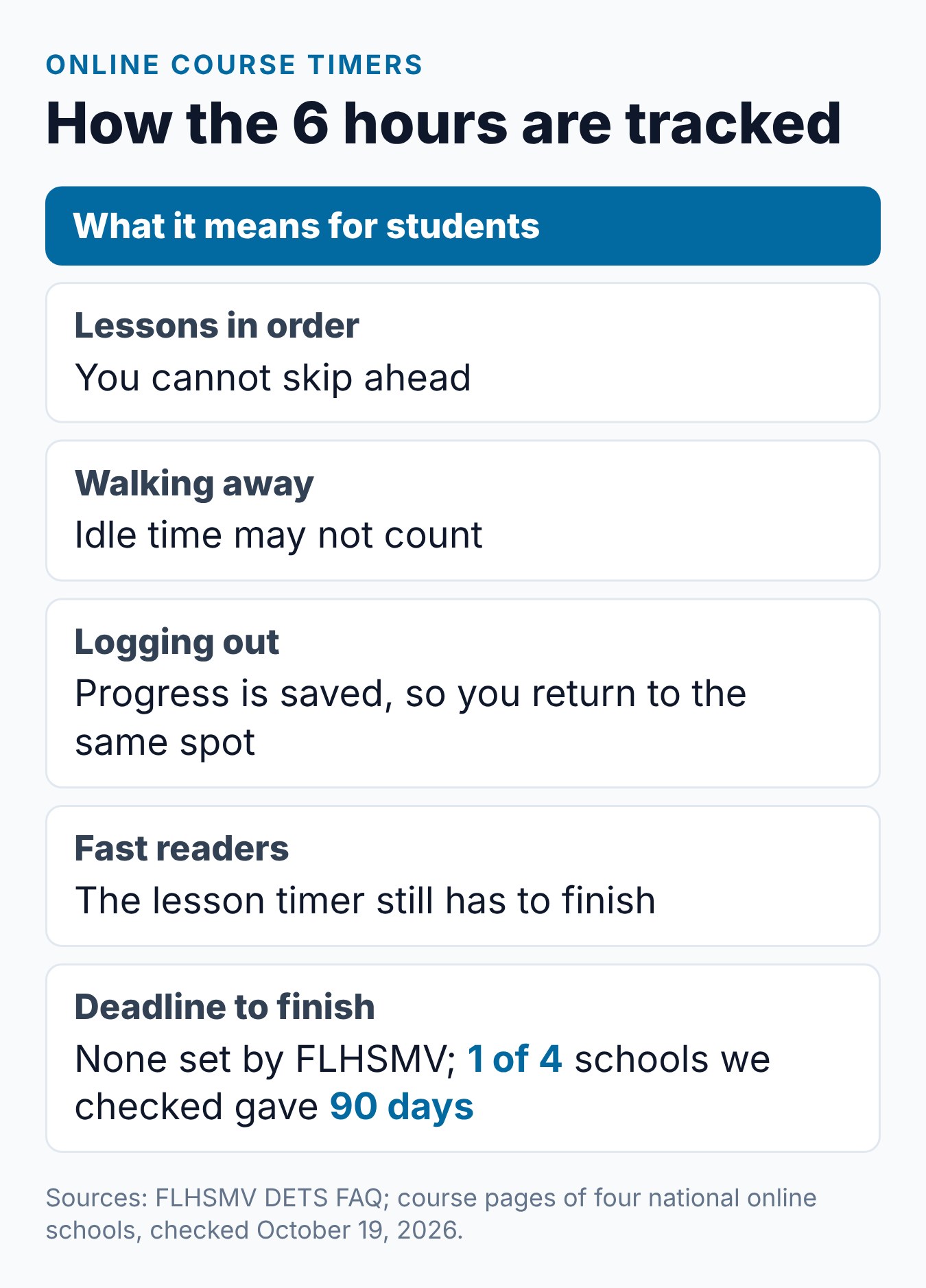
Online providers need a way to show that each student spent at least 6 hours in the course. Most use timers on each lesson. One national online school we checked says its course uses timed sections and saves progress automatically.
Here is what that usually means for students:
- You cannot skip ahead. The next lesson opens after the current one is done.
- Idle time may not count. If you walk away, the timer may pause.
- Progress is saved. You can log out and return to the same spot.
- Fast readers still wait. Even if you read quickly, the lesson timer has to finish.
These rules can frustrate a fast reader. Use the extra time to take notes on rules with numbers, like speed limits and license restrictions.
Is There a Time Limit to Finish?
FLHSMV does not set a deadline to finish the course once you start. Providers can set their own access window.
Of the four national online schools we checked on October 19, 2026, one gave 90 days to finish the course and pass the exam. The other three did not state a deadline on their course pages. Ask before you pay if you plan to spread the course out.
Sample Schedules for 6 Hours
There is no single right way to schedule DETS. Pick the plan that fits your teen’s week.
| Plan | How it works | Good for |
|---|---|---|
| One long day | Six hours plus breaks on a weekend or holiday | Teens who like to finish things in one push |
| Two sessions | Three hours on each of two days | Busy school weeks |
| Three sessions | Two hours on each of three days | Most teens, since shorter sessions help memory |
| One week | About an hour a day for six days | Teens with sports or jobs |
Add time for the final exam at the end. Most students also want a short review before they start the exam.
Long single sessions are possible, but they are tiring. Many families find that two or three sessions lead to better exam scores.
The Final Exam Step
After the lessons, you take the final exam. According to the FLHSMV DETS FAQ, it has 40 questions, and you need 80% (32 correct) to pass.
A provider may allow up to three attempts. If you need a retake, it can add time, and some providers charge for it. One school we checked gives three tries and then a free restart, and another said you must buy the course again.
When you pass, the provider reports your completion to FLHSMV. For more on the exam, read Florida DETS Course Final Exam: What to Expect.
Online vs. In-Person Time
FLHSMV allows DETS online or in person. The 6-hour minimum is the same either way.
Online courses let you set your own pace within the timer rules. On October 19, 2026, every provider on FLHSMV’s approved DETS list delivered the course online.
School courses that count instead of DETS run on the school’s schedule. These include Florida Department of Education courses 1900300 and 1900310 and some county DELAP programs. They usually take much longer than 6 hours because they are full school classes.
See Florida DETS Course Online: How the 6-Hour Program Works for more on the online format.
How DETS Fits the Full Licensing Timeline
DETS is the shortest part of a teen’s path to a license. Here is the bigger picture, based on FLHSMV’s teen licensing rules:
- DETS course: At least 6 hours, plus the final exam.
- Learner’s license: Available at 15, after the knowledge exam, vision and hearing tests, and a signed HSMV 71142 consent form.
- Learner’s license period: Held for 12 months or until age 18, whichever comes first.
- Practice driving: At least 50 hours, including 10 at night, certified by a parent or guardian.
- Driver license: Available at 16, after the driving skills test and the other requirements.
So a teen who finishes DETS before turning 15 can apply for a learner’s license on or after that birthday. The 12-month learner period then sets the earliest date for a full license.
Hours Compared: DETS, TLSAE, and School Driver Education
Families often compare DETS with other Florida courses. Here is how the time stacks up:
| Course | Minimum time | Who it is for |
|---|---|---|
| DETS | At least 6 hours | First-time applicants under 18 |
| TLSAE | At least 4 hours | First-time applicants 18 and older |
| School driver education (1900300 or 1900310) | Set by the school course | Students in qualifying school programs, which count instead of DETS |
The school courses are longer because they are full classes. If your teen is already in one, ask the school if it counts before you buy DETS.
Tips to Make the 6 Hours Count
Six hours is long enough to learn a lot, and short enough to waste if a teen just clicks through. These habits help the time pay off:
- Turn off phone alerts. Distracted studying leads to missed details on the final exam.
- Keep a one-page note sheet. Write down numbers like speed limits, following distances, and learner’s license hours.
- Say the rule out loud. Explaining a right-of-way rule helps it stick.
- Retake missed quiz questions in your head. Ask yourself why the right answer is right.
- Review before the exam. Spend 15 minutes on your notes before you start the final.
The same material shows up again on the learner’s license knowledge exam. So time spent learning it now pays off twice.
What Parents Can Do During the Course
Parents do not need to sit with a teen for all 6 hours. A few check-ins make a big difference:
- Set up the account together. Make sure the legal name and date of birth are correct.
- Agree on a schedule. Two or three short sessions are easier to keep.
- Ask about one lesson each day. For example, “What did you learn about texting and driving?”
- Check the exam rules. Know how many attempts the provider allows before the teen starts the final.
- Save the certificate. Store a copy with the documents you will need for the learner’s license visit.
What Can Make DETS Take Longer
A few things can stretch the time beyond 6 hours:
- Failing the final exam and waiting for a retake or restart
- Letting the timer pause by walking away during lessons
- Losing access if the provider has a deadline and it passes
- Account problems like a misspelled name that must be fixed before the certificate
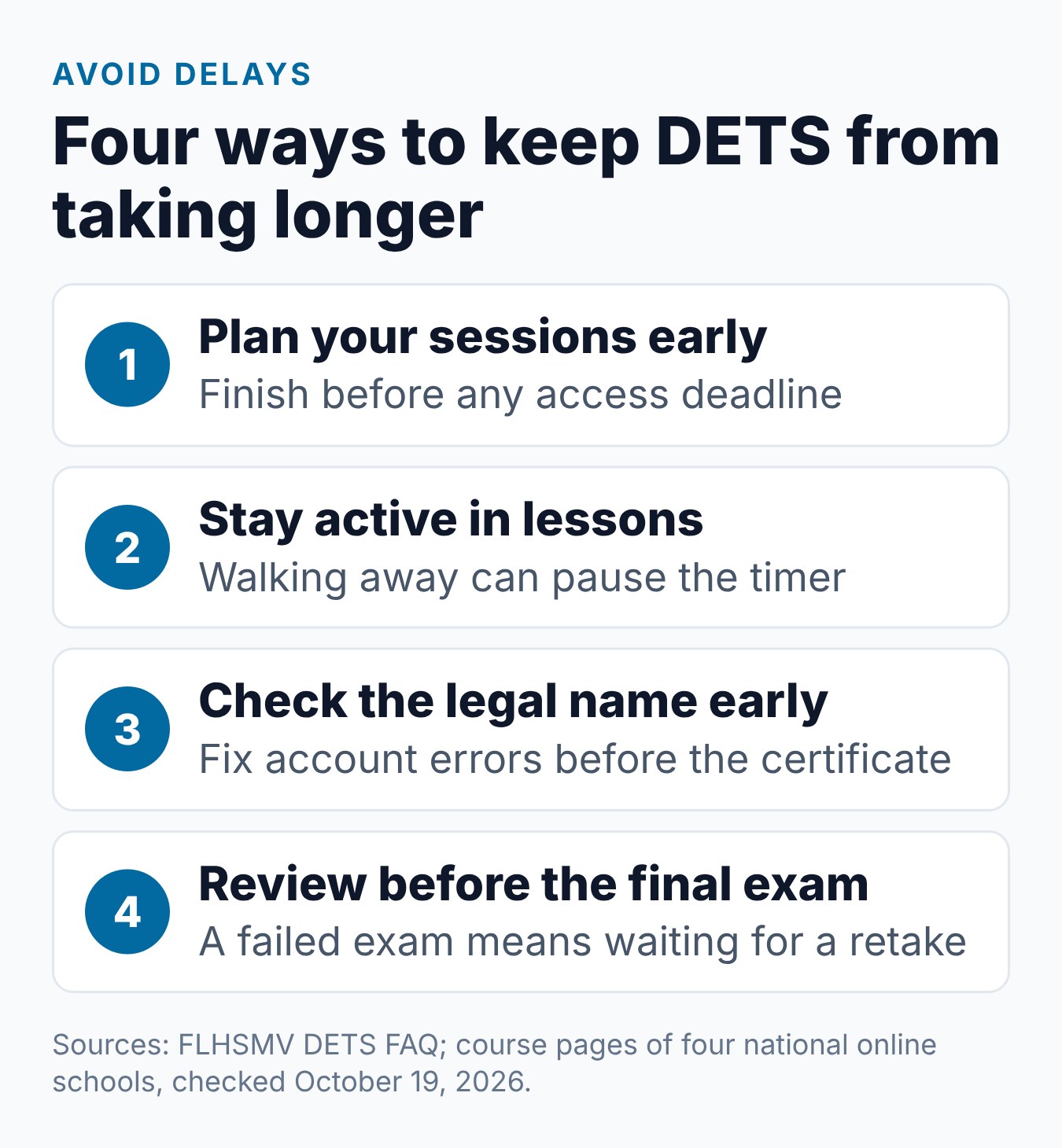
Most of these are easy to avoid. Plan your sessions, read carefully before the exam, and check the student’s name early.
If something does go wrong, contact the provider’s support team first. They can fix account details, explain retake rules, and confirm when your completion was reported to FLHSMV.
How Requirements Can Vary
Florida’s course and license rules apply statewide, but some details depend on where you live. Driver license services are often handled by your county tax collector’s office, and each office sets its own appointment process and hours. Some county school boards also offer driver education programs, such as DELAP courses, that can count instead of DETS.
FLHSMV can update course rules, forms, documents, and fees. Check FLHSMV and your county office for current requirements before your appointment.
Frequently Asked Questions
How many hours is the Florida DETS course?
At least 6 hours. FLHSMV sets that minimum for every approved DETS course.
Can you do DETS in one day?
Yes, if the provider allows it, but it is a long day. Many teens find two or three shorter sessions easier.
Can you pause the DETS course and come back later?
Most online courses save your progress. You can log out and pick up where you left off.
Does the final exam count toward the 6 hours?
It depends on the provider’s course design. Plan for the exam as a separate step after the lessons.
Is DETS longer than TLSAE?
Yes. DETS is at least 6 hours, and TLSAE is at least 4 hours. TLSAE is for adults 18 and older.
How long do I have to finish the DETS course?
FLHSMV does not set a deadline, but providers can. One school we checked gives 90 days, so ask before you pay.
How long after DETS can I get my learner’s license?
You can apply once your completion is on record and you are at least 15. You also need the knowledge exam, vision and hearing tests, and a signed HSMV 71142 form.
How long does the whole process take to get a full license?
After the learner’s license, teens hold it for 12 months or until 18, whichever comes first. They also need 50 hours of practice driving, including 10 at night.
Conclusion
How long is the Florida DETS course? At least 6 hours, usually split into two or three sessions, followed by a 40-question final exam.
Plan your schedule, check the provider’s deadline and retake rules, and save your certificate when you pass. Driving Logic is a state-approved driver improvement course provider, and our online Florida DETS course is coming soon.
Related Articles
- Florida DETS Course: The Complete Guide for Teens Under 18
- Florida DETS Course Online: How the 6-Hour Program Works
- Florida DETS Course Final Exam: What to Expect
Sources
- FLHSMV — Driver Education Traffic Safety (DETS) and approved provider list
- FLHSMV — DETS Course Frequently Asked Questions
- FLHSMV — Teen Licensing Requirements and Graduated Driver License Laws
- Florida Statutes — F.S. 322.1615 (Learner’s Driver License)
- CPALMS — Driver Education/Traffic Safety-Classroom (#1900300)
- Course comparison: Driving Logic review of the public Florida DETS course pages of four national online schools, October 19, 2026.
Billy Forte is the owner of Driving Logic, a state-approved driver improvement course provider serving Florida and other U.S. states.
This article is general information, not legal advice. Florida licensing requirements, course rules, documents, and fees are set by FLHSMV and Florida law and can change. Use official FLHSMV and Florida statute sources for current requirements before you enroll in a course or visit a driver license office.