
Updated October 2026 · Reviewed by Billy Forte
To get a new Florida resident driver’s license, visit a driver license office within 30 days of becoming a resident. You pass a vision test and surrender your valid out-of-state license. If you hold a valid license from another U.S. state, you skip DETS and TLSAE, and you may not need the written or road test.
Key Facts
- Deadline: Get a Florida license within 30 days of becoming a resident. See the deadline.
- No DETS or TLSAE: Not needed if you hold a valid license from another state. See who skips the courses.
- Tests: A vision test is given. Written and road tests may be waived for a valid license. See the tests.
- Documents: All REAL ID documents, even if your old license is REAL ID compliant. See what to bring.
- Teens: A teen with a valid out-of-state license also skips DETS. See the teen rules.
When You Become a Florida Resident
The 30-day clock starts when you become a resident, not when you arrive. FLHSMV’s new resident page says you may be considered a resident when you do any of these:
- Start a job in Florida
- Enroll your children in a Florida public school
- Register to vote in Florida
- File for a homestead exemption
- Live in Florida for more than six months in a row
So a family that moves in July and enrolls kids in school in August has started the clock by August at the latest.
The 30-Day Deadline
FLHSMV says new residents “must obtain a valid Florida driver license within 30 days of establishing residency to drive on Florida roads.” The Pinellas, Pasco and other county tax collectors repeat the same rule.
Your vehicle has its own, shorter deadline. Here is how the two compare on FLHSMV’s page:
| Task | Deadline after becoming a resident |
|---|---|
| Get a Florida driver license | 30 days |
| Get Florida insurance from a Florida-licensed agent (to title and register your vehicle) | 10 days |
Book your driver license visit early. Many county offices require a reservation, and slots can fill up. Driving on an out-of-state license after the 30 days means driving without a valid Florida license, so don’t leave the visit to the last week.
A First-Month Plan
Moving brings a lot of paperwork at once. Lining up the license and vehicle steps by deadline keeps you legal.
- Days 1 to 10: Get Florida auto insurance from a Florida-licensed agent, since that’s the 10-day deadline for your vehicle.
- Week 1 or 2: Gather your REAL ID documents and two Florida address proofs. A new lease and a utility hookup order often work.
- Week 2: Book a reservation at your county driver license office.
- Before day 30: Visit the office, take the vision test and surrender your old license.
- Same trip or soon after: Handle your vehicle title and registration.
County tax collector offices handle both driver license and vehicle services. Check your county’s site to see whether you can book both for the same trip.
Do You Need DETS or TLSAE?
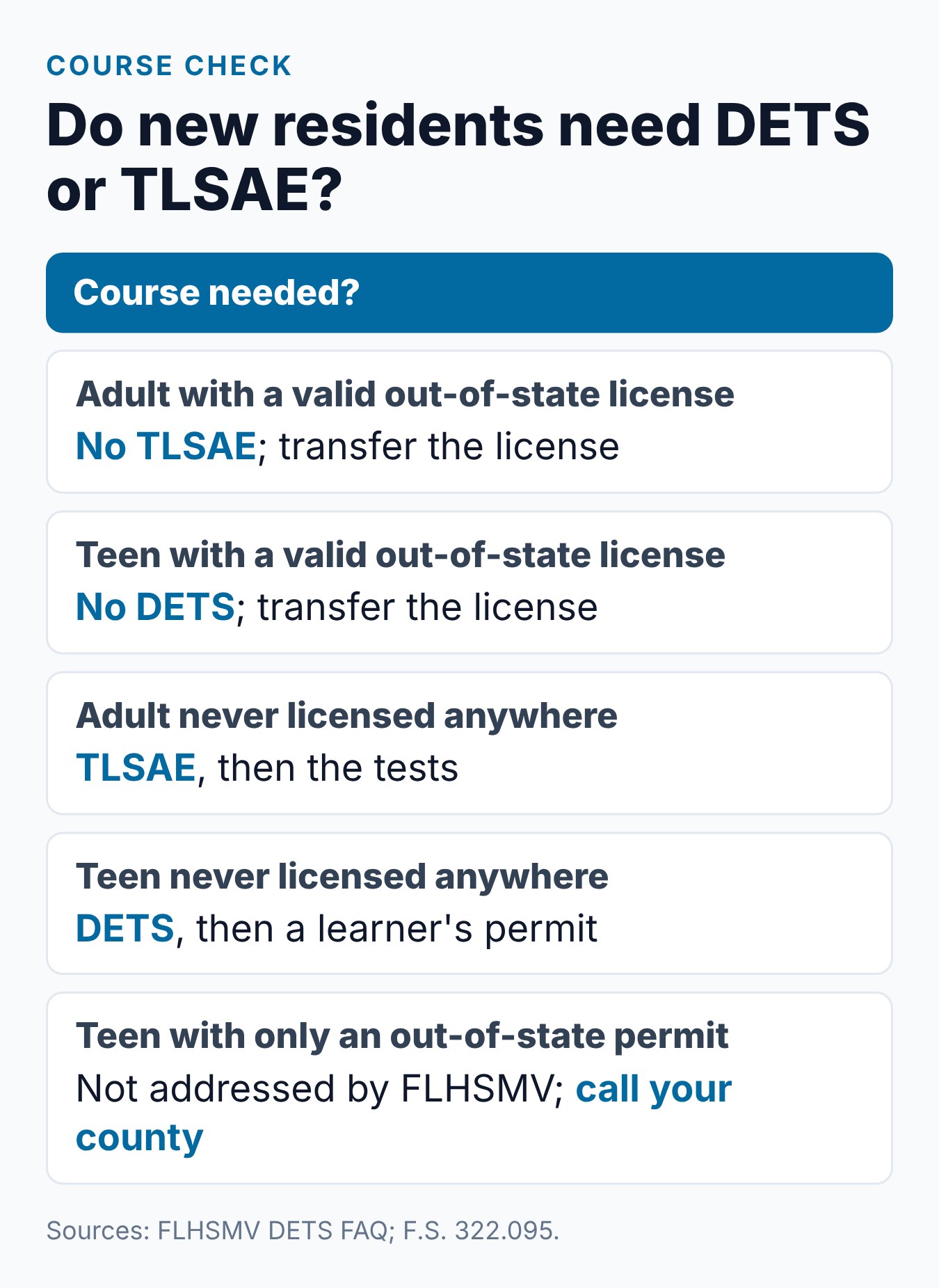
Most new residents don’t. Both courses are for people who have never been licensed, so a valid license from another state is your ticket past them.
- Adults with a valid out-of-state license: No TLSAE. F.S. 322.095 requires TLSAE for applicants 18 and older “unless the applicant has been licensed in another jurisdiction.”
- Teens under 18 with a valid out-of-state license: No DETS. FLHSMV’s DETS FAQ says the DETS change does not affect applicants under 18 who already hold a valid out-of-state license and are transferring to Florida.
- Adults who have never had a license: Take TLSAE. See our adult first-license guide.
- Teens who have never had a license: Take DETS and get a learner’s permit. See our learner’s permit guide.
The DETS FAQ defines who must take DETS as someone under 18 who “has never held a driver license from any other state, country or jurisdiction.” If your teen held a license outside the U.S., ask your county office how they apply that rule.
What About an Out-of-State Learner’s Permit?
FLHSMV’s public pages don’t say whether a learner’s permit from another state counts as a license for these rules. The DETS FAQ exemption names a valid out-of-state license.
Don’t assume a permit transfers. Call your county tax collector before the visit and ask whether your teen needs DETS and a Florida learner’s permit.
Documents to Bring
The Pinellas County Tax Collector says new residents must bring all REAL ID documents, even if their out-of-state license or ID is already REAL ID compliant. For U.S. citizens, FLHSMV’s What to Bring page lists:
- Identity: For example, a certified U.S. birth certificate or a valid U.S. passport
- Social Security number: Your card, a W-2, a pay stub or a 1099 with your full number
- Two Florida address proofs: For example, a lease, a utility bill or a utility hookup order dated within 60 days
- Name-change papers: An original or certified marriage certificate, divorce decree or court order, if your name changed
- Your out-of-state license: You surrender it at the visit
Your current out-of-state license can’t be one of your address proofs. Mail sent to your old address won’t work either, since both proofs must show your Florida home address. A new lease and a utility hookup order are often the easiest proofs for someone who just moved.
Our document checklist explains which versions of each document FLHSMV accepts.
Getting Your New Florida Resident Driver’s License at the Office
You apply in person at a driver license office, usually run by your county tax collector. Many people call it “the DMV,” but the licensing agency in Florida is FLHSMV.
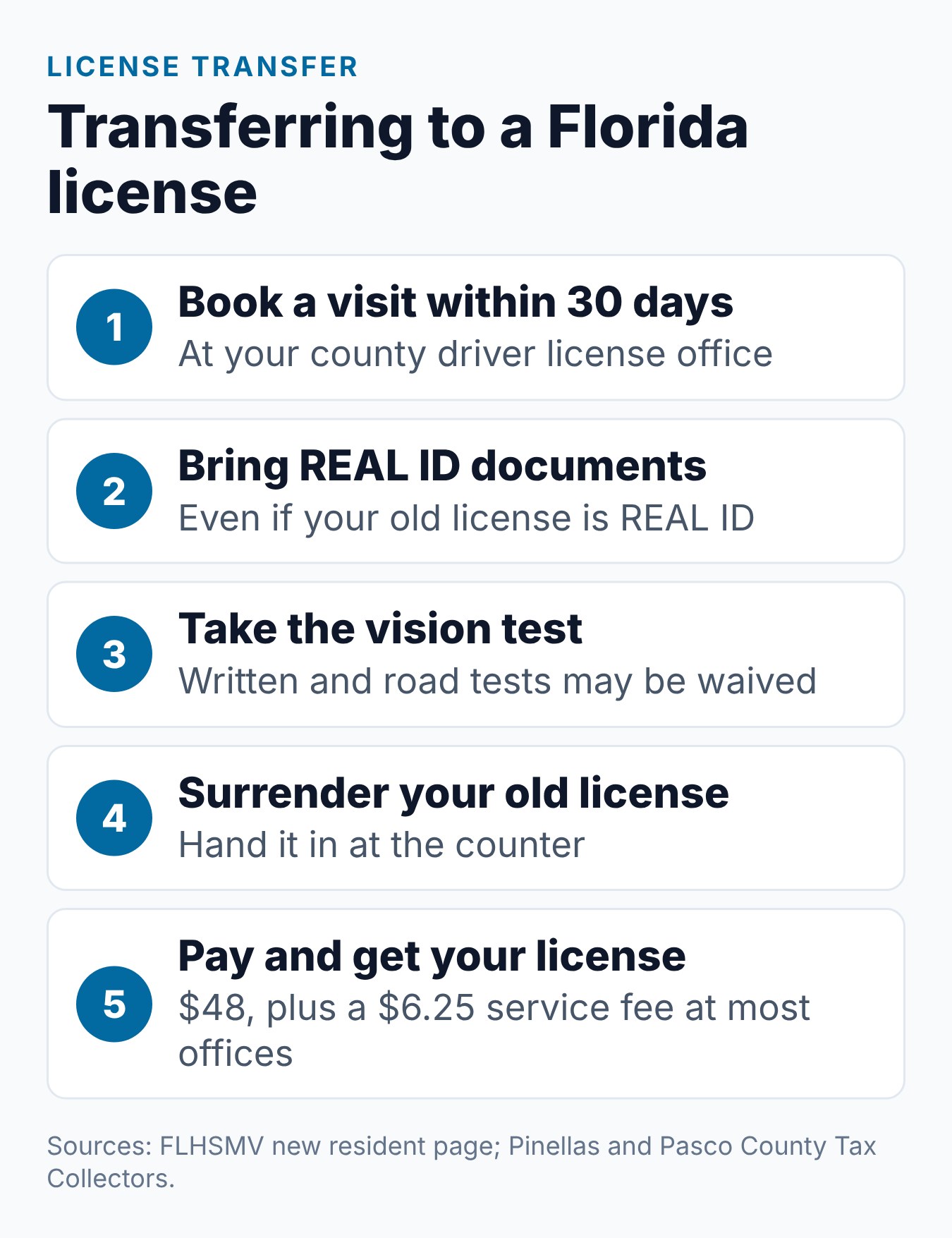
- Document check. Staff review your REAL ID documents and address proofs.
- Vision test. FLHSMV says you will be given a vision test.
- Written and road tests. FLHSMV says you may be eligible for a license without taking them.
- Surrender. You hand in your out-of-state license.
- Pay and get your license. You pay the fee and get your Florida license.
When Tests May Be Required
The Pasco County Tax Collector says a written and/or road test may be required if the out-of-state license is expired, suspended or revoked.
Pinellas also notes that FLHSMV keeps a list of out-of-state license classes that are not valid in Florida, and that Florida doesn’t recognize Alabama motorcycle endorsements. If your license has a special class or endorsement, check before you go. Commercial drivers have extra steps too: Pinellas notes that change-of-state applicants who want a hazmat endorsement must pass a new hazardous materials exam.
Moving From Another Country
The rules above are for people with a license from another U.S. state. FLHSMV’s new resident page doesn’t explain how a license from another country is handled.
The DETS FAQ does mention other countries. It says DETS is for a teen under 18 who “has never held a driver license from any other state, country or jurisdiction.” For adults, F.S. 322.095 uses the phrase “another jurisdiction.” Ask your county office how they apply these rules to a foreign license before you book a course.
Non-citizens also use different document lists. FLHSMV keeps separate What to Bring pages for immigrants and non-immigrants, so pick the one for your status.
What It Costs
FLHSMV’s new resident page lists $48 for an initial Florida Class E license. Most tax collector offices add a $6.25 service fee.
Other credentials cost more or less. FLHSMV lists $75 for a commercial Class A license and $25 for an ID card. Endorsements, such as a motorcycle endorsement, are $7 each.
Teens Moving to Florida
A teen under 18 with a valid out-of-state license transfers it and doesn’t take DETS. But some Florida rules for minors still apply.
- Parent consent: F.S. 322.09 says any license application from someone under 18 must be signed by a parent or guardian. Expect to need HSMV 71142.
- School attendance: Florida ties a minor’s driving privilege to school attendance.
- Hour limits: Under F.S. 322.16, a licensed 16-year-old can’t drive from 11 p.m. to 6 a.m., and a 17-year-old from 1 a.m. to 5 a.m., unless a licensed driver 21+ is along or they’re driving directly to or from work.
FLHSMV’s pages don’t say how a transferring teen’s past driving hours or permit time are counted. Ask your county office before the visit so you bring the right forms.
Your Vehicle Is a Separate Step
Transferring your license doesn’t register your car. FLHSMV’s new resident page lists separate steps for vehicles:
- Get Florida insurance from a Florida-licensed agent within 10 days of becoming a resident.
- Bring proof of identity, proof of Florida insurance and the original out-of-state title.
- Have the VIN physically verified, for example by a law enforcement officer, a licensed Florida dealer or a tax collector employee.
- Complete HSMV 82040, the title application, signed by all owners.
If a lender holds your title, contact the lender to have the title sent to Florida.
Mistakes New Residents Make
These come from FLHSMV and county tax collector rules.
- Waiting past 30 days. The deadline runs from when you become a resident.
- Bringing only your old license. You need all REAL ID documents.
- Using your old license as an address proof. It isn’t accepted.
- Signing up for DETS or TLSAE you don’t need. A valid out-of-state license means you skip both.
- Letting your old license expire first. An expired license can mean written and road tests.
How Requirements Can Vary
Florida’s course and license rules apply statewide, but some details depend on where you live. Driver license services are often handled by your county tax collector’s office, and each office sets its own appointment process and hours. Some county school boards also offer driver education programs, such as DELAP courses, that can count instead of DETS.
FLHSMV can update course rules, forms, documents, and fees. Check FLHSMV and your county office for current requirements before your appointment.
Frequently Asked Questions
How long do I have to get a Florida driver’s license after moving?
30 days from when you become a Florida resident. Starting a job, enrolling kids in school or registering to vote can make you a resident.
Do I need to take TLSAE if I have an out-of-state license?
No. F.S. 322.095 doesn’t require TLSAE for an applicant who has been licensed in another jurisdiction.
Does my teen need DETS if they have a license from another state?
No, if the license is valid. FLHSMV’s DETS FAQ says the DETS change doesn’t affect teens transferring a valid out-of-state license.
Do I have to take a driving test when I move to Florida?
Usually not with a valid license. You take a vision test, and FLHSMV says you may be eligible without written or road tests. An expired license can mean tests.
Do I have to give up my out-of-state license?
Yes. County offices say you surrender your out-of-state license when you get the Florida license.
Can I transfer an out-of-state learner’s permit to Florida?
FLHSMV’s public pages don’t say. Call your county tax collector before your visit.
How much does it cost to transfer a license to Florida?
FLHSMV lists $48 for an initial Class E license, and most tax collector offices add a $6.25 service fee.
What makes me a Florida resident?
FLHSMV lists starting a job, enrolling children in public school, registering to vote, filing for a homestead exemption or living here more than six months in a row.
Conclusion
A new Florida resident driver’s license is due within 30 days of becoming a resident, and a valid out-of-state license means no DETS or TLSAE.
Bring all REAL ID documents and two Florida address proofs, plan for a vision test and surrender your old license. Teens who have never been licensed start with DETS and a learner’s permit instead. Our online Florida DETS course is coming soon.
Related Articles
- Florida Learner’s Permit: How to Get It, Requirements, and What It Allows
- First-Time Florida Driver’s License for Adults: The Complete Process
- Florida Learner’s Permit Documents: What to Bring
Sources
- FLHSMV — New Florida Residents
- FLHSMV — DETS Course Frequently Asked Questions
- Florida Statutes — F.S. 322.095 (TLSAE)
- Pinellas County Tax Collector — New Florida Residents
- Pasco County Tax Collector — New Florida Residents
- FLHSMV — What to Bring: U.S. Citizen
- FLHSMV — Driver License and ID Card Fees
- Florida Statutes — F.S. 322.09 (Application of Minors)
- Florida Statutes — F.S. 322.16 (License Restrictions)
- FLHSMV — Teen Licensing Frequently Asked Questions
Billy Forte is the owner of Driving Logic, a state-approved driver improvement course provider serving Florida and other U.S. states.
This article is general information, not legal advice. Florida licensing requirements, course rules, documents, and fees are set by FLHSMV and Florida law and can change. Use official FLHSMV and Florida statute sources for current requirements before you enroll in a course or visit a driver license office.