
Updated November 2026 · Reviewed by Billy Forte
The short answer to “is the Florida DETS course available in Spanish” is that it can be, because FLHSMV’s DETS pages do not say what language the course must be in. Driving Logic’s courses are offered in Spanish as well as English. The exams are a different matter: since February 6, 2026, FLHSMV gives all driver license knowledge and skills exams in English only.
Key Facts
- No course language rule: FLHSMV’s DETS page and FAQ do not set a language for the course. See what FLHSMV says.
- A note on the list: some providers on the state list are marked “(Other languages available).” See the provider list.
- Exams in English: all knowledge and skills exams have been in English only since February 6, 2026. See the exam rule.
- The permit test: 50 questions, and 40 correct answers to pass. See the permit test.
- No translation help: language translation services are no longer permitted in the exams. See what changed.
- Ask first: confirm the course language with the provider before you pay. See what to ask.
Is the Florida DETS Course Available in Spanish? What FLHSMV Says
DETS stands for Driver Education Traffic Safety. It is the course most Florida teens must finish before a first license.
The agency behind it is the Florida Department of Highway Safety and Motor Vehicles, or FLHSMV. Some families call it the DMV. In Florida, the agency’s name is FLHSMV.
FLHSMV has two pages about the course. One is its DETS page. The other is its DETS FAQ.
Neither page sets a language for the course. They do not require English, and they do not promise Spanish.
The FAQ does list what a DETS course must be:
- Length. The course must be a minimum of 6 hours long.
- Content. It must meet or exceed the Florida Department of Education Traffic Safety classroom course description.
- Delivery. The course can be delivered in-person or online.
Language is not on that list. So whether a course is taught in Spanish is up to each provider.
What the Provider List Shows
The DETS page ends with a list of all authorized providers for the course. The list has three columns:
- Name.
- Delivery Method.
- Contact Information.
There is no language column. Language shows up only as a short note in the Delivery Method column of some providers.
The note reads “(Other languages available).” It does not name a language. The list does not say Spanish beside any provider.
So the list can point you to providers worth a call. It cannot tell you which ones teach in Spanish. Only the provider can.
A provider with no note may also have a Spanish course. The Contact Information column gives a phone number and a website for each one.
What DETS Is and Who Must Take It
The rule is recent. FLHSMV states it this way: as of August 1, 2025, anyone under 18 who has never held a driver license from any other state, country or jurisdiction must complete a 6-hour DETS course before applying for a license in Florida.
Three points in that sentence matter:
- Age. The rule is for people under 18.
- License history. It applies to those who have never held a license anywhere else.
- Timing. The course comes before the license application.
FLHSMV names one substitute. Driver Education Licensing Assistance Program (DELAP) courses offered by some county school boards may count instead. Contact the local school board to learn more.
DETS is not the adult course. Adults 18 and older take a different course called TLSAE. Our guide on DETS vs TLSAE explains who needs which one.
The FAQ also covers teens caught between the old rule and the new one. A person under 18 who completed a TLSAE course prior to August 1, 2025 may use that completion certificate for one year after the completion date.
The Exam Rule: English Only
The course language is open. The exam language is not.
FLHSMV announced the change in a news release dated January 30, 2026. Beginning Friday, February 6, 2026, all driver license knowledge and skills examinations are administered exclusively in English.
The release leaves little room for doubt:
- Every license class. The change applies to all driver license classifications.
- Oral exams too. It includes exams administered orally.
- Both kinds of test. It covers knowledge exams and skills exams.
For a teen, that means two tests. The first is the written knowledge exam for a learner’s license. The second is the driving skills test for the license itself.
What Changed on February 6
The release explains what came before. Previously, knowledge exams for most non-commercial driver license classifications were offered in multiple languages.
That is no longer the case. Under the updated policy, all driver license knowledge and skills testing is conducted in English.
FLHSMV said it took two steps to make the change:
- Translation services. Language translation services are no longer permitted for knowledge or skills examinations.
- Printed exams. Printed exams in languages other than English were removed.
The Jacksonville tax collector’s office posted the same announcement. County tax collector offices handle many driver license services in Florida.
Older websites may still list several exam languages. Go by the FLHSMV release, and confirm with FLHSMV or your tax collector office before test day.
Each Part of the Process and Its Language Rule
A teen’s path to a license has several parts. The language rule is not the same for each one.
| Part of the process | Language rule on the official pages |
|---|---|
| The DETS course | The DETS pages set no language |
| The Class E Knowledge Exam | English only |
| The Class E Driving Skills Test | English only |
| Translation help during an exam | No longer permitted |
| The course’s own final exam | No official page says |
| The DETS completion record | No official page says |
The last two rows are gaps, not answers. We make no claim about either one. If the language of the course exam or of your records matters to you, ask the provider.
The Permit Test in Brief
The permit test has an official name. FLHSMV calls it the Class E Knowledge Exam. A teen must pass it to obtain a learner’s license.
FLHSMV’s Class E Knowledge Exam page gives the basics:
- Questions. The exam has 50 multiple-choice questions.
- Passing score. A customer must answer 40 out of 50 correctly, or score 80 percent.
- Topics. The questions cover Florida traffic laws, safe driving practices and identifying traffic controls.
- Language. The page states that Class E knowledge examinations are available in English only.
The same page says any applicant under the age of 18 can take the exam online. Approved third party administrators provide that service. A Parent Proctoring Form is required for online tests.
To prepare, FLHSMV points to two tools. Study the Official Florida Driver License Handbook, and take the Class E Knowledge Practice Test.
Our guide on what to expect on the permit test covers the exam in full.
The Driving Test Is in English Too
The second exam is the Class E Driving Skills Test. The January 30 release covers it by name, because it applies to skills examinations.
FLHSMV’s page describes the test as a series of maneuvers. The examiner uses them to judge whether an applicant can safely operate a motor vehicle.
Two details on that page matter to a Spanish-speaking family:
- No other passengers. No other passengers are permitted during the exam.
- Mistakes are explained. The examiner will explain any mistakes after the exam is completed.
A teen will hear the examiner’s instructions in English. Practice the words for each maneuver ahead of time. Stop, turn, back up and park are a good start.
FLHSMV also sets a waiting period before this test. To qualify for a driver license, a teen must hold the learner’s license for one year from the issuance date or must be 18 years old.
What a Spanish Course Can and Cannot Do
A course in Spanish has real value. It can help a teen understand the rules of the road in the language spoken at home.
It cannot change the exams. The teen must still pass the knowledge exam and the driving test in English.
So a good plan uses both languages:
- Learn the ideas in the language you know best. Right of way, speed limits and safe following distance are the same in any language.
- Learn the test words in English. The exam questions and the answer choices are in English.
- Use FLHSMV’s own study tools. The agency names the handbook and the practice test.
- Practice early. Do not wait for test day to read English questions for the first time.
Parents can help even if their own English is limited. Ask your teen to explain each rule to you in Spanish after studying it in English.
Steps for a Spanish-Speaking Family
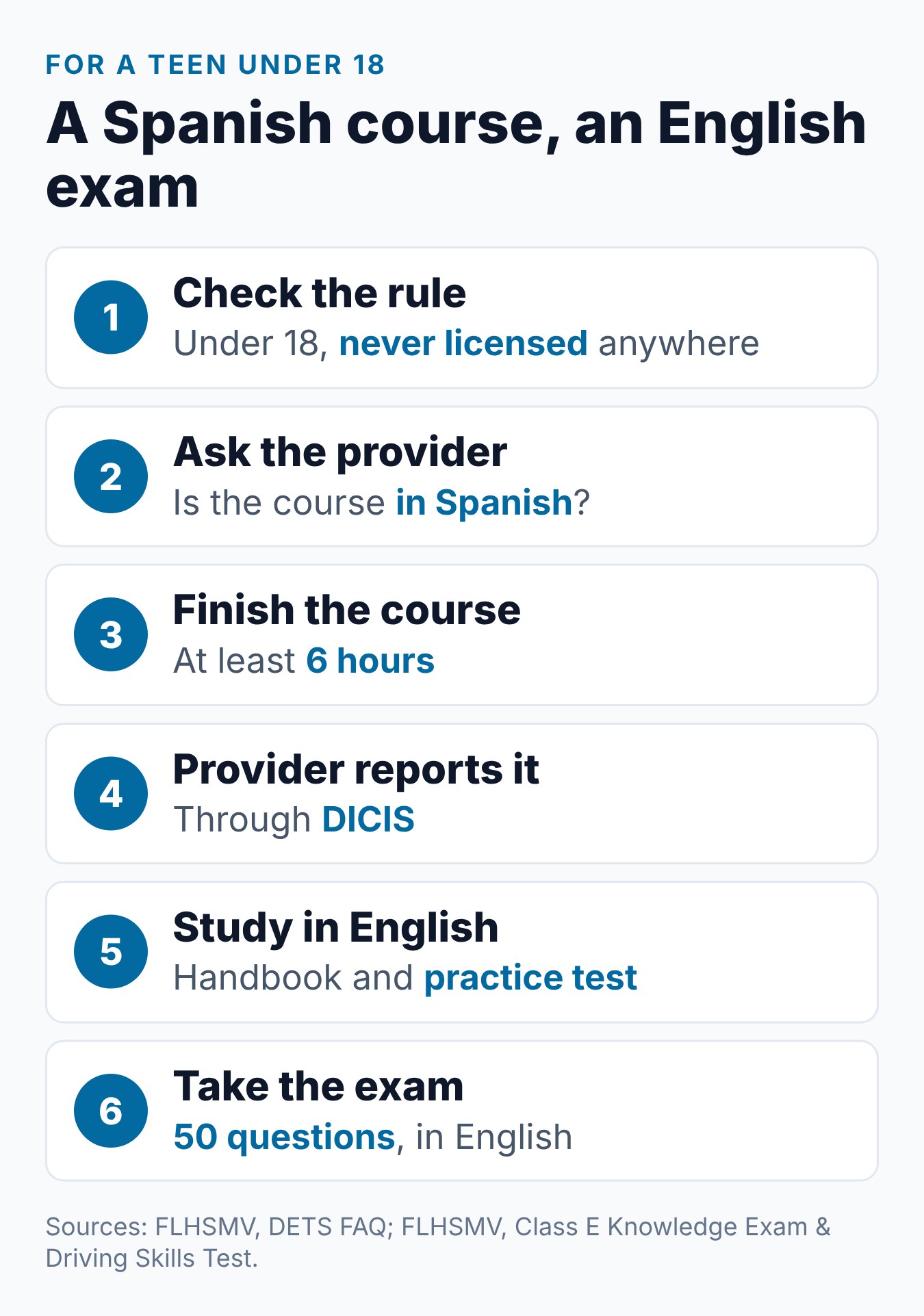
These steps put the official rules in order.
- Check the rule. DETS is for people under 18 who have never held a license anywhere.
- Open the provider list. Look at the delivery method and any language note.
- Ask about Spanish. Contact the provider and confirm the course language before you pay.
- Finish the course. It is at least 6 hours long.
- Let the provider report it. Providers report DETS completions to FLHSMV through the Driver Improvement Certificate Issuance System, or DICIS.
- Study for the exam in English. Use the handbook and the practice test.
- Confirm before test day. Ask FLHSMV or your tax collector office about current exam rules.
Step 5 means the provider sends the record. Our guide on the next steps after DETS covers what comes after the course.
Questions to Ask Before You Pay
A short call can settle the language question. Ask the provider:
- Is the full DETS course in Spanish?
- Is the course online or in person?
- What language is the course’s final exam in?
- How will my teen’s completion be reported?
Then ask FLHSMV or your tax collector office:
- Is the knowledge exam still in English only?
- What should my teen bring on test day?
Write down the answers and the date you asked. Exam policy changed in 2026, and it can change again.
What We Found on the Official Pages
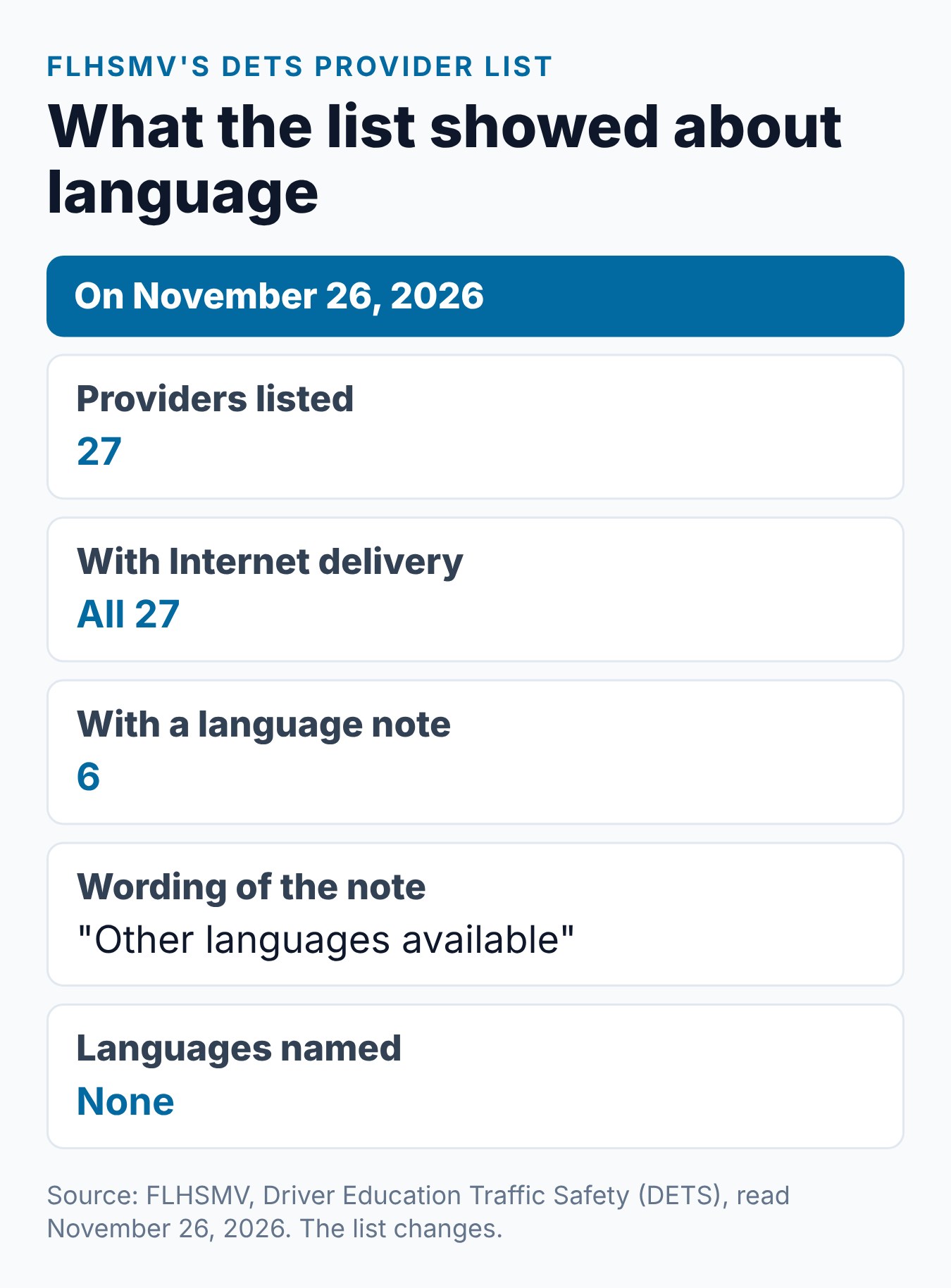
On November 26, 2026, we read FLHSMV’s DETS page, its DETS FAQ, the provider list and the Class E exam page. We looked for every statement about language. Here is what stood out:
- 27 providers were on the DETS list. All 27 showed Internet as a delivery method.
- 6 carried a language note. Each note read “(Other languages available).”
- None of the notes named a language. The word Spanish did not appear beside any provider.
- The DETS FAQ has no language question. Its course requirements list length and content only.
- The exam page is plain. It states that Class E knowledge examinations are available in English only.
The first three findings explain why families ask this question. Fewer than one in four listed providers had a language note, and the note does not say Spanish.
These counts are a snapshot. The list changes as FLHSMV approves more providers.
Common Mistakes to Avoid
These mistakes cost families time:
- Assuming a Spanish course means a Spanish exam. The exams are in English only.
- Reading the language note as proof of Spanish. The note does not name a language.
- Counting on an interpreter. Translation services are no longer permitted in the exams.
- Trusting an old language list. Go by the January 30, 2026 release.
- Mixing up the two courses. DETS is for teens under 18. TLSAE is for adults 18 and older.
- Leaving English practice for the last week. Start with the practice test early.
How Requirements Can Vary
Florida’s course and license rules apply statewide, but some details depend on where you live. Driver license services are often handled by your county tax collector’s office, and each office sets its own appointment process and hours. Some county school boards also offer driver education programs, such as DELAP courses, that can count instead of DETS.
FLHSMV can update course rules, forms, documents, and fees. Check FLHSMV and your county office for current requirements before your appointment.
Frequently Asked Questions
Is the Florida DETS course offered in Spanish?
It can be. FLHSMV’s DETS pages do not set a course language, so it depends on the provider. Confirm the language with the provider before you pay.
Is the Florida permit test in Spanish?
No. Since February 6, 2026, FLHSMV gives all driver license knowledge exams in English only. That includes the Class E Knowledge Exam for a learner’s license.
Can my teen use an interpreter for the exam?
No. FLHSMV’s January 30, 2026 release says language translation services are no longer permitted for knowledge or skills examinations.
Is the driving test in English too?
Yes. The English-only policy covers skills examinations as well as knowledge exams, for all driver license classifications.
How many questions are on the permit test?
The Class E Knowledge Exam has 50 multiple-choice questions. A customer must answer 40 correctly, which is 80 percent, to pass.
Who has to take the DETS course?
Anyone under 18 who has never held a driver license from any other state, country or jurisdiction. The rule took effect on August 1, 2025.
How do I find a DETS provider that teaches in Spanish?
Start with the provider list on FLHSMV’s DETS page. Look for a language note, then contact the provider and ask about Spanish.
Conclusion
Florida does not set a language for the DETS course, so a Spanish course depends on the provider. The exams are different: the permit test and the driving test have been in English only since February 6, 2026. A course in Spanish can help a teen learn the rules, but exam practice needs to happen in English. To see the course, visit Driving Logic’s online Florida DETS course page.
Related Articles
- Florida DETS Course: Do Adults Need It? Who Takes TLSAE
- Florida DETS Course Online: How the 6-Hour Program Works
- FLHSMV-Approved DETS Course: What It Means and How to Verify Your Provider
- Florida DETS Course for Teens: What Parents Need to Know
- Florida DETS Course Next Steps: What Happens After You Finish
Sources
- FLHSMV — Driver Education Traffic Safety (DETS)
- FLHSMV — DETS Course Frequently Asked Questions
- FLHSMV news release, January 30, 2026 — Driver License Exams to Be Administered in English Only
- Jacksonville Tax Collector — FLHSMV Announces Driver License Exams to Be Administered in English Only
- FLHSMV — Class E Knowledge Exam & Driving Skills Test
- FLHSMV — Driver Education Courses
- Florida Statutes — F.S. 322.1615 (DETS)
Billy Forte is the owner of Driving Logic, a state-approved driver improvement course provider serving Florida and other U.S. states.
This article is general information, not legal advice. Florida licensing requirements, course rules, documents, and fees are set by FLHSMV and Florida law and can change. Use official FLHSMV and Florida statute sources for current requirements before you enroll in a course or visit a driver license office.