
Updated November 2026 · Reviewed by Billy Forte
The official list of Texas approved defensive driving courses is the Texas Department of Licensing and Regulation (TDLR) Driving Safety Provider Search. It lists licensed driving safety providers, not single courses, and no Texas agency publishes a separate list of approved courses. Search it by city or ZIP, provider name or license number, and use a provider only if its status says CURRENT.
Key Facts
- One state list: TDLR’s Driving Safety Provider Search is the only official list. See where the list is.
- Providers, not courses: the list names licensed businesses, and any of them may offer the 6-hour course. See why it lists providers.
- Three searches: city or ZIP, provider name, or license number. See how to search.
- Status comes first: the list holds CURRENT and EXPIRED licenses, so being on it is not enough. See reading each row.
- Not a ranking: TDLR says inclusion “is not an endorsement, recommendation, or advertising.” See what the list leaves out.
- A second check: TDLR’s certificate tool confirms a certificate after the course. See the certificate check.
Where the Official List Is
The list lives on TDLR’s website. The page is titled “Driving Safety Provider Search,” and its address is tdlr.texas.gov/driver/safety/providers/search/.
TDLR is the state agency for this course. In Texas, “defensive driving course” and “driving safety course” are two names for the same course. So a list of approved defensive driving courses and a list of driving safety providers point to the same place.
Some people search for a “DMV list” of courses. In Texas, driver licenses and driving records are handled by the Department of Public Safety (DPS), and neither DPS nor the Texas DMV approves this course. TDLR does.
What a List on Another Website Is
You may find pages that call themselves a “list of approved courses.” Those are not the state’s list. No other site can speak for TDLR.
A list on another site may be out of date, and it is not TDLR’s list. Treat it as a starting point at most. Then confirm each name in TDLR’s search before you pay anyone.
Why the List Names Providers
Many people expect a list of courses, one line per class. TDLR’s list does not work that way, and the law explains why.
The Texas Education Code says a person may not provide driving safety courses unless the person holds a driving safety provider license. That rule is in Section 1001.201(a)(3) of Chapter 1001 of the Education Code. So the license goes to the business that teaches the course.
TDLR’s Taking a Driving Safety Course page adds the other half. It says any licensed driving safety provider may offer a 6-hour course that can be used for ticket dismissal or insurance discounts.
Put those together and the list makes sense. If a provider is licensed, its 6-hour course is the course the state means.
Where the Word “Approved” Comes From
People search for an “approved” list because of the ticket law. Article 45A.352(a) of the Code of Criminal Procedure says the course must be “a driving safety course approved by the Texas Department of Licensing and Regulation.”
Our article on what TDLR approval means explains that label and why courts want it. This article stays on the list itself.
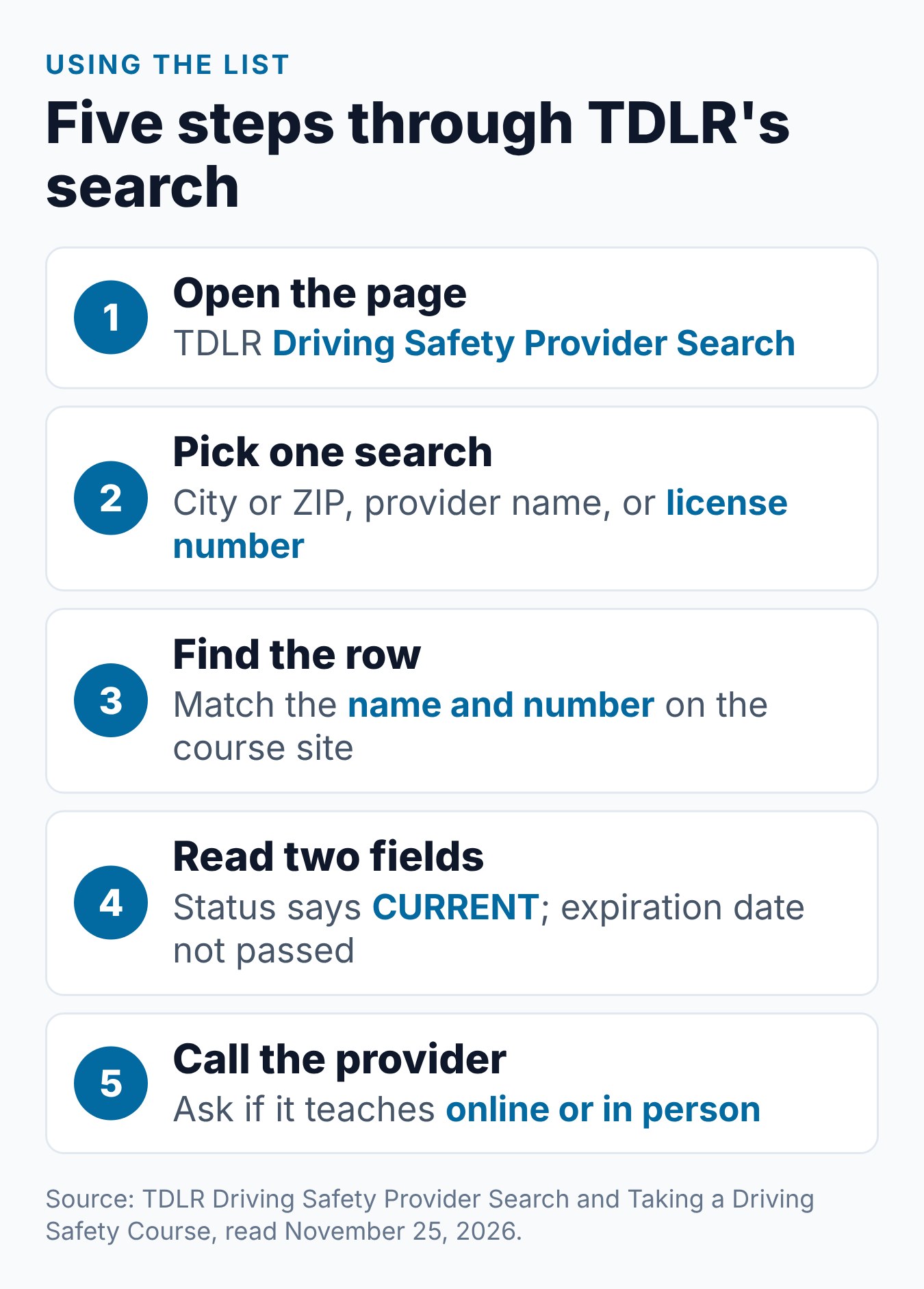
How to Search the TDLR Driving Safety Provider Search
The page has a “Find a Provider” box. It gives you three ways to search, and each one fits a different moment.
- By city or ZIP. Use this when you are starting from zero and want to see providers tied to a place.
- By provider name. Use this when you already have a school in mind, such as one a friend used.
- By license number. Use this when a course website shows a license number and you want to match it.
The license number search is the most exact. Two businesses can have similar names, but each license number belongs to one provider.
A city or ZIP search does not mean the course is taught in that city. The list does not say whether a provider teaches online or in a classroom, as covered below. So a provider that shows up in your ZIP search may or may not have a class near you.
A Worked Example
Here is one search you can repeat yourself. Driving Logic Inc is on TDLR’s list with driving safety provider license number CP1235. When we read TDLR’s search on November 25, 2026, its status was CURRENT.
Do not take our word for it. Type CP1235 into the license number search and read the row for yourself. That is the habit this list is built for, and it works the same way for any provider you are thinking about.
How to Read Each Row
Each row in the results gives you five pieces of information. Each one answers a small question.
| Field in the row | The question it answers | What to look for |
|---|---|---|
| Provider name | Who holds the license? | The same name the course website uses |
| License number | Which license is it? | The same number the course website shows |
| Status | Is the license good right now? | CURRENT |
| Expiration date | When does the license run out? | A date that has not passed |
| Phone number | How do I reach the provider? | A way to ask about online or in-person classes |
Two of these fields matter most: status and expiration date. When we read the list on November 25, 2026, it held licenses marked CURRENT and licenses marked EXPIRED.
That means a name on the list is not proof by itself. A business whose license has expired still shows up. Read the status before you read anything else.
We do not give a count of how many providers are on the list. The number changes as licenses are issued and run out, so any count would soon be wrong.
When the Name Does Not Match
Sometimes a course website uses a brand name, and the list shows a company name. The license number is the tie-breaker. If the number on the website matches a CURRENT row, you have found the right provider.
If you cannot find any match, stop. Ask the business for its exact license number and search again. If it still does not match, do not pay.
What the List Does Not Tell You
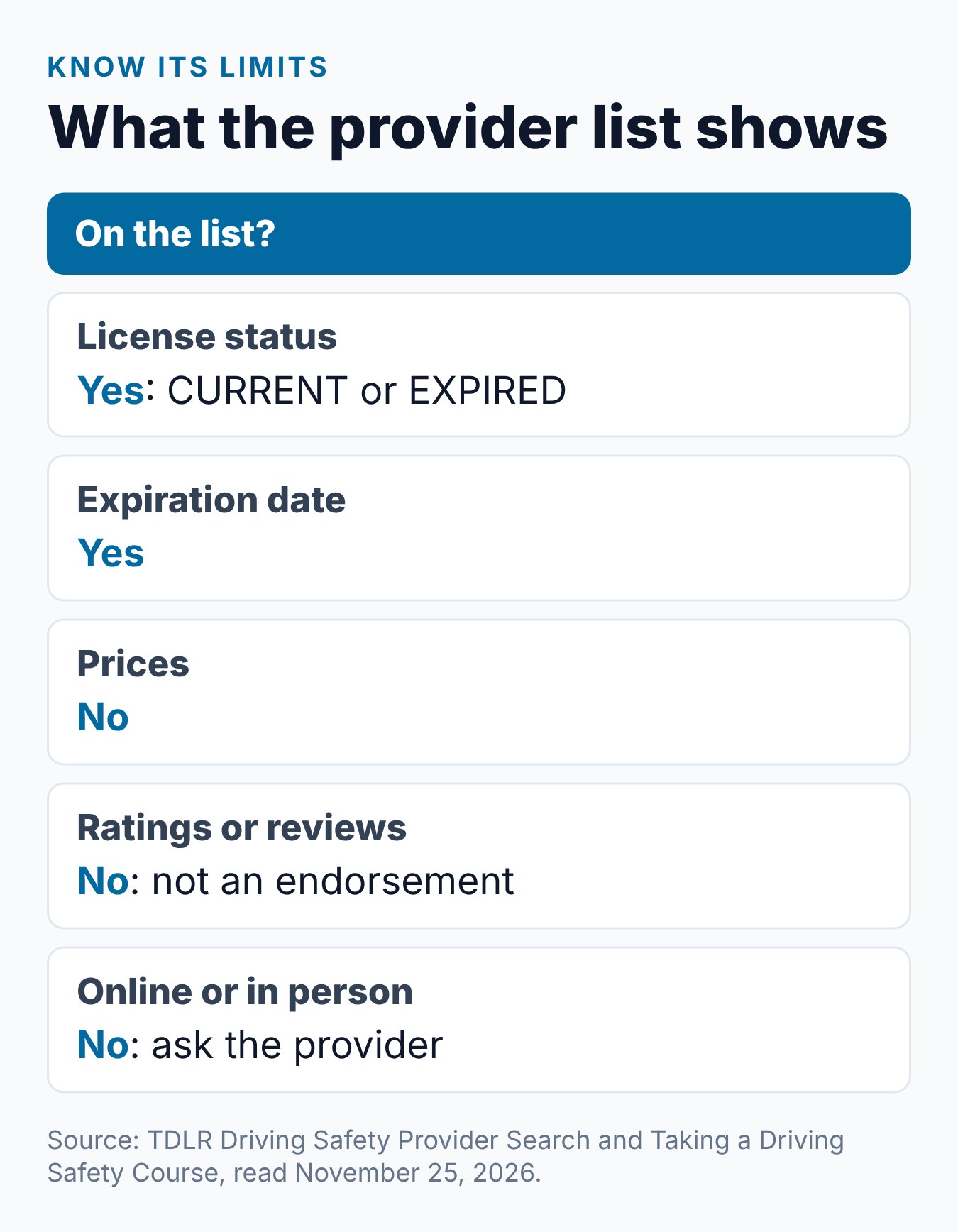
TDLR is clear about the purpose of this page. It says the directory is “provided for the sole purpose of verifying the license status” of the providers it regulates.
It also says: “Inclusion in this list is not an endorsement, recommendation, or advertising.” And TDLR’s student page says the agency cannot recommend a specific provider.
So the list answers one question: is this provider licensed? Here is what it does not show:
- No prices. You will not see what any course costs.
- No ratings or reviews. Nothing on the list says one provider is better.
- No ranking. The order of the results is not a “best of” list.
- No delivery method. It does not say online, in person or both.
That last point trips people up. TDLR’s student page says, “You must contact the provider to find out which delivery method they offer.” Use the phone number in the row, or the provider’s own website, to ask.
For help comparing licensed providers on price, format and support, see our guide on how to choose a Texas driving safety course.
A Licensed Provider Is Only Half the Answer for a Ticket
The list tells you about the business. It tells you nothing about your ticket.
TDLR’s student page puts the court first. If you plan to use the course for ticket dismissal, you must first receive notice from the Texas court system that you are eligible to take the course to dismiss the ticket.
You must make your request on or before the answer date on your citation. A court may still allow a later request, but it does not have to. Our article on the Texas defensive driving deadline covers that date in detail.
Who Cannot Use the Course for Dismissal
A CURRENT provider does not change who qualifies. Some drivers and some charges are left out of the right to dismissal:
- Commercial drivers. Anyone who holds a commercial driver’s license (CDL), or held one when the offense happened, cannot use the course for dismissal or deferred disposition, in any vehicle.
- High speeds. Speeding 25 mph or more over the limit, or 95 mph or more.
- School buses. Passing a school bus.
- Crash duties. Leaving the scene and other crash-duty offenses.
- Work zones. Work-zone offenses when workers are present.
- Serious offenses. Serious traffic violations and DWI.
Deferred disposition is a different court option with its own rules. Ask the court which option fits your case. The Texas Driver Safety Course (DSC) guide walks through the full dismissal process.
A Second Official Check After the Course
The provider list is for before you enroll. TDLR has a separate tool for after you finish, called Validate a Driving Safety Certificate.
It looks up a certificate number, not a provider. TDLR’s example number looks like CP123-12345678. For a driving safety certificate, you type only the numbers after the dash.
TDLR says certificates may take up to 5 days after the issuance date to appear. If yours does not show up at first, that delay is the likely reason. Our certificate guide explains what to do with the certificate once you have it.
What We Found When We Read the List
On November 25, 2026, we read TDLR’s Driving Safety Provider Search and the data the page loads. Here is what stood out:
- Expired licenses stay on the list. Rows marked EXPIRED sat next to rows marked CURRENT, so the status field does real work.
- The page states its own limits. It says it is there “for the sole purpose of verifying the license status” of providers, and that inclusion is not an endorsement.
- There is no field for format. Nothing in a row says online or in person, even though that is often the first thing drivers want to know.
- There is no field for price. Every row has the same five fields, and cost is not one of them.
The takeaway is simple. The state’s list is a license checker, not a shopping guide. Use it to rule providers in or out, then compare the ones that pass.
Common Mistakes to Avoid
Each of these comes from how the list works or from TDLR’s own words:
- Trusting a list on another site. Only TDLR’s search is the state’s list. Confirm every name there.
- Stopping at the name. A name can be on the list with an EXPIRED status. Read the status and the expiration date.
- Reading the order as a ranking. TDLR says inclusion is not an endorsement or recommendation.
- Assuming a ZIP result means a local class. The list does not show whether a provider teaches online or in person.
- Looking for a course name. The list names providers. Search for the business, not the class title.
- Enrolling before the court says yes. For a ticket, get the court’s notice first and ask by the answer date.
- Asking the wrong agency. TDLR licenses providers. DPS handles driver licenses and driving records.
How Requirements Can Vary
The driving safety course rules come from Texas law and TDLR and apply statewide. Each justice or municipal court still sets its own fees, filing steps and contact methods, and the facts of your citation decide which options you have.
Laws, fees and court procedures can change. Check your citation, ask the court that handles your case, and use the TDLR and Texas DPS websites for current rules before you act.
Frequently Asked Questions
Is there a list of Texas approved defensive driving courses?
Yes. The official list is TDLR’s Driving Safety Provider Search. It lists licensed providers rather than single courses, and any licensed provider may offer the 6-hour course.
Why does the list show providers instead of courses?
Texas law licenses the business that teaches the course. A person may not provide driving safety courses without a driving safety provider license, so the state tracks providers.
What should I check in each row?
Check the status and the expiration date first. The list holds both CURRENT and EXPIRED licenses, so the status must say CURRENT. Then match the name and license number to the course website.
Does the list show prices or online classes?
No. The list has no prices, ratings or reviews. It also does not say whether a provider teaches online or in person, so you must contact the provider to ask.
Does TDLR recommend any provider on the list?
No. TDLR says inclusion in the list is not an endorsement, recommendation, or advertising. It also says it cannot recommend a specific provider.
Does using a listed provider mean my ticket will be dismissed?
No. The court decides that. You must first receive notice from the court that you are eligible, and you must ask on or before the answer date on your citation.
How do I check my certificate after the course?
Use TDLR’s Validate a Driving Safety Certificate tool. Enter the numbers after the dash, and allow up to 5 days after the issuance date for it to appear.
Conclusion
The list of Texas approved defensive driving courses is TDLR’s Driving Safety Provider Search, and it lists licensed providers rather than courses. Search by license number when you can, and use a provider only if its row says CURRENT. For a ticket, get the court’s notice and ask by the answer date before you enroll. When you have checked the license, you can take Driving Logic’s defensive driving course texas.
Related Articles
- Texas Driver Safety Course (DSC): The Complete Guide
- Texas Approved Defensive Driving Course: Approved by Whom?
- Best Defensive Driving Course Texas: How to Choose
- Texas Driver Safety Course Certificate: What It Is and How to Submit It
- Best Online Defensive Driving Course Texas: How to Choose
- Texas Driving Safety Course Certificate: Proof for Court
Sources
- TDLR — Driving Safety Provider Search
- TDLR — Taking a Driving Safety Course
- TDLR — Validate a Driving Safety Certificate
- Texas Code of Criminal Procedure Chapter 45A (PDF)
- Texas Education Code Chapter 1001
- Texas DPS — How to Order Your Driver Record
- List review: Driving Logic reading of TDLR’s Driving Safety Provider Search, November 25, 2026.
Billy Forte is the owner of Driving Logic, a state-approved driver improvement course provider serving Texas and other U.S. states.
This article is general information, not legal advice. Texas traffic and driving safety course rules are set by Texas law, TDLR, Texas DPS and each court, and they can change. Check with the court on your citation and the official TDLR and DPS websites for current requirements, and talk to a Texas lawyer about your specific case.