
Updated November 2026 · Reviewed by Billy Forte
Drivers license requirements are set by each state, so there is no single list for the whole country. The list that counts is the one your own state’s licensing agency publishes. Most states group their requirements in similar ways, though, so you can know what kinds of proof to look for before you read it.
Key Facts
- Who sets the list: your state, not the federal government. See why it depends on your state.
- Common proof: USAGov says most states ask for proof of identity, Social Security number and residency. See the kinds of requirements.
- Where to read it: your state agency’s page, through USAGov’s directory. See finding the official list.
- Texas: DPS lists eight items to gather before your visit. See the Texas list.
- Texas ages 18 through 24: a six-hour adult course is on that list for a first license. See the course item.
- Florida: FLHSMV asks for identity, Social Security and two address proofs. See Florida in brief.
Why Requirements Depend on Your State
Every driver license in the country is issued by a state. USAGov’s REAL ID page calls them state-issued driver’s licenses.
The same page says your state decides the process and the documents needed for a REAL ID card. It then tells you to visit your state’s licensing agency website for what to bring.
That is the whole reason a national checklist does not work. Two states can ask for different papers, different courses and different tests. Even the agency name changes.
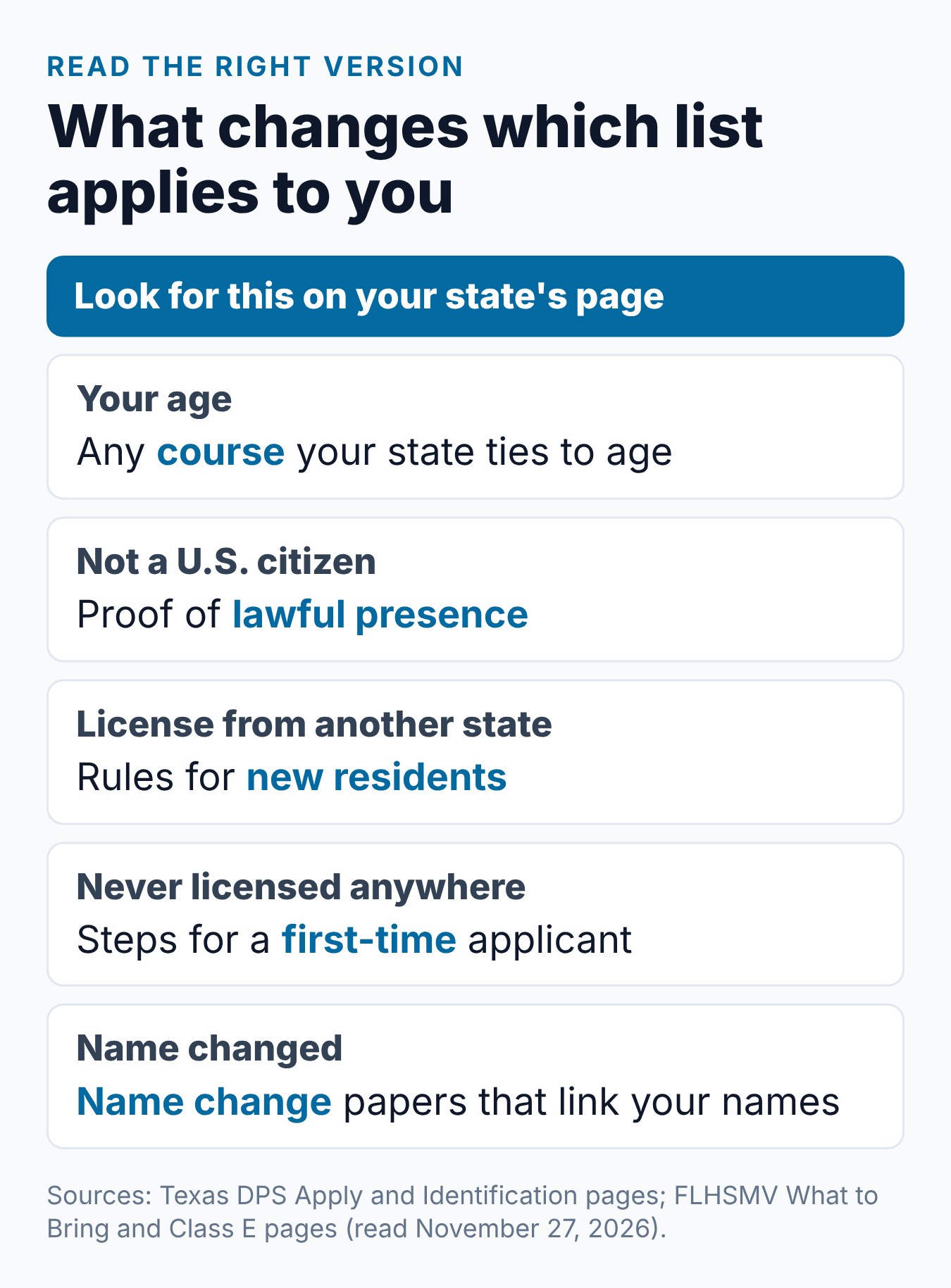
So the useful question is not “what does everyone need?” It is “what does my state list for someone like me?” Your age, your citizenship and whether you were licensed before can all change the answer.
The Kinds of Requirements to Look For
You can still prepare before you find your state’s page. USAGov gives a general picture of the documents states ask for.
It says that in most cases, your state licensing agency will want proof of three things for a REAL ID:
| Proof of | Example documents USAGov lists |
|---|---|
| Identity | U.S. birth certificate, U.S. passport, or a Permanent Resident Card for non-citizens |
| Social Security number | Social Security card, Form W-2, or a pay stub or paycheck |
| Residency in the state | Deed, mortgage statement, lease, utility bill or bank statement |
These are examples, not a promise that your state accepts each one. Your state’s list is the one to follow.
Beyond documents, the Texas and Florida pages read for this guide group their requirements into a few more kinds. Look for each kind on your own state’s page:
- Driver education. Some states require a course for certain ages or for first-time applicants.
- Tests. Look for a vision test, a knowledge test on signs and laws, and a driving test.
- Fees. States post their own license fees.
- Insurance. Some states ask about vehicle insurance.
Where to Find Your State’s Official List
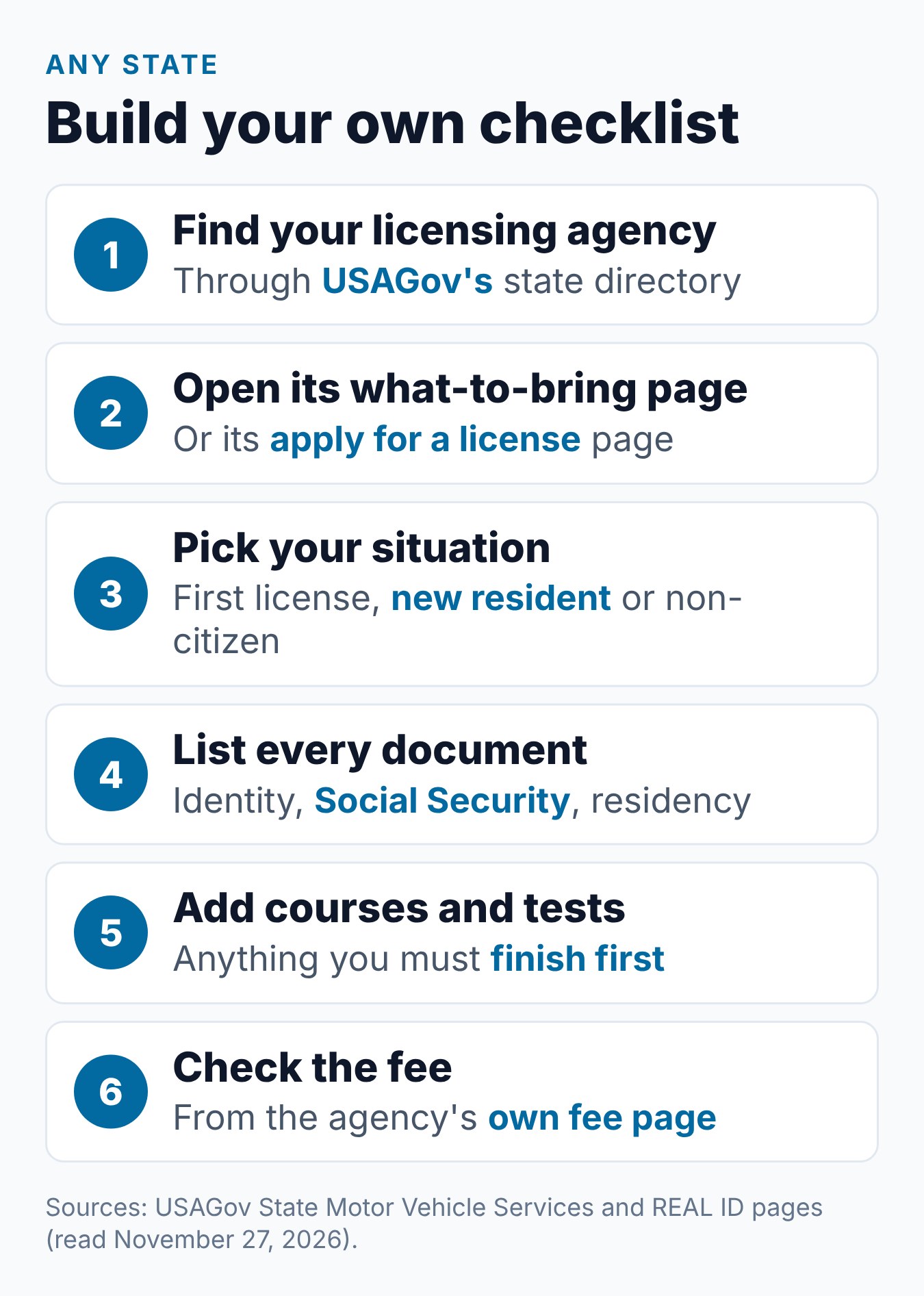
Start at USAGov’s State Motor Vehicle Services page. Pick your state or territory, and follow the link to the agency that handles driver licenses.
Some states split licensing and vehicles into separate agencies. FLHSMV’s Locations page says so. Make sure the page you open is about licenses.
On the agency’s site, look for pages named “what to bring,” “apply for a license” or “new drivers.” Read the version for your situation, such as a first license, a new resident or a non-citizen.
If your state offers a document check tool, use it. These tools ask questions and build a list just for you.
To turn the list into action, see How to Get a Drivers License: Steps in the United States, which covers the order of the steps.
Drivers License Requirements in Texas
Texas is the state this site covers in detail. In Texas, the Department of Public Safety (DPS) issues driver licenses, not a DMV.
Here is what DPS lists under “Step 1. Gather the Required Documentation” on its Apply for a Texas Driver License page, read on November 27, 2026. The names are DPS’s own:
- Proof of U.S. Citizenship or Lawful Presence (if not a U.S. citizen)
- Proof of Texas Residency
- Proof of Identity
- Social Security Number
- Evidence of current Texas Vehicle Registration for each vehicle you own. DPS says this applies only to new residents surrendering an out-of-state license.
- Proof of Insurance for each vehicle you own, or a statement that you do not own a vehicle
- Impact Texas Driver (ITD) certificate, if you will take a driving test
- A six-hour adult Driver Education course, if you are 18 through 24 and applying for your first Texas license
DPS also says that if you already have a Texas ID card, you surrender it when you apply for a driver license.
The Texas-only guide to each item is Texas Driver’s License Requirements: Everything You Need Before Your DPS Appointment.
Proof of Identity in Texas
DPS’s Identification Requirements page gives three ways to prove identity. You bring one primary document, or two secondary documents, or one secondary document plus two supporting documents.
DPS also says the name and date of birth on your documents must match. It does not accept photocopies.
The full Texas document list is in What Documents Do You Need for Your First Texas Driver’s License?
Non-citizens have extra steps in Texas. See Texas Driver’s License for Immigrants and Non-Citizens.
The Course and Video Items
Two items on the DPS list are not papers you already own. You earn them first.
The adult course. DPS lists the six-hour adult course for ages 18 through 24 getting a first Texas license. Transportation Code Sec. 521.1601 backs this up: DPS may not license a person under 25 without a driver education certificate.
DPS waives the course for new residents 18 or older who surrender a valid, unexpired license from another state. It lists no driver education requirement for ages 25 and older.
Only a course approved by the Texas Department of Licensing and Regulation (TDLR) counts. To check your own case by age, use TDLR’s Do I Need Driver Education page. The adult course is not defensive driving, which is a separate course for tickets or insurance.
The ITD certificate. DPS’s ITD program page says adults watch Impact Texas Adult Drivers (ITAD), a one-hour video on distracted driving.
The certificate is valid for 90 days. You print it and bring it to the driving test.
Tests and Fee in Texas
At the office, DPS lists a vision exam, a written knowledge test and a driving skills test. You may finish the testing at DPS or with a third-party provider.
DPS’s Driver License Fees page lists $33 for a new license at ages 18 to 84. It says the license expires after eight years, on your birthday.
Florida in Brief
In Florida, the Department of Highway Safety and Motor Vehicles (FLHSMV) issues licenses. Its What to Bring page for U.S. citizens lists three groups:
- Primary identification, such as a U.S. birth certificate or a valid U.S. passport
- Proof of Social Security, such as a Social Security card or a W-2
- Two proofs of residential address with a Florida address
FLHSMV’s Class E exam page adds a course rule: if you have never held a license in any state or country, you complete a TLSAE course before you apply. For teens, see Florida Learner’s Permit Documents: What to Bring.
When Your Name Has Changed
A name change is one of the most common reasons a document list gets longer. Both states read for this guide address it directly.
Texas. DPS’s Identification Requirements page says that if you use a name other than the one on your birth certificate, you must show legal proof of the change. It lists these as acceptable:
- a marriage license
- a divorce decree
- an original or certified copy of a revised birth certificate
- a court ordered name change
- a Department of State Health Services marriage verification letter
DPS adds that these must be originals or certified copies, and certified copies should not be laminated.
Florida. FLHSMV’s What to Bring page says a person who changed their name by marriage, divorce or court order must bring the original or a certified copy of that record. It says photocopies and church-issued marriage certificates are not accepted.
FLHSMV also says the name tied to your Social Security number must match the name on your license. It suggests updating your Social Security record first.
If your name changed, gather these papers early. Ordering a certified copy can take time.
Texas and Florida Requirements Compared
This shows how two states answer the same question. Each cell comes from the official pages above.
| Requirement | Texas (DPS) | Florida (FLHSMV) |
|---|---|---|
| Address proof | Proof of Texas Residency | Two documents with a Florida address |
| Social Security | Social Security Number | An original document with your full SSN |
| Course before a first license | Six-hour adult course, ages 18 through 24 | TLSAE, if never licensed anywhere |
| Insurance | Proof for each vehicle you own, or a no-vehicle statement | Not on the U.S. citizen document list |
What the Official Pages Show
We read the USAGov, DPS, TDLR, statute and FLHSMV pages behind this guide on November 27, 2026. The goal was to see what a “requirements” list really contains.
Three things stood out:
- Identity, Social Security and address show up everywhere. USAGov, DPS and FLHSMV all list them.
- Courses and tests differ most. Texas ties its course to age; Florida ties its course to never having held a license.
- Each list has fine print. Texas adds insurance and an ITD certificate; Florida asks for two address proofs.
One FLHSMV first-time driver page that older guides link to returned “Page Not Found” during this review. The FLHSMV pages linked above were used instead.
Common Mistakes to Avoid
These come from the official pages above:
- Using another state’s list. Each state publishes its own.
- Bringing photocopies. Texas DPS does not accept them for identity.
- Mismatched names. In Texas, the name and birth date on your documents must match, or you need name change papers.
- Forgetting earned items. The Texas adult course and ITD certificate take time to complete.
- Letting ITAD expire. The Texas certificate is valid for 90 days.
- Keeping two cards. Texas DPS says you surrender a Texas ID card when you get a license.
How Requirements Can Vary
Texas driver license rules come from state law, Texas DPS rules and TDLR rules, and they apply statewide. What you need still depends on your age, whether you hold a license from another state, and which tests you have already passed.
Laws, fees and office procedures can change. Check the Texas DPS and TDLR websites for current rules before you book an appointment or enroll in a course.
Frequently Asked Questions
What do you need to get a drivers license?
It depends on your state. USAGov says most states ask for proof of identity, Social Security number and residency, and your state’s agency lists the rest.
Are drivers license requirements the same in every state?
No. USAGov says your state decides the process and the documents. Courses, tests and fees also differ.
Where can I find my state’s list?
Use USAGov’s State Motor Vehicle Services page to reach your state’s licensing agency. Look for its “what to bring” or “apply” page.
What does Texas require for a first license?
DPS lists proof of identity, Texas residency and Social Security number, plus insurance proof. Applicants 18 through 24 also need the six-hour adult course.
How much is a new Texas license?
DPS lists $33 for a new license at ages 18 to 84. That fee includes a $1 administrative fee.
What does Florida ask a first-time adult to bring?
FLHSMV lists primary identification, proof of Social Security and two proofs of a Florida address for U.S. citizens. A TLSAE course comes first if you were never licensed.
Conclusion
Drivers license requirements come from your own state, so start with its official list and read the version for your situation. Expect proof of identity, Social Security number and residency, plus any course or test your state adds. In Texas, DPS lists eight items, and ages 18 through 24 need the adult course for a first license. If that is you, start with texas adult drivers ed.
Related Articles
- How to Get a Texas Driver’s License at 18: The Complete Step-by-Step Guide
- How to Get a Drivers License: Steps in the United States
- Drivers License Appointment: How to Book One in Your State
- Texas Driver’s License Requirements: Everything You Need Before Your DPS Appointment
- How Much Does It Cost to Get Your First Texas Driver’s License?
Sources
- Texas DPS — Apply for a Texas Driver License
- TDLR — Do I Need Driver Education?
- Texas Transportation Code Chapter 521 (PDF)
- USAGov — How to Get a REAL ID
- USAGov — State Motor Vehicle Services
- Texas DPS — Identification Requirements
- Texas DPS — Impact Texas Drivers (ITD) Program
- Texas DPS — Driver License Fees
- Texas Transportation Code Chapter 521 (HTML)
- FLHSMV — What to Bring: U.S. Citizen
- FLHSMV — Class E Knowledge Exam and Driving Skills Test
- FLHSMV — Locations
Billy Forte is the owner of Driving Logic, a state-approved driver improvement course provider serving Texas and other U.S. states.
This article is general information, not legal advice. Texas driver license and driver education rules are set by Texas law, Texas DPS and TDLR, and they can change. Check the official DPS and TDLR websites for current requirements before you apply.