
Updated October 2026 · Reviewed by Billy Forte
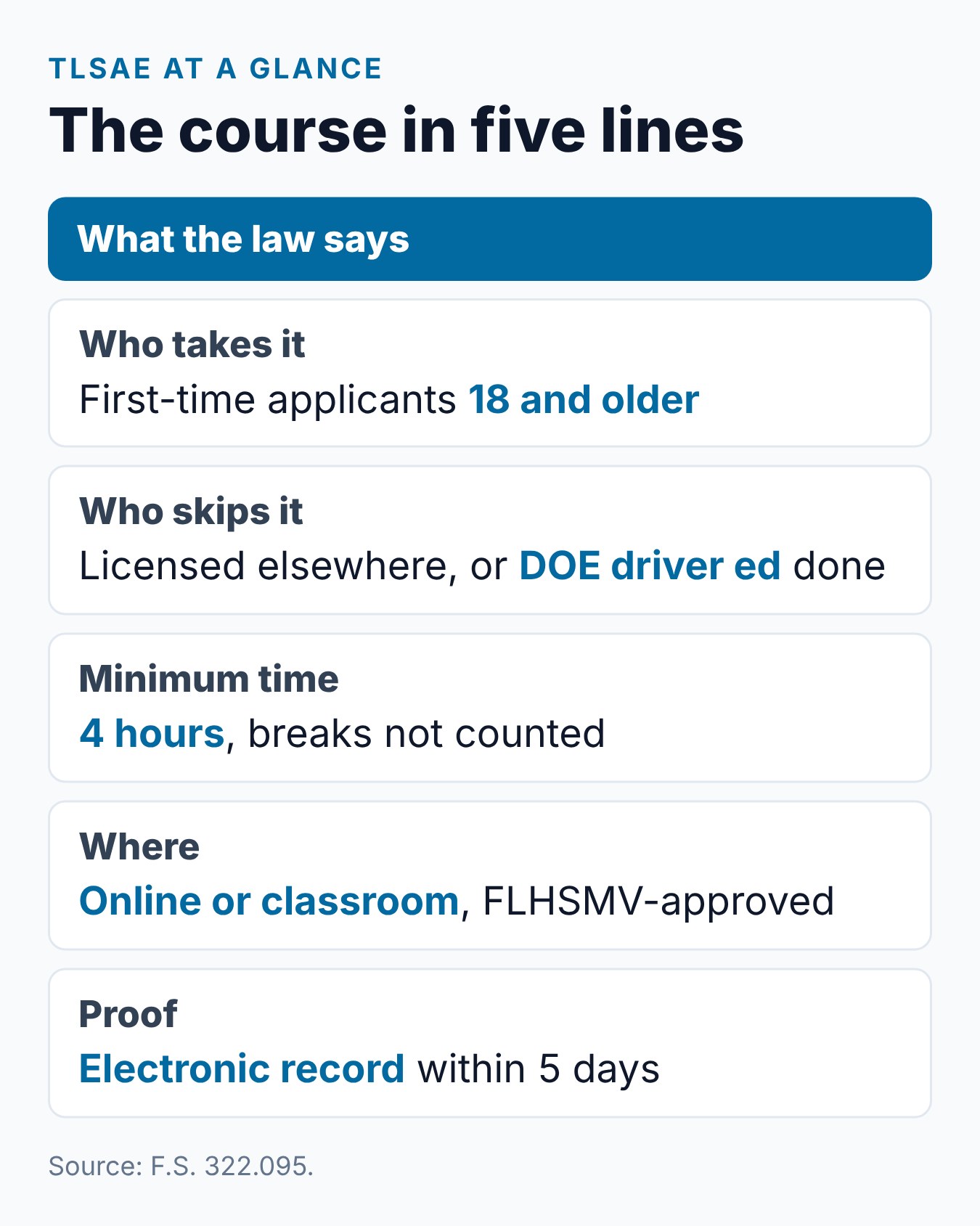
The Florida drug and alcohol course is the 4-hour Traffic Law and Substance Abuse Education course, or TLSAE, that most adults take before their first Florida driver license. Florida law requires it for license applicants 18 and older, unless they were licensed in another jurisdiction or finished a Department of Education driver education course. Teens under 18 take the 6-hour DETS course instead.
Key Facts
- Who: First-time license applicants 18 and older. See who needs it.
- Length: At least 4 hours of content, not counting breaks. See the time rules.
- Format: Online or in a classroom, from an FLHSMV-approved provider. See your options.
- Proof: The provider reports your completion to FLHSMV electronically within 5 days. See the completion record.
- Next: The 50-question knowledge exam in person, the vision test and the driving skills test. See what comes after.
What the Course Is
TLSAE is a short safety class set by Florida law. The rules for it are in F.S. 322.095, which names the topics, the minimum time and how completion is reported.
You may not hear it called TLSAE. People search for the “drug and alcohol course,” the “4-hour course” or the “first-time driver course.” All of these mean the same class.
FLHSMV doesn’t teach the course itself. It approves private providers, and those providers sell it online or in a classroom. You pick a provider from FLHSMV’s approved TLSAE list.
For a deeper look at the name, the law and how approval works, read What Is the Florida TLSAE?.
Who Needs the Florida Drug and Alcohol Course
You need TLSAE if you are 18 or older and applying for your first driver license in Florida. That includes adults who never drove before and adults who learned to drive but never held a license.
The course is a step before licensing, not a penalty. Taking it doesn’t mean you did anything wrong.
Who Is Exempt
F.S. 322.095 lists two exemptions:
- You were licensed in another jurisdiction. This covers people with a license from another state or country.
- You completed a Department of Education driver education course. This is the driver education class offered through Florida schools.
If you move to Florida with a valid license from another state, you usually transfer it instead. See our new Florida resident guide for that path.
Teens Take DETS Instead
Since August 1, 2025, teens under 18 take the 6-hour Driver Education Traffic Safety course, called DETS, before a learner’s license. TLSAE was not dropped. It still applies to adults.
So your age on the day you apply decides the course. If you are 17, take DETS, and if you are 18 or older, take TLSAE.
Our DETS vs TLSAE comparison explains the switch in detail.
What the Course Covers
The law lists the topics every approved course must teach:
- Florida laws on driving
- The physical and mental effects of alcohol and drug abuse
- The social and economic costs of alcohol and drug abuse
- How alcohol and drugs affect driving
- Safety for motorcyclists, bicyclists and pedestrians
- Risky habits such as speeding, reckless driving and running red lights and stop signs
- What happens when drivers use electronic devices while driving
Each provider builds its own lessons around this list. Some use video and some use reading and short quizzes, but the required topics are the same everywhere.
The course doesn’t replace the driver handbook. The knowledge exam later asks about signs, right-of-way and many rules the course only touches on.
How Long the Course Takes
F.S. 322.095 sets a floor of 4 hours of course content. Breaks don’t count toward those hours, and breaks may total no more than 30 minutes.
The online providers we reviewed let you stop and come back later. You don’t have to finish in one sitting if your provider saves your place.
Plan a little more time than 4 hours. The final exam and any slower sections add to it. Our article on how long the Florida drug and alcohol course takes breaks down the full timeline.
Online or Classroom
Approved providers offer TLSAE online, in a classroom or both. Both formats teach the same required topics, and both count the same for licensing.
Online lets you study on a computer or phone at your own pace.
A classroom course runs on a set schedule with an instructor. The law requires classroom locations to be free of distractions and reasonably accessible.
How to choose between them:
- Pick online if you work odd hours, want to split the course into sessions or don’t live near a classroom.
- Pick a classroom if you learn better with an instructor and a fixed time, or you’d rather not study on a screen.
- Either way, confirm the provider is on FLHSMV’s list and read its exam and retake rules first.
See our guide to the Florida TLSAE course online for how the online version works from start to finish.
The Course Final Exam
Three of the four providers we reviewed list their own final exam. No statewide rule we found sets its length or passing score, so each provider sets its own.
We reviewed four approved providers’ public pages on October 20, 2026. Two list 40 multiple-choice questions with 80% needed to pass, and two list unlimited retakes. Check your provider’s rules before you start.
This exam is not the permit test. Our article on the Florida drug and alcohol course test explains the difference.
What the Course Costs
Providers set their own prices, and FLHSMV doesn’t run a free version. In our October 20, 2026 review, list prices were $19.95, $20 plus a separate $8 certificate and handling fee, and $29.95. One provider didn’t show a price.
The law adds a few fee rules:
- Schools collect a $3 assessment fee per student for the state.
- Providers must disclose all fees and can’t add hidden fees during sign-up.
- Providers can’t make you buy a completion certificate.
The course is separate from state license fees. FLHSMV lists $48 for an original Class E license, and most tax collector offices add $6.25. Our TLSAE cost guide covers “free” offers and total costs.
Your Completion Record
When you finish, the provider reports your completion to FLHSMV through its Driver Improvement Certificate Issuance System. The law gives providers 5 days and doesn’t let them charge you for it.
Only that electronic record counts for licensing. Paper certificates are not accepted, even if a provider offers one.
A printed copy is still a handy backup. Our article on the Florida drug and alcohol course certificate explains what to check and what to do if your record is missing.
How to Find an Approved Course
Start with FLHSMV’s approved TLSAE provider list. A course that isn’t on it won’t count.
Some schools sell an approved provider’s course under their own brand name. If a school’s name isn’t on the list, ask which approved provider’s course it uses.
Our guide on how to get an FLHSMV-authorized TLSAE course walks through the checks to make before you pay.
How FLHSMV Oversees Providers
Approval isn’t a one-time stamp. F.S. 322.095 gives FLHSMV several ways to keep courses in line:
- Review before approval. FLHSMV reviews the course materials, a presentation by the provider and the provider’s plan for overseeing instructors.
- Updates on request. A provider must update its course within 90 days when FLHSMV asks, or its approval is suspended.
- Records. Providers keep course records for 5 years and make them available to FLHSMV.
- Effectiveness studies. FLHSMV studies each delivery method every 5 years, looking at DUI citations, moving violations or crashes.
FLHSMV can suspend or revoke a provider. Certificates from courses taken after a suspension or revocation are not accepted, which is one more reason to check the list right before you pay.
Tips to Finish Without Delays
A little planning keeps the course from holding up your license:
- Use your legal name and birth date. They should match the identity documents you bring to the office.
- Keep your login details. The online courses we reviewed save your place, but only if you can sign back in.
- Finish a week before your office visit. That covers the 5-day reporting window.
- Save your confirmation. A copy helps if the record is late or a detail is wrong.
- Start studying the handbook early. The knowledge exam covers more than the course does.
If you can’t finish because of the provider’s or school’s error, the law requires the provider to let you complete the course at no extra cost.
After the Course
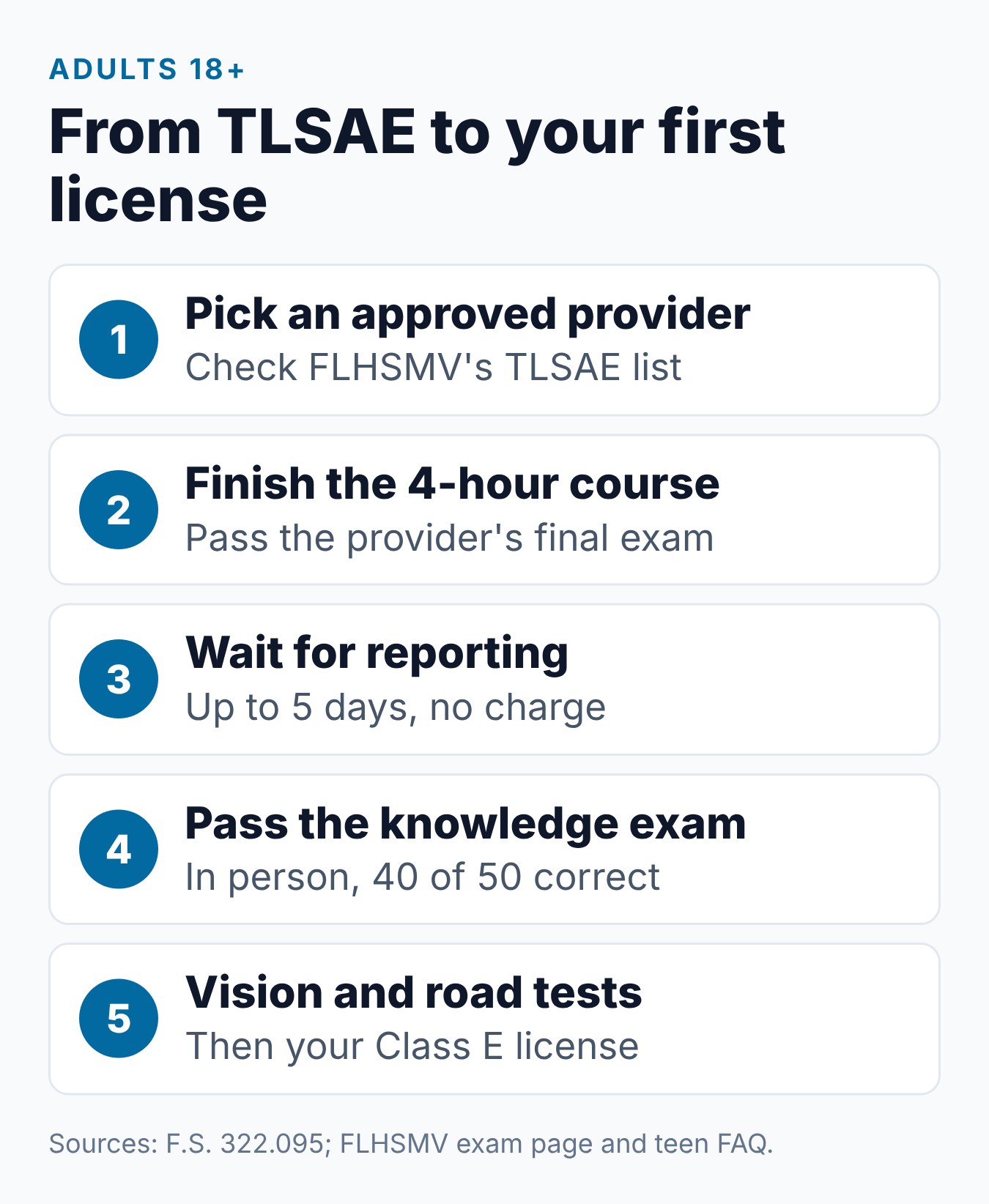
TLSAE is one step. After your completion is on file, adults still need to pass these at a driver license office:
- The Class E knowledge exam. It has 50 questions, and you need 40 correct. Adults take it in person, because online knowledge exams are for applicants under 18 only.
- The vision test. It’s done at the office.
- The driving skills test. You bring a registered, insured vehicle.
Since February 6, 2026, Florida gives driver license exams in English only. Plan your study around that.
Adults don’t need a learner’s license first. Our guides to the permit test for adults and the first-time adult license process cover each visit.
Common Mistakes
These mix-ups slow people down:
- Taking TLSAE at 17. Teens under 18 now need DETS.
- Using an unapproved course. Check FLHSMV’s list before you pay.
- Booking the office visit too soon. Allow up to 5 days for the provider to report.
- Relying on a paper certificate. Only the electronic record counts.
- Thinking the course final is the permit test. The knowledge exam is a separate test at the office.
How Requirements Can Vary
Florida’s course and license rules apply statewide, but some details depend on where you live. Driver license services are often handled by your county tax collector’s office, and each office sets its own appointment process and hours. Some county school boards also offer driver education programs, such as DELAP courses, that can count instead of DETS.
FLHSMV can update course rules, forms, documents, and fees. Check FLHSMV and your county office for current requirements before your appointment.
Frequently Asked Questions
What is the Florida drug and alcohol course?
It’s the 4-hour Traffic Law and Substance Abuse Education course, or TLSAE. Florida requires it for most first-time license applicants 18 and older.
Do I need TLSAE if I’m under 18?
No. Since August 1, 2025, teens under 18 take the 6-hour DETS course instead.
Who is exempt from TLSAE?
Anyone licensed in another jurisdiction, and anyone who completed a Department of Education driver education course.
Can I take the Florida drug and alcohol course online?
Yes. FLHSMV-approved providers offer it online, in a classroom or both.
How does FLHSMV know I finished?
Your provider reports it electronically within 5 days at no charge. Only that electronic record counts for licensing.
Is the course test the same as the permit test?
No. The course final is the provider’s own exam. The 50-question knowledge exam is a separate test you take in person.
Is there a free Florida drug and alcohol course?
FLHSMV doesn’t offer one. Providers set their own prices, so check the full cost, including any certificate fee.
Conclusion
The Florida drug and alcohol course is a 4-hour TLSAE class that most adults 18 and older finish before their first license.
Pick a provider on FLHSMV’s approved list, allow up to 5 days for reporting, then book the knowledge, vision and road tests. Teens under 18 take DETS instead. Our online Florida TLSAE course is coming soon.
Related Articles
- Florida Drug and Alcohol Course Cost: Is There a Free Option?
- Florida TLSAE Course Online: How to Take It and What It Covers
- What Is the Florida TLSAE? Traffic Law and Substance Abuse Education Explained
- Florida Drug and Alcohol Course Certificate: What It Is and What to Do With It
- How Long Is the Florida Drug and Alcohol Course (TLSAE)?
- Florida Drug and Alcohol Course Test: What to Expect
- How to Get a FLHSMV-Authorized TLSAE Course in Florida
Sources
- Florida Statutes — F.S. 322.095 (TLSAE)
- FLHSMV — Approved TLSAE Course Providers
- FLHSMV — First-Time Florida Driver
- FLHSMV — Driver Education Courses
- Florida Statutes — F.S. 322.1615 (Learner’s Driver License)
- FLHSMV — Driver Education Traffic Safety (DETS) and approved provider list
- FLHSMV — Class E Knowledge Exam and Driving Skills Test
- FLHSMV — Teen Licensing Frequently Asked Questions
- FLHSMV — Driver License and ID Card Fees
- Hillsborough County Tax Collector — Driver License Exams in English Only Beginning February 6
Billy Forte is the owner of Driving Logic, a state-approved driver improvement course provider serving Florida and other U.S. states.
This article is general information, not legal advice. Florida licensing requirements, course rules, documents, and fees are set by FLHSMV and Florida law and can change. Use official FLHSMV and Florida statute sources for current requirements before you enroll in a course or visit a driver license office.