
Updated November 2026 · Reviewed by Billy Forte
The short answer to how does parent taught drivers ed work in Texas is a set order: a parent becomes the instructor through TDLR, the teen takes a parent-taught course from a TDLR-licensed provider, gets a learner license at Texas DPS, completes 44 in-car hours, finishes Impact Texas Teen Drivers, and passes the driving test for a provisional license. The Texas Department of Licensing and Regulation (TDLR) approves the instructor and licenses the course providers, while the Texas Department of Public Safety (DPS) issues both licenses. The parent named on the TDLR designation goes to the DPS office with the teen twice, once for each license.
Key Facts
- Nine steps: each step needs the one before it, so the order matters. See the checklist.
- Two agencies: TDLR handles the instructor and the course rules, and Texas DPS handles the licenses. See who does what.
- First fee: the TDLR instructor designation costs $20, one application per child. See step 2.
- Hours: 24 classroom hours and 44 in-car hours. See step 4 and step 6.
- Last stop: Impact Texas Teen Drivers, then the road test for a provisional license. See step 8.
How Does Parent Taught Drivers Ed Work in Texas: The Short Answer
Parent taught drivers ed (PTDE) is one of four ways a Texas teen under 18 can take driver education. The DPS page Choosing a Driver Education Course lists it next to driving schools, online school courses and public school programs. In PTDE, a parent or guardian teaches, and the lessons come from a licensed provider.
TDLR’s Getting Started page gives the size of the job. The course has 24 hours of classroom instruction, 7 hours of observation, 7 hours of behind-the-wheel training and 30 more hours of behind-the-wheel practice. TDLR also says to read its parent-taught pages before you begin.
This article is the short checklist. Each step says who does it, what you need before it, and what you hold when it is done.
If you want to know how the online lessons themselves work, see How Texas Parent Taught Drivers Ed Works Online. For the whole program on one page, read the complete PTDE guide.
PTDE is a teen program. Adults 18 and older take a separate adult driver education course when the law requires one, so this checklist does not apply to them.
Who Does What
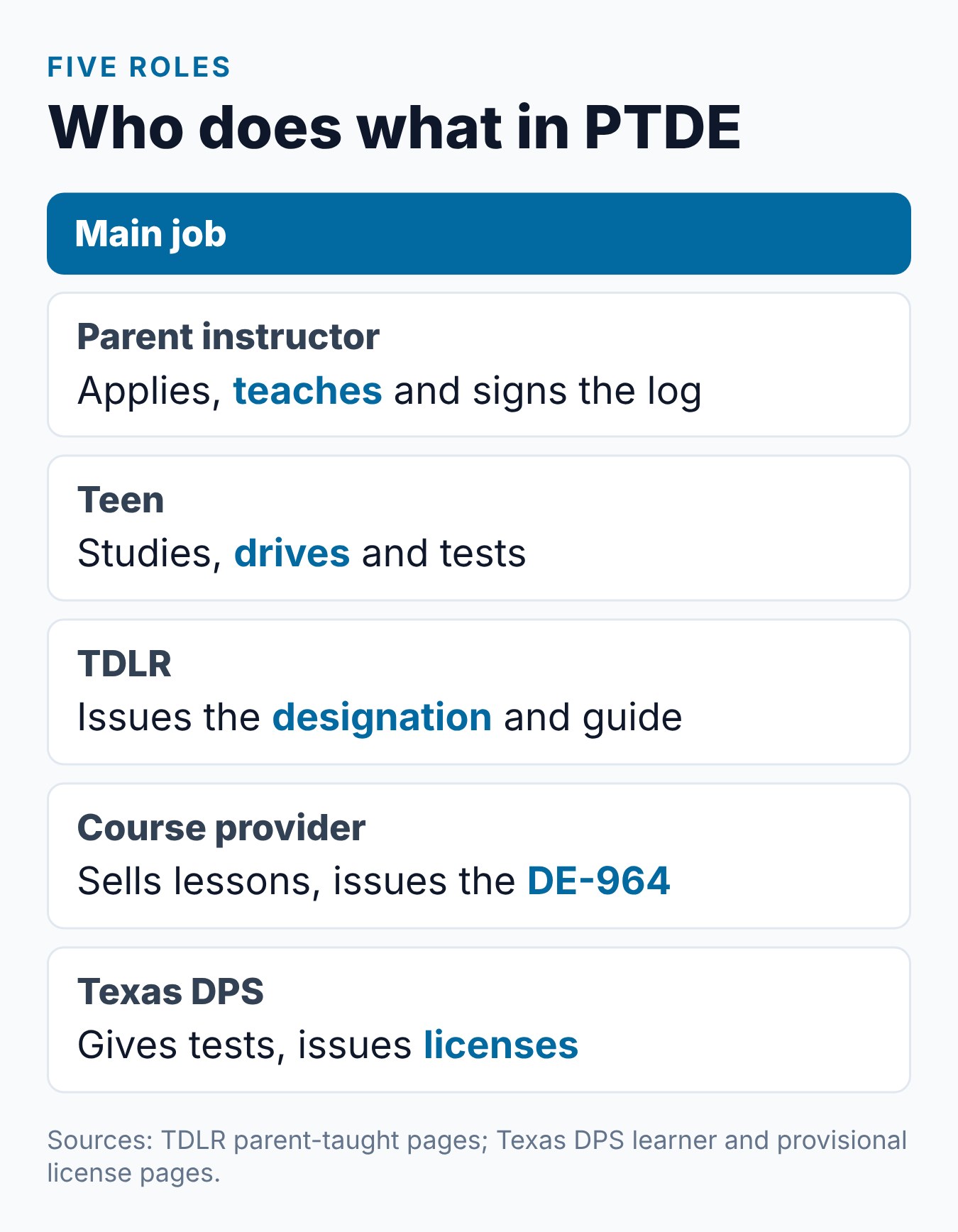
Five people or groups share the work. Knowing who owns each task saves calls to the wrong office.
- The parent instructor: applies to TDLR, teaches the lessons, rides along for the in-car hours, signs the practice log and goes to both DPS visits.
- The teen: studies the lessons, takes the knowledge test, drives the hours, watches Impact Texas Teen Drivers and takes the road test.
- TDLR: checks the instructor application, issues the designation and sends the PTDE Program Guide.
- The course provider: sells the parent-taught curriculum and issues each part of the DE-964 certificate.
- Texas DPS: checks the instructor’s driving record, gives the tests and issues the learner and provisional licenses.
Many people say “Texas DMV” when they mean the license office. In Texas, driver licenses come from Texas DPS, and the Texas Department of Motor Vehicles (TxDMV) handles vehicle titles and registration.
TDLR does not pick a course for you. Its classroom page says TDLR cannot recommend specific courses, and its instructor page says TDLR will not text or email you to send you to a provider.
The Parent-Taught Checklist, Step by Step
Tick off each step before you move to the next. The order below follows TDLR’s five-part guide and the DPS teen license pages.
Step 1: Check That the Adult Can Teach
- Who does it: the parent, guardian or alternate who wants to teach.
- Before it: a teen under 18 who will take driver education.
- After it: you know whether this adult can be the instructor.
TDLR’s Become an Instructor page says the instructor needs an excellent driving history and no convictions for certain criminal offenses. A driver license with the B restriction rules a person out. A parent, legal guardian or judge can name an alternate instructor, who must meet the same rules and may not charge a fee.
The teen has to qualify too. A student without a diploma or equivalent must be enrolled in school or a high school equivalency program and meet the school’s progress and attendance rules.
DPS checks the instructor’s driving record at both license visits, so TDLR suggests buying a copy of the record first if the adult has had a ticket or crash in recent years. Our instructor requirements article covers each rule.
Step 2: Apply to TDLR for the Designation
- Who does it: the parent.
- Before it: an adult who passed step 1, and the teen’s legal name exactly as it reads on the birth certificate.
- After it: a TDLR receipt, the instructor designation and the PTDE Program Guide.
The application is online only, and TDLR does not take paper forms. The fee is $20 and is not refunded. One application covers one parent and one child, so a family teaching two teens applies twice.
After you apply, TDLR sends an email link with more details. The Program Guide also comes by email, and you can download it from the Parent Instructor Portal.
Keep the receipt, because TDLR lists it among the papers for both DPS visits. Our Program Guide article explains what is inside.
Step 3: Choose a Parent-Taught Course
- Who does it: the parent, often with the teen.
- Before it: the TDLR designation from step 2.
- After it: the course materials, so lessons can begin.
TDLR says to buy the curriculum from a licensed driver education provider with the parent-taught endorsement. Courses range in price, and TDLR says all of them were reviewed to meet its standards. Use TDLR’s provider search to confirm a course before you pay.
Lessons start only after TDLR confirms the designation and the provider sends the materials. Every student also needs the Texas Driver Handbook, which TDLR says is now online only, in English and Spanish. For a list of points to compare, see how to choose a parent-taught course.
Step 4: Start the Classroom Hours
- Who does it: the teen, with the parent as teacher and the provider’s lessons.
- Before it: the course materials and the designation confirmation.
- After it: enough classroom hours for the learner license, plus the first DE-964 portion.
The classroom part is 24 hours, and your method decides how much comes before the learner license. DPS describes the concurrent method as the first 6 hours, then the learner license, then the other 18 hours while the teen practices. The block method finishes all 24 hours first.
Under 16 TAC 84.43, the provider issues the “For Learner License Only” portion of the DE-964 after Module One. Some providers include the written knowledge test in the course, and if yours does not, the teen takes it at DPS. Our concurrent vs block article helps you choose.
Step 5: Get the Learner License at DPS
- Who does it: the teen, with the parent instructor on record.
- Before it: age 15, the learner license portion of the DE-964, a DPS appointment and the documents.
- After it: a learner license, so practice driving can start.
Book the visit at txdpsscheduler.com, where DPS allows appointments up to six months ahead. TDLR’s learner license page lists what a parent-taught student brings beyond the usual identity papers:
- Proof of Texas vehicle registration and vehicle insurance, or a signed statement if the family has no vehicle.
- The DE-964 showing classroom completion.
- A Verification of Enrollment and Attendance form, or a diploma or GED.
- The receipt from the instructor designation.
The DPS fee page lists the learner license for a teen under 18 at $16. For the full visit, see how to get a Texas learner’s permit at 15.
Step 6: Drive With the Parent and Keep the Log
- Who does it: the parent instructor and the teen, plus any other licensed adult who helps with practice.
- Before it: the learner license in hand. TDLR says no in-car lessons or practice may happen before it.
- After it: all 44 in-car hours done and a signed 30-hour log.
TDLR’s behind-the-wheel page splits the in-car part into 14 hours of instruction and 30 hours of practice, for 44 hours. The 14 hours are 7 hours of observation and 7 hours behind the wheel. At least 10 practice hours must be at night.
On a learner license, the teen drives only with a licensed adult 21 or older in the front passenger seat. A parent or guardian certifies the 30 practice hours on TDLR’s log form. Our driving log article shows how to fill it in.
Step 7: Finish the Course and Get the Second DE-964 Portion
- Who does it: the course provider, once the teen finishes.
- Before it: every classroom hour and every in-car hour complete.
- After it: the “For Driver License Only” portion of the DE-964.
The same rule, 16 TAC 84.43, says the provider issues this portion when the whole course is done. Parent-taught and driving school students get the DE-964. The DE-964E is the public school certificate, so a PTDE family should not expect that form.
If a provider will not send the certificate, TDLR asks you to email its customer service with the student’s full name and the course name. Our DE-964 article explains both portions.
Step 8: Complete Impact Texas Teen Drivers
- Who does it: the teen, online.
- Before it: the in-car hours finished.
- After it: a printed ITTD certificate that stays valid for 90 days.
Impact Texas Teen Drivers (ITTD) is a free, two-hour DPS video about distracted driving. The DPS ITD page says teens 15 to 17 in a parent-taught course must take it after behind-the-wheel training and before the road test. The teen signs up on the Impact Texas Drivers site.
The ITTD FAQ says the certificate arrives by email, and the testing office needs a printed paper copy. The adult version, ITAD, is a different program. See our Impact Texas Teen Drivers guide for the details.
Step 9: Pass the Driving Test and Get the Provisional License
- Who does it: the teen, with the parent instructor on record at the license visit.
- Before it: age 16, the learner license held at least six months, the ITTD certificate, the second DE-964 portion and the 30-hour log.
- After it: a provisional license, which DPS issues first as a temporary paper license.
The teen can take the road test at a DPS office or through a third-party tester. At DPS, book “Class C” under Road Skills Test and bring current registration and insurance for the test car. TDLR says the knowledge test is waived if the teen passed it in the course.
TDLR’s provisional license page says DPS checks the instructor’s record again at this visit. DPS lists the fee for a driver license under 18 at $16. Our teen driver’s license guide walks through this last step.
What You Have at the End
When the checklist is done, the teen holds a provisional license. It lets the teen drive without an adult in the front seat, but under-18 limits still apply.
Texas Transportation Code 545.424 sets these limits for every driver under 18:
- No wireless devices: no phone use while driving, hands-free included, except in an emergency.
- No late driving: no driving from midnight to 5 a.m. unless it is for work, a school activity or a medical emergency.
- One young passenger: no more than one passenger under 21 who is not a family member.
The provisional license expires on the teen’s 18th birthday. Our article on provisional license restrictions covers each limit in depth.
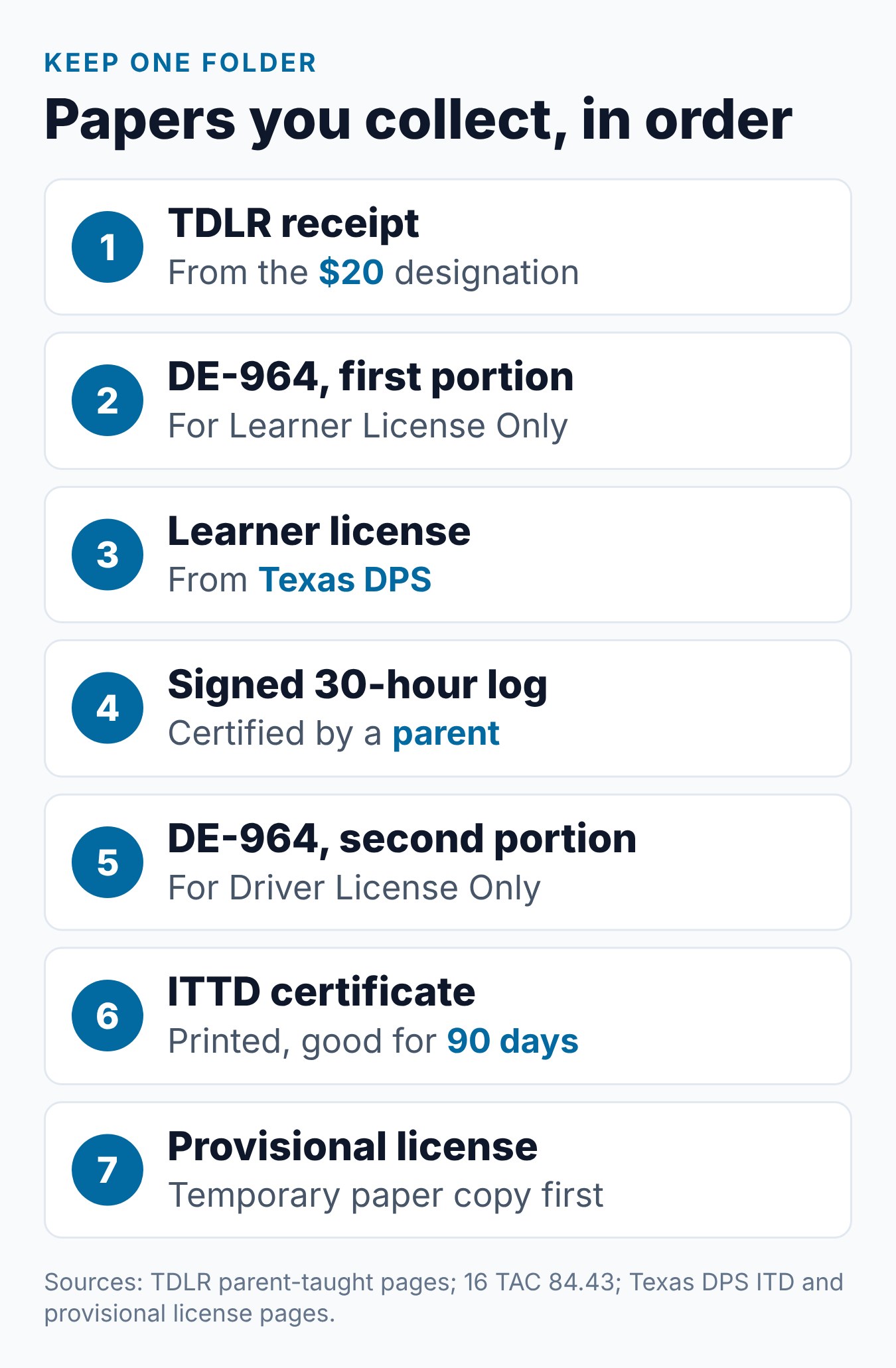
Keep the paperwork in one folder until the license comes in the mail. That folder should hold the TDLR receipt, both DE-964 portions, the signed log and the ITTD certificate.
Common Mistakes
These problems come from missing a rule on a TDLR or DPS page. Each one can cost a second trip.
- Letting someone else teach. Only the instructor on the TDLR designation, or an alternate named on it, may give the lessons. To change instructors, contact TDLR customer service first.
- A name that does not match. TDLR wants the student’s legal name typed exactly as on the birth certificate. It has to match the papers you show DPS at both license visits.
- Coming to DPS alone. The parent instructor on record has to be at both license visits, not just any adult.
- Practice before the permit. TDLR says no in-car lessons or practice may happen before the learner license is issued. Driving without a valid license on a public road is unlawful.
- A course without the endorsement. TDLR says to buy the curriculum from a provider that holds the parent-taught endorsement. Check the provider before you pay.
- Watching ITTD too soon. ITTD comes after the in-car hours, and an expired certificate means watching it again.
- Leaving the log at home. TDLR lists the completed 30-hour log among the papers for the provisional license visit.
How Requirements Can Vary
Texas driver education rules come from TDLR, and driver license rules come from Texas DPS. They apply statewide, but what you need depends on the student’s age, the course method, and whether the classroom part comes from a parent-taught course, a driving school, or a public school.
Fees, forms, and office procedures can change. Check the TDLR parent-taught pages and the DPS driver license pages before each step, and follow the instructions from your course provider.
Frequently Asked Questions
Who approves parent taught drivers ed in Texas?
TDLR. It issues the parent-taught instructor designation and licenses the course providers. Texas DPS gives the tests and issues the licenses.
Can we start the course before applying to TDLR?
No. TDLR says lessons begin after you receive the designation confirmation and the course materials. Apply first, then buy the course.
How many times does the parent go to DPS?
Twice. TDLR says the parent instructor on record goes with the teen for the learner license and again for the provisional license.
Who can ride along for practice hours?
Any licensed adult 21 or older who meets TDLR’s rules for practice can supervise. A parent or guardian then certifies the 30 practice hours on the log.
When does the teen take Impact Texas Teen Drivers?
After the in-car hours are done and before the road test. The certificate is valid for 90 days, so plan the test inside that window.
Does the teen take the knowledge test at DPS?
It depends on the course. Some providers include the written test, and DPS gives it at the learner license visit if the course did not.
Conclusion
Parent taught drivers ed in Texas works in a fixed order: the TDLR designation, a licensed parent-taught course, the learner license, 44 in-car hours, the second DE-964 portion, ITTD and the road test. Each step has an owner, so check who does it and what you need before you start it. For a course built for this order, see Driving Logic’s parent taught drivers ed texas page.
Related Articles
- Parent Taught Drivers Ed Texas: The Complete PTDE Guide
- How Texas Parent Taught Drivers Ed Works Online: Step-by-Step
- Texas PTDE: Concurrent vs Block Method — Which Should Your Family Choose?
- Texas Driver Education Certificate DE-964: What It Is and How to Use It
Sources
- TDLR — Parent-Taught Driver Education
- TDLR — Become a Parent-Taught Instructor
- TDLR — Parent-Taught Classroom Instruction
- TDLR — Parent-Taught Learner License
- TDLR — Parent-Taught Behind-the-Wheel Instruction
- TDLR — Parent-Taught Provisional License
- Texas DPS — Choosing a Driver Education Course
- Texas DPS — Texas Learner License as a Teen
- Texas DPS — Texas Provisional License as a Teen
- Texas DPS — Impact Texas Drivers (ITD) Program
- Impact Texas Drivers — ITTD FAQs
- Texas DPS — Driver License Fees
- Texas DPS — Driver License Services Appointments
- 16 Tex. Admin. Code § 84.500 — Courses of instruction
- 16 Tex. Admin. Code § 84.43 — Driver education certificates
- Texas Transportation Code § 545.424 — Drivers under 18
Billy Forte is the owner of Driving Logic, a state-approved driver improvement course provider serving Texas and other U.S. states.
This article is general information, not legal advice. Texas driver education and licensing rules are set by TDLR, Texas DPS, and Texas law, and can change. Check the official TDLR and DPS websites for current requirements.