
Updated November 2026 · Reviewed by Billy Forte
The Texas drivers license exam is really three exams: a vision exam, a knowledge (written) exam and a driving exam, under Transportation Code 521.161(b). The Texas Department of Public Safety (DPS) may also add any other exam it finds necessary. Below is one section per exam, with who gives it, where, what it checks, what happens if you fail, and a link to the detailed guide.
Key Facts
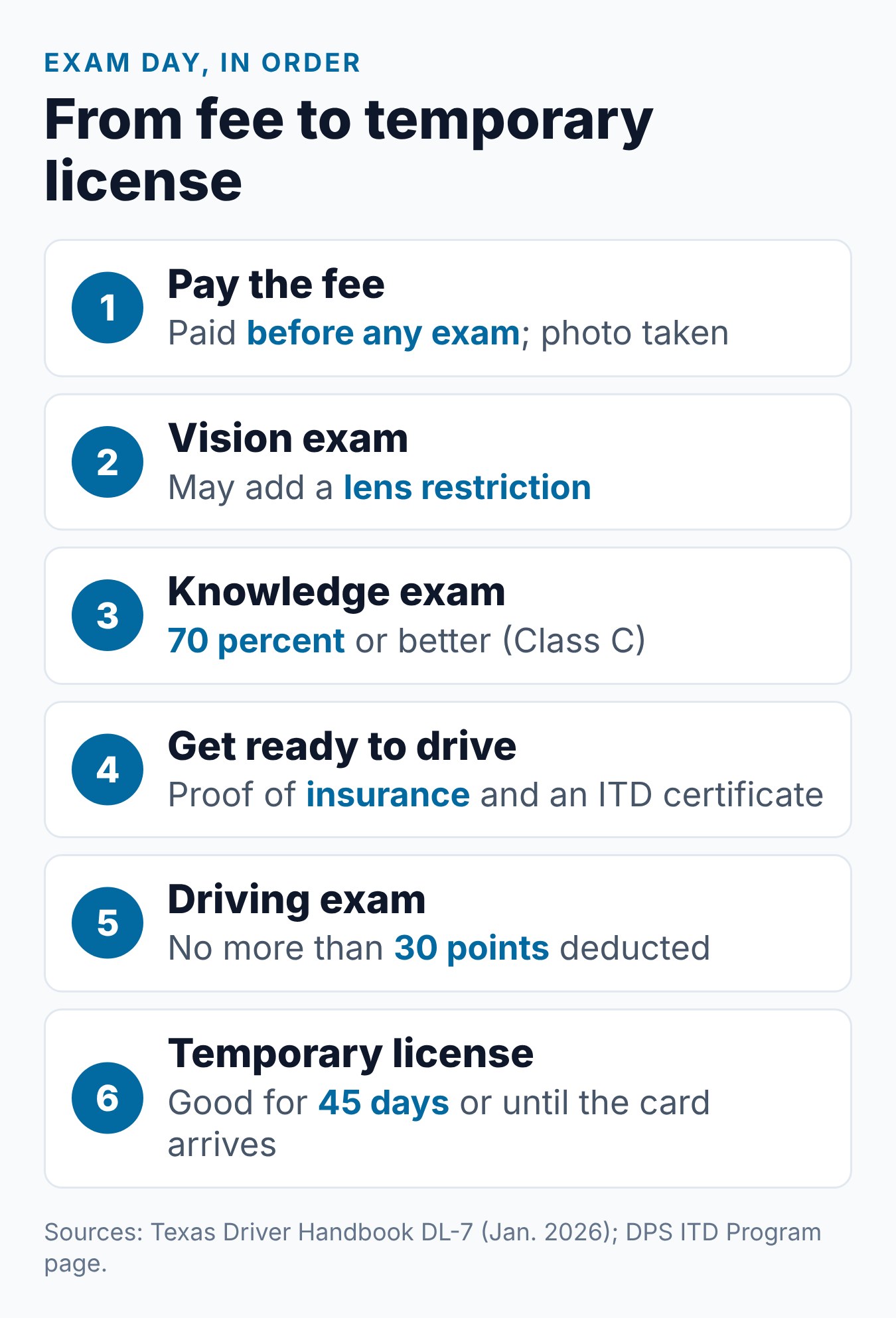
- Three exams: vision, knowledge and driving, in that order. See the three exams at a glance.
- Knowledge pass mark: 70 percent or better on the Class C knowledge exam. See the knowledge exam.
- Driving exam last: only after the other exams and proof of insurance. See the driving exam.
- Language: the knowledge test is in English or Spanish only. See language rules.
- Retakes: three tries at each part per application and fee, held 90 days. See if you fail.
The Texas Drivers License Exam at a Glance
The law sets the list. Transportation Code 521.161(b) calls for a vision exam, a knowledge exam and a driving exam. The Texas Driver Handbook (DL-7), revised January 2026, describes each one in its Examinations part.
| Exam | Who gives it | Where | Passing rule |
|---|---|---|---|
| Vision | DPS | Driver license office | Results may add a lens restriction or a referral to your doctor |
| Knowledge (written) | DPS, or a licensed driver education provider for the sign and law parts | Driver license office, or inside a driver education course | 70 percent or better (Class C) |
| Driving | DPS, or a third-party skills testing (TPST) school | Driver license office or TPST school | Not approved after a law violation, refusal, dangerous driving, a crash, or more than 30 points deducted |
Each exam has its own detailed guide on this site. This page shows how the three fit together.
Before Any Exam: Fee and Photo
The handbook says the fee must be paid before any exams are given. Your picture is also taken at this point.
A new license for ages 18 to 84 costs $33, per the DPS Driver License Fees page. Our guide to the cost of a first Texas license lists the other fees. For the papers to bring, see first-time license documents.
Exam 1: The Vision Exam
Who and where: DPS examines your vision at the driver license office.
What it checks: whether your eyesight is good enough to drive, and whether you need lenses to do it.
What can happen: depending on the results, you may have to wear corrective lenses while driving. If the results are inconclusive, DPS may refer you to your doctor. Bring your glasses or contacts if you wear them.
The scores and restrictions are covered in Texas DPS Vision Test: What to Expect.
Exam 2: The Knowledge Exam
What the law covers: Transportation Code 521.161(b)(1) lists four subjects:
- Highway signs in English.
- Texas traffic laws.
- Motorists’ rights and responsibilities toward bicyclists.
- The effect of wireless devices and other distractions.
Who takes it: the handbook says the Class C knowledge exam is for all original applicants. You need a grade of 70 percent or better.
Who can give it: DPS gives it at the driver license office. But under Transportation Code 521.1655, a licensed driver education provider may give the highway sign and traffic law parts to its own students. A pass there counts for those parts.
The detailed topics and study tips are in Texas DPS Written Knowledge Test: What It Covers and How ADE May Help.
Where the Six-Hour Adult Course Fits
If you are 18 through 24 and getting a first license, Texas requires a six-hour adult driver education course. TDLR, the Texas Department of Licensing and Regulation, oversees it. TDLR’s Program of Organized Instruction for the adult six-hour course, dated May 2026, includes the “Texas Department of Public Safety Highway Sign and Traffic Law Examination.”
So for drivers 18 through 24, the sign and law parts of the knowledge exam are built into the required course. This does not cover every part of every exam. The vision and driving exams still happen at DPS or a TPST school.
If you are 25 or older, do not assume the course changes where you take the knowledge exam. Ask DPS or the provider first.
TDLR’s Do I Need Driver Education? page sets out who needs which course.
Exam 3: The Driving Exam
When: the handbook says the driving exam is given only after all other exams are passed. You must also show evidence of financial responsibility, which means proof of insurance.
Who and where: you can take it at a driver license office or through a third-party skills testing (TPST) school.
How it is graded: every driver is graded on four areas: control, observation, positioning and signaling.
What stops approval: the application is not approved if you violate the law, refuse to follow instructions, drive in a dangerous way or have a crash. It is also not approved if more than 30 points are deducted.
What to finish first: you must complete the Impact Texas Drivers program for your age group before the driving exam.
The certificate is valid for 90 days, per DPS’s Impact Texas Drivers (ITD) Program page. For adults, that program is Impact Texas Adult Drivers (ITAD), a free DPS video about distracted driving. It is separate from the six-hour course.
Three guides go deeper:
- What test day looks like: Texas Driving Test: What to Expect and How to Prepare.
- The graded maneuvers: Texas Drivers License Test: Skills and Maneuvers Graded.
- Testing at a school: Texas Third-Party Driver’s License Testing.
What Language the Exams Are In
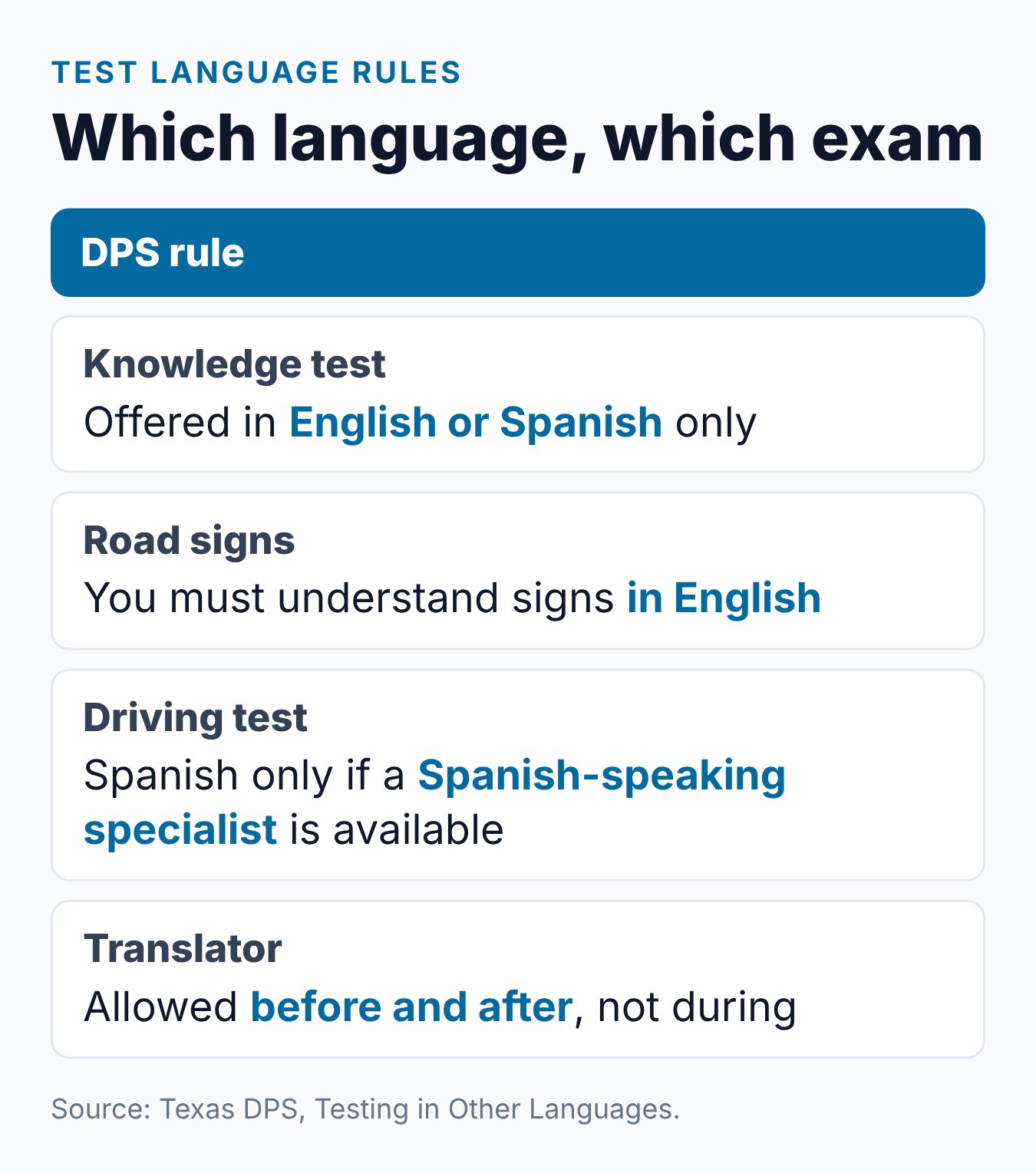
Language rules differ by exam. DPS explains them on its Testing in Other Languages page.
- Knowledge test: DPS can only offer it in English or Spanish.
- Road signs: you must be able to understand road signs written in English.
- Driving test: DPS cannot promise a Spanish driving test at every office. It gives one in Spanish only if a Spanish-speaking specialist is available.
- Translators: a translator may help before and after a test, but not during it.
So a Spanish speaker can take the knowledge test in Spanish. Still, plan to read English signs, and ask the office about the driving test language before you go.
If You Fail an Exam
A failed exam is not the end of the application. Transportation Code 521.161(d) gives you three examinations of each part for each application and fee.
The handbook adds a time limit. The application is held for 90 days. After 90 days, or after three failed exams, you need a new application and a new fee.
That means the clock and the count both matter. Our guide on what to do if you fail the Texas driving test covers the next steps.
Who Can Skip Exams
Not everyone takes all three. The handbook says the knowledge and driving exams are not required if you are 18 or older and surrender a valid license from another state.
There is a firm limit on age. No one younger than 18 is exempt from the driving exam.
If you are moving to Texas with a license, see our guide for new Texas residents.
After You Pass
Once you pass, DPS gives you a temporary license. The handbook says it may be used for 45 days or until the permanent license arrives by mail.
Our guide on what happens after you pass covers the steps after the exams.
Planning Your Exams by Situation
Your path through the three exams depends on where you start. Here is how the rules above apply to common situations:
- First license at 18 through 24. Take the required six-hour adult course, which includes the sign and law exam. Then finish ITAD and take the vision and driving exams.
- First license at 25 or older. Plan to take the knowledge exam with DPS unless DPS or your provider tells you otherwise. Then finish ITAD and take the driving exam.
- Moving from another state at 18 or older. Surrender your valid license. The knowledge and driving exams are not required.
- Under 18. You cannot skip the driving exam, even with a license from another state.
In every case, pay the fee first and keep track of the 90 days the application is held. Plan the ITD certificate so it is still within its 90 days on the day of your driving exam.
What We Found in the Handbook
We compared how the January 2026 handbook decides each exam, as read in November 2026. Each of the three exams uses a different kind of rule:
- Vision is described by outcomes. Depending on the results, you may need lenses to drive, or you may be referred to your doctor. The exact acuity standards are in our vision test guide.
- Knowledge has a percent. The Class C exam needs 70 percent or better.
- Driving has points and stop rules. More than 30 points deducted fails, and so does any one of four events, such as a crash.
This matters for how you prepare.
For vision, bring your lenses. For the knowledge exam, study the subjects the law lists. For the driving exam, practice the four graded areas and avoid the four events that end the test.
Common Mistakes to Avoid
Each mistake below breaks a rule from the handbook, the law or DPS:
- Showing up without paying. The fee comes before any exam.
- Leaving your glasses at home. The vision exam may decide you need lenses to drive.
- Booking the road test too early. The driving exam comes only after the other exams.
- Forgetting proof of insurance. It is required before the driving exam.
- Letting the ITD certificate expire. It is good for 90 days.
- Expecting a translator during a test. Help is allowed only before and after.
- Losing track of the 90 days. After that, you need a new application and fee.
How Requirements Can Vary
Texas driver license rules come from state law, Texas DPS rules and TDLR rules, and they apply statewide. What you need still depends on your age, whether you hold a license from another state, and which tests you have already passed.
Laws, fees and office procedures can change. Check the Texas DPS and TDLR websites for current rules before you book an appointment or enroll in a course.
Frequently Asked Questions
How many exams are on the Texas driver license exam?
Three: vision, knowledge and driving. DPS may also add any other exam it finds necessary.
What score do I need on the knowledge exam?
You need 70 percent or better on the Class C knowledge exam. The handbook says the exam is for all original applicants.
Can I take the written test in Spanish?
Yes. DPS offers the knowledge test in English or Spanish only, and you must still understand road signs written in English.
Can a driver education course give part of the exam?
Yes. A licensed driver education provider may give the highway sign and traffic law parts to its students. For ages 18 through 24, the required six-hour adult course includes that exam.
How many times can I retake an exam?
You get three examinations of each part for each application and fee. The application is held for 90 days.
Do I need insurance for the driving exam?
Yes. You must show evidence of financial responsibility before the driving exam.
Can I use my license from another state instead of testing?
If you are 18 or older and surrender a valid out-of-state license, the knowledge and driving exams are not required. Ask DPS what else applies to you.
Conclusion
The Texas drivers license exam is three exams in a set order: vision, knowledge, then driving. Pay the fee first, pass the knowledge exam with 70 percent or better, and bring proof of insurance and a current ITD certificate for the road test. If you are 18 through 24, the required six-hour course is where the sign and law exam can happen, and you can start with texas adult drivers ed.
Related Articles
- Texas Driving Test: What to Expect and How to Prepare
- Texas DPS Vision Test: What to Expect
- Texas DPS Written Knowledge Test: What It Covers and How ADE May Help
- Texas Drivers License Test: Skills and Maneuvers Graded
Sources
- Texas DPS — Apply for a Texas Driver License
- TDLR — Do I Need Driver Education?
- Texas Transportation Code Chapter 521 (PDF)
- Texas DPS — Texas Driver Handbook, DL-7 (PDF)
- Texas DPS — Driver License Fees
- Texas DPS — Testing in Other Languages
- Texas DPS — Impact Texas Drivers (ITD) Program
- TDLR — Program of Organized Instruction, Adult Six-Hour Course (PDF)
Billy Forte is the owner of Driving Logic, a state-approved driver improvement course provider serving Texas and other U.S. states.
This article is general information, not legal advice. Texas driver license and driver education rules are set by Texas law, Texas DPS and TDLR, and they can change. Check the official DPS and TDLR websites for current requirements before you apply.