
Updated November 2026 · Reviewed by Billy Forte
If you are asking what do I need to get a Florida drivers license for the first time, the answer is five things: the required course for your age, passing results on the vision, hearing, knowledge and driving exams, identity documents, the $48.00 fee and, if you are under 18, a parent’s consent plus a learner’s license held for 12 months with 50 hours of practice. The course is the 6-hour DETS course if you are under 18 and the TLSAE course of at least 4 hours if you are 18 or older. The identity documents are one primary identification, proof of your Social Security number and two proofs of your Florida residential address.
Key Facts
- Course first: DETS if you are under 18, TLSAE if you are 18 or older. See the two checklists side by side.
- Under 18: a parent’s consent, 12 months with a learner’s license and 50 practice hours. See the under-18 checklist.
- 18 or older: no consent form and no 12-month wait. See the adult checklist.
- Documents: one primary identification, proof of Social Security number and two address proofs. See the documents.
- Exams: vision, hearing, knowledge and driving skills, given in English. See the four exams.
- Fee: $48.00 for an original Class E license. See what you pay.
What Do I Need to Get a Florida Drivers License? The Five Things
A first Florida license for a car is a Class E driver license. At any age, the list has the same five parts:
- A course. Which one depends on your age.
- Four exams. Vision, hearing, knowledge and driving skills.
- Identity documents. One primary identification, proof of your Social Security number and two proofs of your Florida address.
- The fee. $48.00 for an original Class E license.
- Extra items under 18. A parent’s consent, a learner’s license held for 12 months and 50 hours of practice.
The course is item one for a reason. Nothing else can be finished at the office without it.
Many people call the office the Florida DMV, but the agency is FLHSMV, the Florida Department of Highway Safety and Motor Vehicles. Florida has no agency called the DMV. FLHSMV sets the rules, and county tax collectors run most driver license offices.
This article is a checklist, not a timeline. For the order of the steps, see our article on how to get drivers license in Florida.
Florida Drivers License Requirements by Age
Florida drivers license requirements split at age 18. The table puts the two checklists side by side and names the official source for each row.
| What you need | Under 18 | 18 or older | Official source |
|---|---|---|---|
| Course | 6-hour DETS course | TLSAE course, at least 4 hours | FLHSMV DETS page; F.S. 322.095 |
| Minimum age | 15 for a learner’s license, 16 for a Class E license | Already met | F.S. 322.1615; F.S. 322.05 |
| Parent’s consent | Form HSMV 71142, unless you are married | Not needed | Form HSMV 71142; F.S. 322.09 |
| Exams | Vision, hearing, knowledge and driving skills | The same four exams | F.S. 322.12 |
| Wait before the driving test | 12 months with a learner’s license, or until you turn 18 | None | FLHSMV Class E exam page |
| Practice hours | 50 hours, 10 of them at night, certified by an adult | Not required | FLHSMV teen licensing page |
| Identity documents | Primary identification, Social Security proof, two address proofs | The same documents | FLHSMV What to Bring page |
| State fee | $48.00 | $48.00 | FLHSMV fee page |
Both columns are for people who have never been licensed anywhere. If you hold a license from another state, skip to that section.
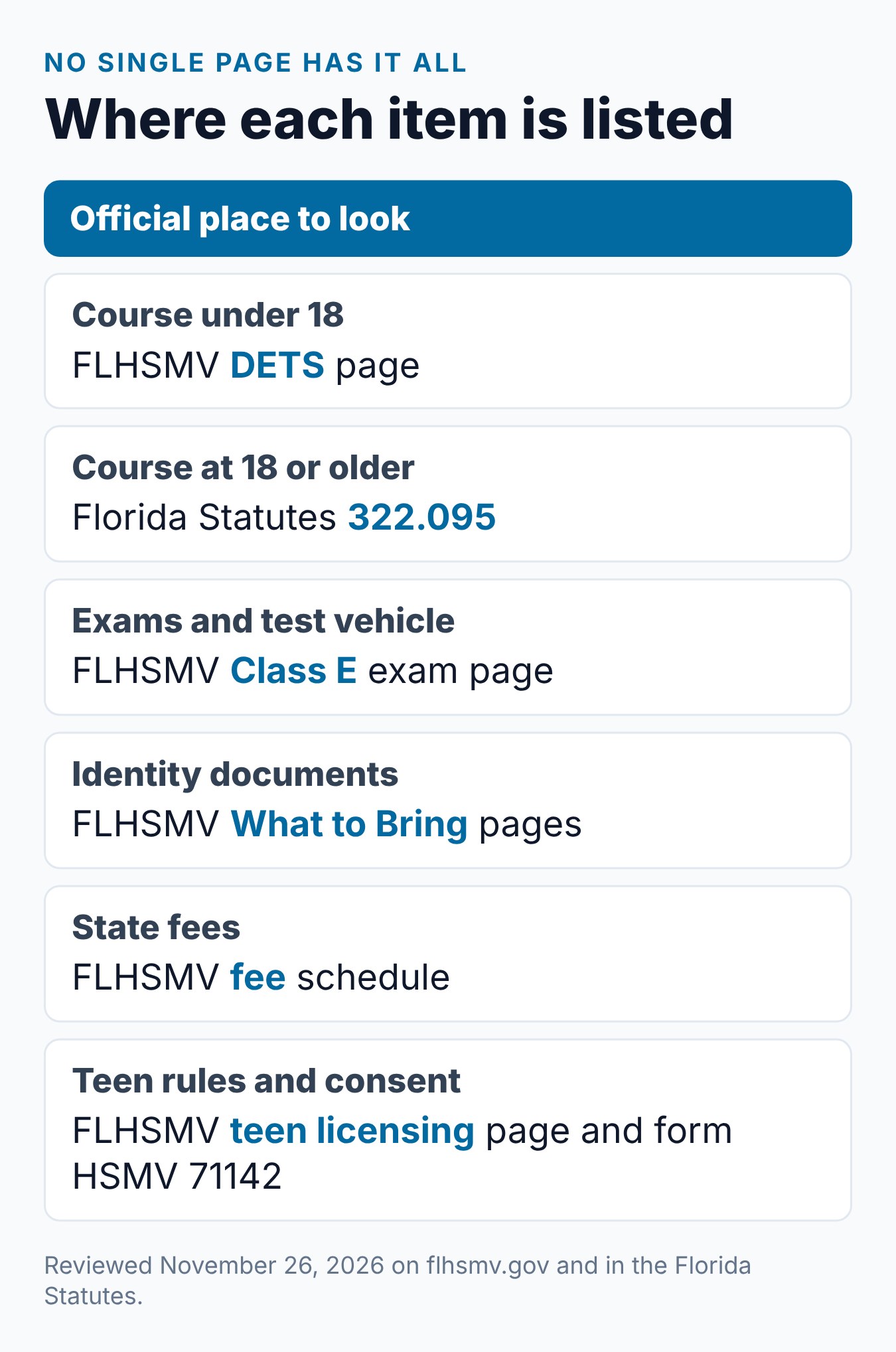
No single official page lists every row. That is why each row names its own source.
The Checklist If You Are Under 18
A teen who has never been licensed has six items to check off. Most of them come from FLHSMV’s teen licensing page.
1. Your Age
You must be at least 15 for a learner’s license. That age is set in F.S. 322.1615.
You must be at least 16 for a Class E driver license. That age is set in F.S. 322.05.
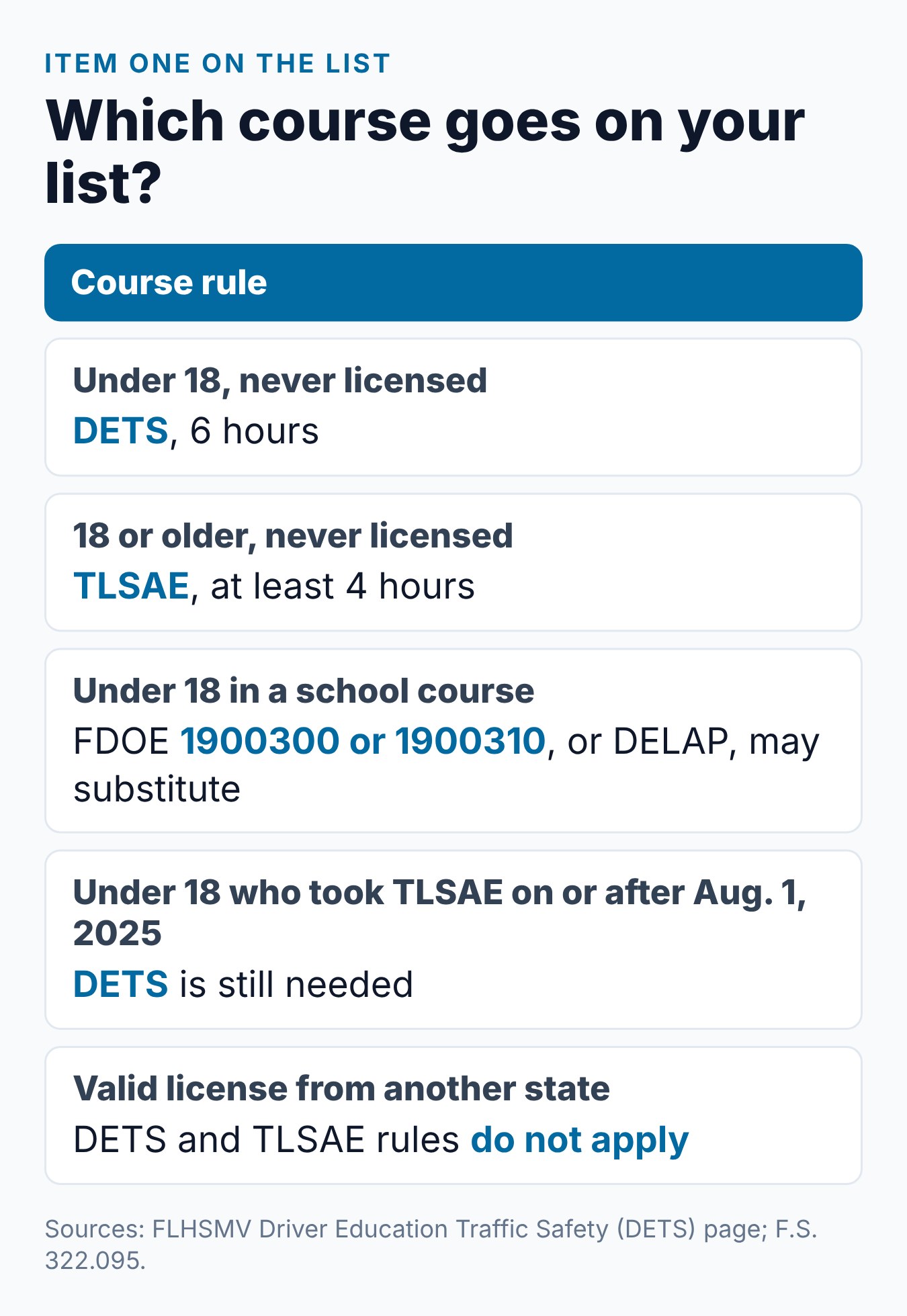
2. The DETS Course
DETS stands for Driver Education Traffic Safety. It is a 6-hour course approved by FLHSMV.
The rule is on FLHSMV’s DETS page. Since August 1, 2025, a person under 18 who has never held a driver license from any other state, country or jurisdiction must finish a 6-hour DETS course before applying for a Florida license.
Some school courses may take its place. The same page says Florida Department of Education Traffic Safety Classroom courses 1900300 and 1900310 may substitute. So may Driver Education Licensing Assistance Program (DELAP) courses that some county school boards run.
Do not take the adult course by mistake. The DETS page says a person under 18 who completes a TLSAE course on or after August 1, 2025 still needs DETS, unless they are in one of those school courses.
3. A Parent’s Consent
Florida’s consent paper is form HSMV 71142, titled Parental Consent for a Driver Application of a Minor. It comes with three rules:
- One signer. One parent or legal guardian must sign.
- A witness. All signatures must be notarized or witnessed by an examiner.
- Stepparents. FLHSMV says a stepparent may sign only if they have legally adopted the child.
The form is not required if you are married. F.S. 322.09 says the signing rule does not apply to a person under 18 who is emancipated by marriage.
Our article on the Florida parental consent form explains what the signer agrees to.
4. School Attendance
F.S. 322.09 also covers school. It says the department may not issue a driver license or a learner’s license to an applicant under 18 who does not comply with F.S. 322.091.
The Pinellas County Tax Collector puts it in plain words. Its learner’s permit page says applicants under 18 must be in good standing regarding school attendance policies.
5. Exams for the Learner’s License
A learner’s license takes three exams: vision, hearing and the Class E Knowledge Exam. The knowledge exam has 50 multiple-choice questions, and you pass with 40 correct, which is 80 percent.
FLHSMV says the vision and hearing tests are given in a service center. Details on all four exams are in their own section below.
6. Before the Class E License
FLHSMV’s teen licensing page lists what must be true before a teen moves up to the Class E license:
- Time. Keep the learner’s license for 12 months or more. The wait ends early if you turn 18 first.
- A clean year. Have no moving violation conviction for one year from the learner’s license issue date. One moving violation is allowed if adjudication was withheld.
- Practice. Drive 50 hours, with 10 of them at night.
- A signature. A parent, legal guardian or responsible adult over 21 certifies those hours on the Certification of Minor Driving Experience Form.
- The road test. Pass the Class E Driving Skills Test in a vehicle with valid registration and proof of insurance. The vehicle must also pass a basic inspection by the examiner.
Florida calls this system graduated driver licensing: a learner’s license first, then a Class E license with hour limits at 16 and 17, then full privileges at 18. Our guide to the Florida graduated driver license explains the stages and the driving-hour limits.
Two more of our articles cover single items on this list. One is on the Florida 50-hour driving requirement. The other is on the learner’s permit holding period.
The Checklist If You Are 18 or Older
The adult checklist is shorter. It has a different course, the same exams and no parent form.
1. The TLSAE Course
TLSAE stands for Traffic Law and Substance Abuse Education. The course has at least 4 hours of content.
F.S. 322.095 sets the rule. It says every driver license applicant aged 18 or older must complete the course, unless the applicant has been licensed in another jurisdiction.
2. The Same Four Exams
F.S. 322.12 lists the exams for a Class E license: eyesight, hearing, a knowledge test and a driving demonstration. Adults take all four.
Two details differ from the teen list:
- No 12-month wait. FLHSMV’s Class E page says a customer must hold the learner’s license for 12 months or must be 18 years old.
- In-person knowledge exam. FLHSMV’s teen FAQ says you must be under 18 to take the knowledge exam online. Adults test in person.
3. What Adults Leave Off the List
An adult does not need the parent consent form. An adult also does not need the 50-hour certification, because F.S. 322.05 applies it to applicants who are 16 or 17.
Our guide to the first-time Florida driver’s license for adults covers the adult visit from start to finish.
Documents Every Applicant Needs
The document list is the same at every age. FLHSMV’s What to Bring page for U.S. citizens names three kinds of proof.
One primary identification. Bring one original document, such as:
- A U.S. birth certificate
- A valid U.S. passport or passport card
- A Consular Report of Birth Abroad
- A Certificate of Naturalization
- A Certificate of Citizenship
Proof of your Social Security number. The document must show your full name and full number. FLHSMV lists a Social Security card, a W-2, a pay stub, an SSA-1099 or any 1099.
Two proofs of your Florida residential address. They must be two different documents. Examples are a deed, mortgage or lease, a Florida voter registration card, a Florida vehicle registration or title, and a utility bill.
If No Bills Are in Your Name
Many teens and young adults have no address papers of their own. FLHSMV allows another way.
You may use two proofs of address from a parent, step-parent, legal guardian or other person you live with, plus a Certification of Address form. The What to Bring page says that person must come to the office or sign the form in front of a notary.
Name Changes and Other Lists
If your name changed, bring the original or a certified copy of the marriage certificate, divorce decree or court order. FLHSMV says photocopies are not accepted.
Immigrants and non-immigrants have their own document lists. They are on FLHSMV’s What to Bring pages, sorted by citizenship status.
Our article on Florida learner’s permit documents goes through each accepted paper and the ones offices turn away.
The Four Exams
Every first-time applicant takes the same four exams:
- Vision. A test of your eyesight.
- Hearing. A test of your hearing.
- Class E Knowledge Exam. 50 multiple-choice questions on Florida traffic laws, safe driving practices and traffic controls. You need 40 correct.
- Class E Driving Skills Test. A set of driving maneuvers with an examiner.
The facts on the last two come from FLHSMV’s Class E Knowledge Exam and Driving Skills Test page.
The Exams Are Given in English
FLHSMV announced the change in a news release on January 30, 2026. Beginning Friday, February 6, 2026, all driver license knowledge and skills examinations are given exclusively in English. Language translation services are no longer permitted.
The Class E exam page agrees. When we read it on November 26, 2026, it said Class E knowledge examinations are available in English only.
Policies like this one can be updated. Check with FLHSMV or your tax collector office before you test.
The Vehicle for the Driving Test
You bring the vehicle. It needs a valid registration and proof of insurance, and it must pass a basic inspection by the examiner.
Our article on the Florida drivers license test covers each exam in depth.
What You Pay
FLHSMV’s fee page lists the state fees for a first license:
- $48.00 for an original Class E license. The page says this includes the learner’s license.
- $10.00 for a knowledge retest.
- $20.00 for a skill retest.
- $6.25 as a service fee that may apply in a tax collector office.
A teen who already paid for a learner’s license may owe nothing at the next stage. FLHSMV’s teen FAQ says there is no fee to trade a learner’s license for the Class E license when no name or address change is needed. Otherwise, a $25 replacement fee applies.
These are state fees only. Course prices are set by each course provider and are not on FLHSMV’s schedule.
If You Already Have a License From Another State
The two checklists above are for people who have never been licensed. A license from another state changes the list in two ways:
- Tests. F.S. 322.12 lets the department waive the knowledge and skills tests for a person who surrenders a valid license from another state.
- Course. FLHSMV’s DETS page says the DETS rule does not affect an applicant under 18 who already holds a valid out-of-state license and is transferring to Florida.
Our article on a new Florida resident driver’s license covers that path.
What We Found on FLHSMV’s Pages
On November 26, 2026, we looked for one official page that lists everything a first-time driver needs. We did not find one. Here is what we found instead:
- The list is spread over six places. The course rule, the exams, the documents, the fees, the teen rules and the consent form each sit on a different FLHSMV page or form.
- Two pages still name only the adult course. The Class E exam page and the teen FAQ both talk about TLSAE and do not mention DETS. If you are under 18 and have never been licensed, follow the DETS page.
- The language rule now matches. The Class E exam page says knowledge exams are available in English only, the same as the January 30, 2026 release.
- The service fee is worded two ways. The fee page says the $6.25 fee may apply in a tax collector office. The teen FAQ says it applies to all driver license transactions completed in a tax collector office.
- Address proofs can be printouts. The What to Bring page says printouts or faxes of the two address documents are acceptable. The primary identification must be an original.
Common Mistakes With the Checklist
Each mistake below comes from one of the official rules above:
- Taking the wrong course for your age. DETS is for first-time drivers under 18. TLSAE is for first-time drivers who are 18 or older.
- Bringing one address proof. FLHSMV asks for two different documents with your Florida residential address.
- Bringing a photocopy of a name-change paper. The marriage certificate, divorce decree or court order must be the original or a certified copy.
- Signing the consent form at home with no notary. Signatures on HSMV 71142 must be notarized or witnessed by an examiner.
- Counting on a translator. The exams are given only in English, and translation services are no longer permitted.
- Bringing a car without proof of insurance. The driving test vehicle needs a valid registration and proof of insurance.
- Using one office’s rules for another. Appointment rules differ by county, so check with the office you will visit.
How Requirements Can Vary
Florida’s course and license rules apply statewide, but some details depend on where you live. Driver license services are often handled by your county tax collector’s office, and each office sets its own appointment process and hours. Some county school boards also offer driver education programs, such as DELAP courses, that can count instead of DETS.
FLHSMV can update course rules, forms, documents, and fees. Check FLHSMV and your county office for current requirements before your appointment.
Frequently Asked Questions
What documents do I need for a first Florida driver license?
You need one original primary identification, proof of your Social Security number and two different proofs of your Florida residential address. A U.S. birth certificate or a valid U.S. passport works as the primary identification. Bring name-change papers if your name has changed.
What does a 16-year-old need to get a Florida license?
A 16-year-old needs a learner’s license held for at least 12 months and 50 hours of certified driving, with 10 at night. The teen also needs a clean record for that year and a passing Class E Driving Skills Test. The DETS course and the parent consent form come earlier, at the learner’s license stage.
Do I need a course if I am 18 or older?
Yes, if you have never been licensed. F.S. 322.095 requires the TLSAE course for applicants who are 18 or older. The statute makes an exception for a person who has been licensed in another jurisdiction.
What is the state fee for a first Florida license?
The state fee is $48.00 for an original Class E license, and the learner’s license is part of that fee. A tax collector office may add a $6.25 service fee. Retests are $10.00 for the knowledge exam and $20.00 for the skills test.
Can I take the Florida driver license exam in Spanish?
No. FLHSMV announced that all driver license knowledge and skills exams are given only in English beginning February 6, 2026. Translation services are no longer permitted.
Can a stepparent sign the parent consent form?
Only in one case. FLHSMV says a stepparent may sign only if they have legally adopted the child. Otherwise, a parent or legal guardian signs form HSMV 71142.
Do I need to hold a learner’s license for a year if I am 18?
No. FLHSMV’s Class E page gives two ways to qualify for the driving test: 12 months with a learner’s license, or being 18. The 12-month wait is on the under-18 checklist only.
Conclusion
A first Florida license comes down to five things: a course, four exams, identity documents, a fee and, under 18, a parent’s consent with a year of practice. Use the checklist for your age, and ask your tax collector office about its document and appointment rules. The course is the first item on both lists. For a teen, that course is DETS, and Driving Logic has a page for its online Florida DETS course.
Related Articles
- Florida Learner’s Permit: How to Get It, Requirements, and What It Allows
- How to Get Drivers License in Florida: Steps for Teens
- Florida Graduated Driver License (GDL): The Three Stages for Teen Drivers
- Florida Learner’s Permit Documents: What to Bring
- First-Time Florida Driver’s License for Adults: The Complete Process
- How to Get Drivers License in Florida Over 18: Adult Steps
Sources
- FLHSMV — Driver Education Traffic Safety (DETS)
- FLHSMV — Licensing Requirements for Teens, Graduated Driver License Laws and Driving Curfews
- FLHSMV — Class E Knowledge Exam and Driving Skills Test
- FLHSMV — Teen Licensing Frequently Asked Questions
- FLHSMV — What to Bring
- FLHSMV — What to Bring, U.S. Citizen
- FLHSMV — What to Bring, Immigrant
- FLHSMV — Driver License and ID Card Fees
- FLHSMV — Parental Consent Form HSMV 71142
- FLHSMV — News release, January 30, 2026: driver license exams in English only
- Florida Statutes — F.S. 322.1615 (DETS)
- Florida Statutes — F.S. 322.05 (Persons not to be licensed)
- Florida Statutes — F.S. 322.09 (Application of minors)
- Florida Statutes — F.S. 322.095 (TLSAE)
- Florida Statutes — F.S. 322.12 (Examination of applicants)
- Pinellas County Tax Collector — Learner’s Permit
- FLHSMV — Driver Education Courses
- FLHSMV — TLSAE Course Provider List
Billy Forte is the owner of Driving Logic, a state-approved driver improvement course provider serving Florida and other U.S. states.
This article is general information, not legal advice. Florida licensing requirements, course rules, documents, and fees are set by FLHSMV and Florida law and can change. Use official FLHSMV and Florida statute sources for current requirements before you enroll in a course or visit a driver license office.